

The route servers at AMS-IX (Amsterdam Internet Exchange) have crossed the 500,000 IPv4 routes received in production threshold for the first time, according to data shared by Stavros Konstantaras, a senior network engineer at the exchange. The cited record reached 503,906 IPv4 routes and around 290,000 announced networks, while IPv6 had already passed 100,000 prefixes in early June. The figures change continuously as BGP sessions announce or withdraw routes.
AMS-IX’s route record in 30 seconds
- AMS-IX’s route servers in the Netherlands have crossed 500,000 received IPv4 routes for the first time.
- The reported record was 503,906 routes, representing around 290,000 prefixes sent to participants.
- According to Konstantaras, the routes present amounted to 46.6% of what was then observed in the Default-Free Zone.
- IPv6 passed 100,000 prefixes in June and is now running above 110,000.
- The milestone reflects both the scale of AMS-IX and the growing complexity of internet routing.
The figure is especially interesting for system and network administrators because it shows a part of the internet that usually stays invisible to end users. A connection can look as simple as sending packets from a server to an IP address, but behind it sits a global infrastructure that is constantly deciding which networks should carry that traffic.
BGP (Border Gateway Protocol) is the protocol involved in that process, used to exchange routing information between autonomous systems.
AMS-IX sits in a privileged position to observe that activity. Its Amsterdam platform currently connects around 900 autonomous systems and has more than 1,000 client ports. Its public statistics also show hundreds of participants connected to its route servers.
What crossing 500,000 routes actually means
The number needs some context, because 500,000 routes at AMS-IX doesn’t mean the internet has only 500,000 IPv4 routes.
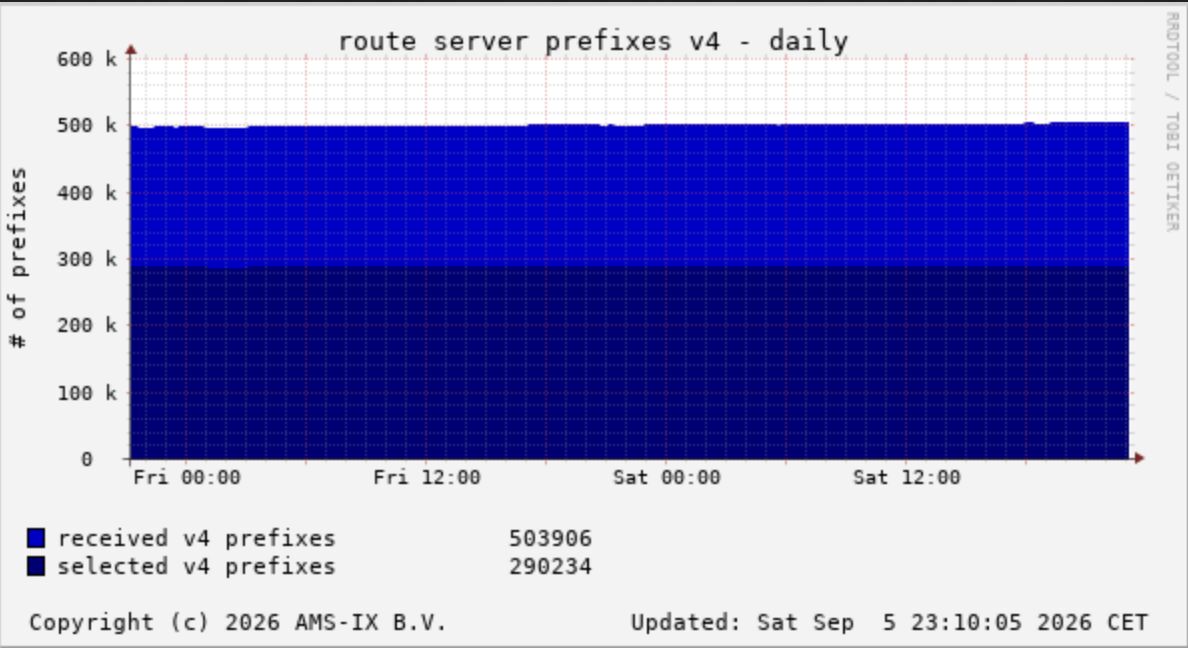
Konstantaras compares the record observed at AMS-IX with the DFZ (Default-Free Zone), the part of the internet made up of routers that maintain a BGP table complete enough to decide where to send packets without relying on a default route.
According to his post, the 503,906 IPv4 routes observed represented roughly 46.6% of DFZ routes, based on the CIDR report from September 5, 2026.
The figure allows for a rough estimate of scale: a global table of more than a million IPv4 routes.
But there’s also a difference between routes received and prefixes ultimately selected or sent.
The statistics provided for rs1 show:
| Metric | IPv4 | IPv6 |
|---|---|---|
| Total peers | 933 | 853 |
| Active peers | 123 | 142 |
| Established peers | 809 | 706 |
| Prefixes received | 503,216 | 114,731 |
| Prefixes sent | 290,076 | 68,230 |
The second server, rs2, recorded 494,781 IPv4 prefixes received and 111,227 IPv6 prefixes at that same point.
The gap doesn’t mean hundreds of thousands of networks are disappearing.
A route server receives announcements from numerous participants. It can have several routes available to reach the same prefix, and BGP selects the ones that apply according to its algorithms and policies.
AMS-IX’s own documentation explains that its master table contains the best routes that the BGP algorithm of BIRD, the software used by its route servers, selects among the announcements received from established sessions.
That’s why Prefixes Received shouldn’t be confused with the number of unique reachable IPv4 networks.
It also explains why the counter can shift considerably.
In fact, a later check of AMS-IX’s public statistics showed different values, with 477,615 IPv4 prefixes received by rs1 and 468,858 by rs2. That doesn’t necessarily contradict the reported peak: BGP tables are dynamic, and announcements appear and disappear depending on sessions, policies, and changes among participating networks.
What AMS-IX’s route servers are for
An internet exchange lets different networks exchange traffic directly — a role that, as we’ve covered before, has grown far more complex than a simple switch.
Without a route server, a network wanting to peer with hundreds of participants would need to maintain a large number of bilateral BGP sessions.
Route servers simplify that.
AMS-IX explains that a participant can replace all or part of those individual sessions with connections to its route servers. In Amsterdam it runs two, rs1.ams-ix.net and rs2.ams-ix.net, both using ASN 6777 and BIRD 2.
The simplified diagram would look like this:
             ┌──────────────┐
Network A ─────►│              │──────► Network B
             │ Route Server │
Network C ─────►│   AMS-IX     │──────► Network D
             │   AS6777     │
Network E ─────►│              │──────► Network F
             └──────────────┘
There’s an important technical nuance: the route server is not in the path that traffic actually takes.
Its role is to exchange BGP information.
Once the routes are known, packets can travel directly between participating networks through the exchange’s infrastructure. AMS-IX explicitly states that its route servers don’t take part in the forwarding path.
This makes it possible to separate the control plane from the actual path packets take.
Participants also don’t have to automatically accept every available route. AMS-IX lets them express policies through IRR (Internet Routing Registry) databases, RPSL, and BGP communities.
It also applies filtering mechanisms.
By default, Amsterdam’s route servers filter RFC 1918 ranges, bogons, Martian addresses, default routes, and certain invalid announcements. AMS-IX also uses RPKI (Resource Public Key Infrastructure) information as part of its filtering options and supports the BGP roles defined in RFC 9234 to help detect and prevent route leaks.
IPv6 is now well past 100,000 prefixes
The other notable figure in this milestone is IPv6.
Konstantaras notes that AMS-IX passed 100,000 received IPv6 prefixes in early June 2026 and that the counter later settled at roughly 110,000 to 115,000.
The data provided shows 114,731 IPv6 routes received by rs1 and 111,227 by rs2.
IPv6’s growth is especially interesting because for years its rollout moved considerably slower than the industry expected — though recent milestones, like IPv6 overtaking IPv4 on Google traffic for the first time, suggest that may be changing.
Still, it wouldn’t be right to directly compare 500,000 IPv4 with 115,000 IPv6 and conclude that IPv6 accounts for roughly a fifth of the internet.
The number of BGP prefixes depends on how organizations split up and announce their address space, on their traffic policies, and on aggregation practices. IPv4 and IPv6 have different addressing structures.
For a network operator, growing tables have more concrete consequences.
Routers need to store and process that information. Platforms that maintain full BGP tables have to be sized with both current prefix counts and future growth in mind.
AMS-IX provides max-prefix recommendations precisely to avoid problems when a session receives more routes than expected. Its public documentation advised keeping headroom above typical volumes because of future growth and the dynamic nature of the platform.
The 500,000-route figure therefore carries a second meaning for network teams.
The internet isn’t growing only in traffic.
The amount of information needed to decide how to reach every part of the internet is growing too.
Every new network, more specific announcement, multihoming strategy, or traffic-engineering decision can add information to the global BGP system.
The more than 500,000 announcements received by an AMS-IX route server are a snapshot of that complexity. They don’t represent the entire global table, but they show just how much of the routes that make up the internet are concentrated at one of Europe’s largest exchange points.
Frequently asked questions
How many IPv4 routes has AMS-IX reached?
Stavros Konstantaras reported a peak of 503,906 IPv4 routes received on AMS-IX’s route servers in the Netherlands. The figures are dynamic and can rise or fall afterward.
What is an AMS-IX route server?
It’s a server that lets participants exchange BGP routing information without setting up a separate bilateral session with every other network. It doesn’t carry traffic between them directly.
What does DFZ mean on the internet?
DFZ stands for Default-Free Zone. It refers to the set of routers and networks that maintain enough global routing information to reach internet destinations without relying on a default route.
How many IPv6 routes does AMS-IX have?
AMS-IX passed 100,000 received IPv6 routes in early June 2026. Data shared afterward put rs1 at 114,731 received IPv6 prefixes.
