
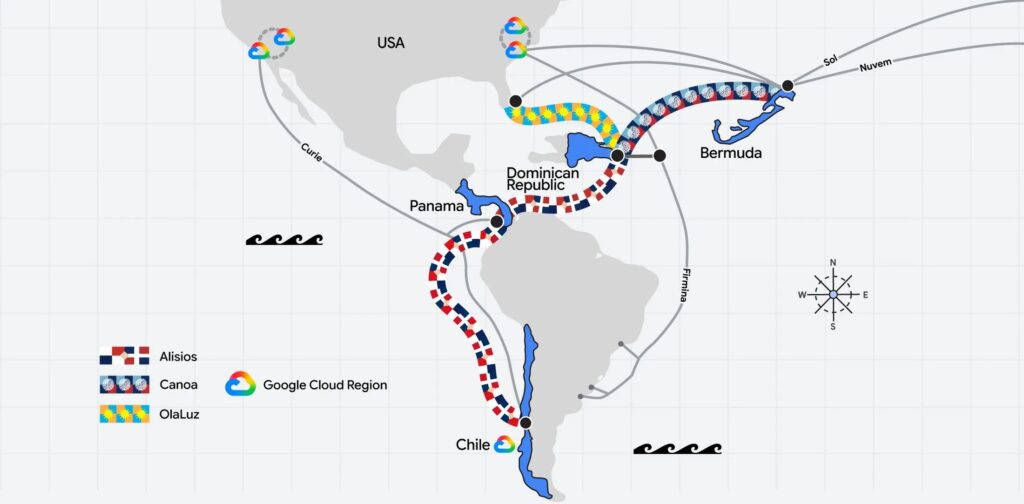
Google is building a new connectivity architecture across Latin America, the Caribbean, the United States, and Europe. Americas Connect pairs three new submarine cable systems, Alisios, Canoa, and OlaLuz, with a new branch of Firmina and the existing routes Curie, Nuvem, and Sol. Announced on August 11, 2026, the project isn’t just about adding capacity: it aims to create alternative routes between Google Cloud regions and cut reliance on a few international corridors.
Americas Connect in 30 seconds
- Google will deploy three new submarine systems: Alisios, Canoa, and OlaLuz.
- Alisios will connect the Dominican Republic, Panama, and Chile; Canoa will link the Dominican Republic with Bermuda; and OlaLuz will reach Florida.
- Firmina will add a new branch toward the Dominican Republic.
- The network will tie in with Curie, Nuvem, and Sol to create redundant paths.
- Americas Connect will connect Google Cloud infrastructure in Chile, the United States, and Madrid.
For years, digital transformation has mostly been told through applications, cloud computing, data centers, and lately the enormous compute needed to train and run AI models.
Behind all of it sits a much less visible physical layer: fiber optic submarine cables.
AI raises their importance further. Building a data center with tens of thousands of accelerators does little if that capacity can’t reach users, other cloud regions, enterprise networks, and other data centers with enough bandwidth and redundancy.
Americas Connect shows how the big cloud providers are answering that. Google’s version isn’t a single point-to-point link but a network of cables that can work together, giving traffic several paths.
Three new cables, one architecture
The first piece is Alisios, connecting the Dominican Republic, Panama, and Chile.
On the Pacific coast, Google plans a submarine ring with redundant routes between Chile and Panama, plus a third link from Panama to the U.S. West Coast. That will feed Google Cloud regions in Chile, Los Angeles, and Las Vegas.
The second part of Alisios runs through the Caribbean from Panama to the Dominican Republic. From there it connects to links toward the U.S. East Coast and Google Cloud regions in South Carolina and Virginia.
That layout matters because it breaks the old picture of a submarine cable as a simple point-to-point line. Americas Connect looks more like a mesh of connected routes.
The second new system, Canoa, will connect the Dominican Republic with Bermuda. From there it links to Nuvem and Sol to form rings toward the United States and Europe.
Notably, Google says outright that this architecture will serve its Madrid region in Europe.
The third system, OlaLuz, connects the Dominican Republic directly with Florida, adding capacity and diversity between the Caribbean and the U.S. East Coast.
Google will also extend Firmina with a new branch to the Dominican Republic. Built to connect North and South America, that added landing point widens what it can do within the architecture.
The result is a network where Alisios, Canoa, and OlaLuz don’t run alone but combine with Firmina, Curie, Nuvem, and Sol to give multiple routing options across South America, the Caribbean, the U.S., and Europe.
The Dominican Republic as a central hub
Look at the Americas Connect map and one name keeps showing up: the Dominican Republic.
All three new systems connect there.
Alisios arrives from Panama, Canoa heads toward Bermuda, and OlaLuz links to Florida. Firmina also adds a new branch to the country.
That makes the Dominican Republic a key interconnection point in Google’s design, though it’s too early to assume the infrastructure will automatically turn the country into a major regional data hub.
Connectivity is necessary but not enough.
Attracting large facilities also depends on electricity availability and cost, access to renewables, land, network stability, taxes, permits, legal certainty, and skilled staff.
Still, having several international routes can meaningfully improve a territory’s standing with cloud operators, content distribution networks, and companies looking to deploy regional infrastructure.
It brings another benefit too: resilience.
Submarine cables are vulnerable to fishing activity, anchors, earthquakes, undersea landslides, and other incidents. Multiple routes let traffic reroute when one connection drops for a while.
Google stresses the geographic diversity of these routes as a main goal of Americas Connect.
Chile’s growing digital infrastructure gets another exit
Chile holds another especially strategic spot in the project.
Already connected via Curie, Google’s cable between Chile and California, it now gains an Alisios route through Panama and the Caribbean.
That reframes Chile’s connectivity.
Chile isn’t only tied to the U.S. West Coast; the combination opens routes to the Caribbean, the U.S. East Coast, and, through other systems, Europe.
That matters as cloud infrastructure and data centers expand across Latin America.
Large data centers need several independent paths. As enterprise and AI workloads concentrate in a region, the cost of a communications outage rises with them.
So international connectivity is becoming as critical as power supply.
A region can have renewable energy and good land for data centers and still need to move vast amounts of data to other markets.
Digital infrastructure has a geography.
Panama as a crossroads between Pacific and Caribbean
Panama sits in a special strategic position.
Alisios uses the country as a junction between the Pacific segment from Chile and the Caribbean route to the Dominican Republic.
Panama has long been a natural hub for transport and telecom infrastructure between the two oceans.
Americas Connect builds on that.
Google plans a Pacific submarine ring linking Chile and Panama, plus a third link from Panama to the U.S. West Coast. From Panama, Alisios reaches the Dominican Republic through the Caribbean.
So Panama acts as a key piece connecting the Pacific infrastructure with the new Caribbean routes.
The value isn’t only shaving milliseconds of latency. More routes can spread traffic better and cut dependence on specific physical points in the network.
Madrid on the other side of the Atlantic
Americas Connect reaches into Europe too.
Canoa will connect the Dominican Republic with Bermuda and tie into Nuvem and Sol to form routes toward the U.S. and Europe.
Google names Madrid among the cloud regions that will benefit.
That underlines a growing trend: the Iberian Peninsula matters more and more as an entry and exit point for submarine cables linking Europe, the Americas, and Africa.
For Spanish data centers, more transatlantic diversity can count as much as adding raw capacity.
Latency between points depends heavily on how far the signal travels. So not every new route automatically lowers latency; the gain may instead be more capacity, redundancy, and routing options.
That nuance matters, because Google talks about improving reach, reliability, and resilience but hasn’t published specific figures on total capacity, fiber pairs, investment, or expected latencies for the three new systems.
Hyperscalers building their own digital highways
Americas Connect is part of a bigger shift on the internet.
The major cloud providers depend less on traditional telecom operators’ international networks. Google, Meta, Microsoft, and Amazon are directly involved in many submarine systems, because their services make up a big share of global traffic.
For Google, the approach has extra logic.
With data centers, Google Cloud regions, YouTube, Search, Gemini, and a vast distributed infrastructure, owning more of the physical route between its facilities lets it design compute and communications together.
AI amplifies the need.
Large AI clusters carry enormous compute, but the applications built on them are spread worldwide. Providers often have to move data between data centers, replicate information, keep services running, or spread inference across regions.
So AI infrastructure reaches beyond the data center itself.
After electric power, GPUs, cooling, and internal high-speed networks, a new layer appears: long-distance connectivity that links data centers and brings them closer to users.
Americas Connect is that physical shift in action.
It’s not one cable crossing an ocean; it’s a network of new and existing infrastructure connecting the Pacific, the Caribbean, the Atlantic, North America, and Europe.
On this new map, Chile, Panama, and especially the Dominican Republic hold positions that, a few years ago, would have looked less obvious.
Frequently Asked Questions
What is Google’s Americas Connect?
Americas Connect is a new connectivity architecture from Google that integrates the submarine cables Alisios, Canoa, and OlaLuz, a new branch of Firmina, and the systems Curie, Nuvem, and Sol.
Which countries will the Alisios cable connect?
Alisios will connect Chile, Panama, and the Dominican Republic. Tying into other routes extends connectivity toward the United States and other destinations in Google’s network.
What role will the Dominican Republic play?
It will serve as a connection point for Alisios, Canoa, and OlaLuz, and receive a new branch of Firmina, which positions it as a central hub within Americas Connect.
Will Americas Connect reach Spain?
Yes. Google says Canoa will connect with Nuvem and Sol to provide routes to Europe, naming the Madrid Google Cloud region among the infrastructure connected by this architecture.
