
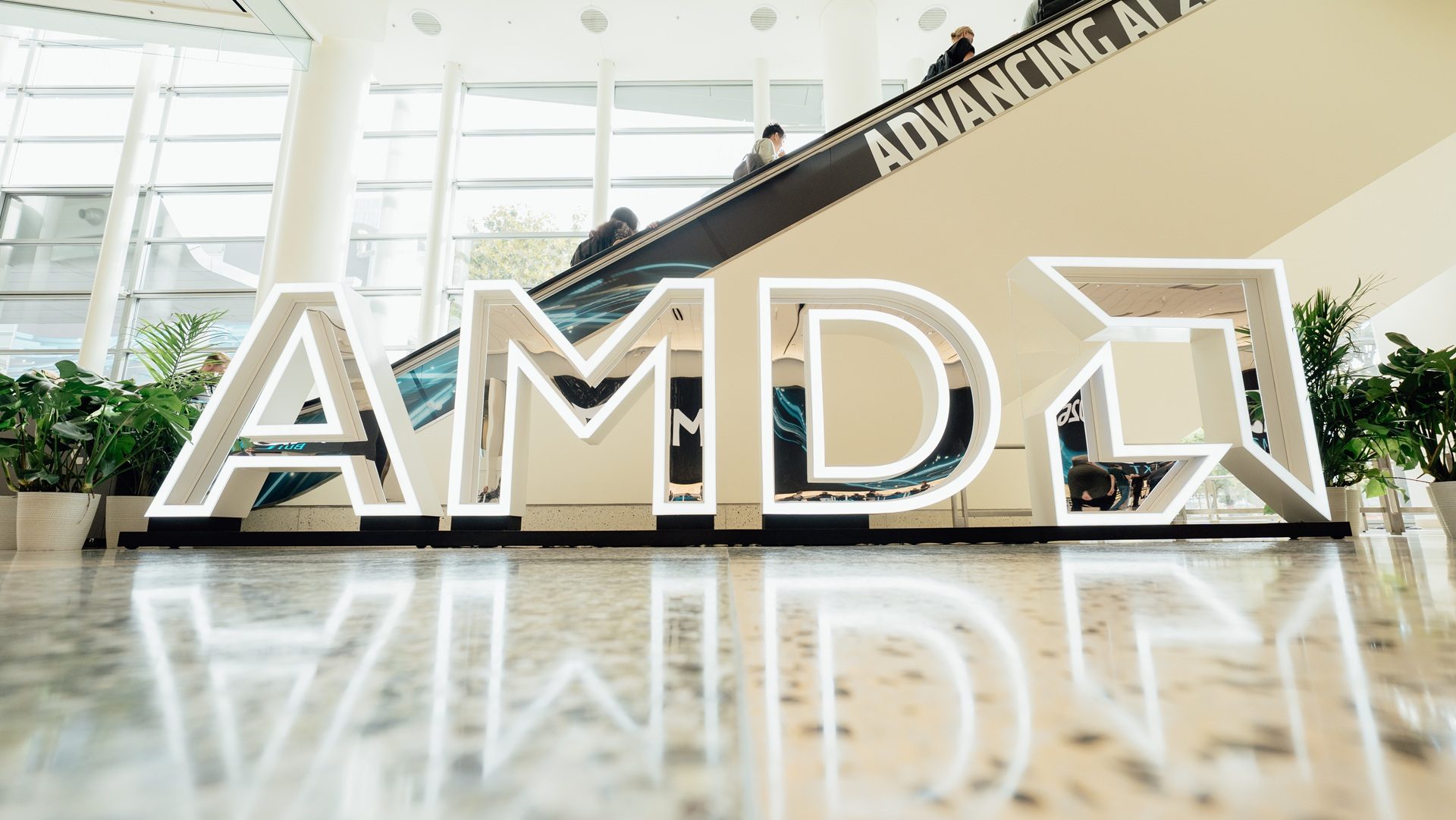
AMD leveraged Advancing AI 2026 to showcase the biggest update to its artificial intelligence strategy since the launch of Instinct. Far from focusing solely on a new accelerator, the company revealed a comprehensive platform encompassing GPU, CPU, networking, software, full rack systems, and partnerships with some of the world’s largest cloud providers and model developers.
This year’s edition sends a clear message: AMD no longer wants to compete only with a NVIDIA GPU. It aims to compete across its entire ecosystem.
The key takeaways from Advancing AI 2026 in 30 seconds
- AMD officially announced the Helios platform, its first rack-scale architecture for AI.
- The Instinct MI455X GPUs arrive, featuring HBM4 memory and CDNA 5 architecture.
- Microsoft will deploy Helios on Azure alongside new EPYC Venice processors.
- Anthropic, OpenAI, Cerebras, Cisco, and AT&T announced new collaborations with AMD.
- The company presented a roadmap extending to 2030 for CPUs, GPUs, and AI infrastructure.
During the keynote, Lisa Su emphasized a recurring idea throughout the conference: the market is no longer purchasing only accelerators. Large data centers seek complete platforms that integrate compute, networking, storage, and software to train and infer AI models at scale. AMD estimates that the AI infrastructure market could reach $2 trillion by 2030, a figure that underscores the company’s strategic shift.
Helios: AMD moves from chip to full data center
The main announcement was AMD Helios, a rack-scale platform designed to directly compete with systems like NVIDIA NVL72 or Vera Rubin.
Helios unifies within a single system:
- GPU AMD Instinct MI455X
- CPU AMD EPYC “Venice”
- Networking AMD Pensando
- High-speed interconnect
- Software ROCm
The reference configuration connects 72 MI455X GPUs within a single coherent domain via a new interconnection architecture. According to AMD, Helios offers increased memory capacity, higher bandwidth for horizontal scaling, and competitive performance compared to equivalent NVIDIA platforms for certain training and inference workloads.
This shift also marks a significant commercial evolution. Instead of merely selling accelerators, AMD now offers an infrastructure ready to deploy in data centers.
Instinct MI455X: HBM4 and CDNA 5
The new Instinct MI455X GPU represents AMD’s most important leap in AI accelerators.
Key features include:
- CDNA 5 architecture;
- Up to 432 GB of HBM4 memory;
- Bandwidth of 23.3 TB/s;
- Improvements in compute efficiency and data movement;
- New optimizations for large model inference and training.
AMD also introduced enhancements in memory hierarchy, new capabilities for tensor operations, and optimizations aimed at reducing energy consumption per token processed.
Microsoft bets on Helios and EPYC Venice
One of the most notable announcements came even before the keynote.
AMD and Microsoft expanded their strategic collaboration to deploy AMD’s new AI infrastructure within Azure.
The agreement includes:
- Deploying Helios for foundational model inference;
- New virtual machines based on EPYC Venice;
- Adoption of Pensando DPUs;
- Integration with Azure Boost to accelerate internal cloud communications.
For AMD, this represents one of the largest commercial endorsements it has received so far in the enterprise AI market.
Anthropic, OpenAI, and Cerebras expand the ecosystem
Advancing AI 2026 was also marked by a series of strategic alliances.
AMD announced a collaboration with Anthropic to deploy up to 2 GW of infrastructure based on upcoming GPU Instinct MI450, along with joint research projects and model optimization initiatives.
With OpenAI, AMD showcased a technical partnership going beyond hardware supply. Both companies are jointly working on software optimization, compilers, and libraries to improve model performance on AMD platforms.
Another key alliance was with Cerebras, which will combine Helios systems with Cerebras’ Wafer-Scale Engine architecture to create hybrid solutions capable of accelerating both initial query processing and subsequent token generation.
ROCm remains the primary choice against CUDA
AMD dedicated a significant portion of the event to software.
ROCm continues to be central to its strategy to compete with CUDA, NVIDIA’s proprietary ecosystem.
The company highlighted improvements in compatibility with AI frameworks, integration with millions of models available on Hugging Face, and new tools to simplify the development of training and inference applications on AMD hardware. The goal is to lower one of the main barriers for clients seeking to diversify their AI infrastructure.
New collaborations with enterprises and operators are also announced
Beyond foundational models, AMD revealed agreements with other tech partners.
AT&T will utilize AMD technologies to develop OpenTelco models in cloud, on-premises, and isolated environments, while Cisco will collaborate on enterprise inference solutions combining accelerators, networking, and observability tools to facilitate AI deployment in large organizations.
These partnerships demonstrate that AMD’s strategy extends beyond hyperscalers. The company also aims to strengthen its presence in the enterprise sector, where seamless integration of hardware, software, and networking will be crucial for accelerating AI adoption.
A broader strategy beyond a new GPU
Although the media focus was on the MI455X, Advancing AI 2026 made it clear that AMD is evolving into a provider of complete AI infrastructure.
Its vision is no longer solely centered on silicon. It includes EPYC processors, Instinct accelerators, Pensando networks, the Helios platform, the ROCm ecosystem, and a growing network of partners ranging from Microsoft and OpenAI to Anthropic, Cisco, Cerebras, and AT&T.
This elevates the competitive landscape with NVIDIA to a new level. It’s no longer just about comparing GPU performance but offering comprehensive platforms capable of powering the future AI factories built by major cloud providers and organizations developing foundational models.
