
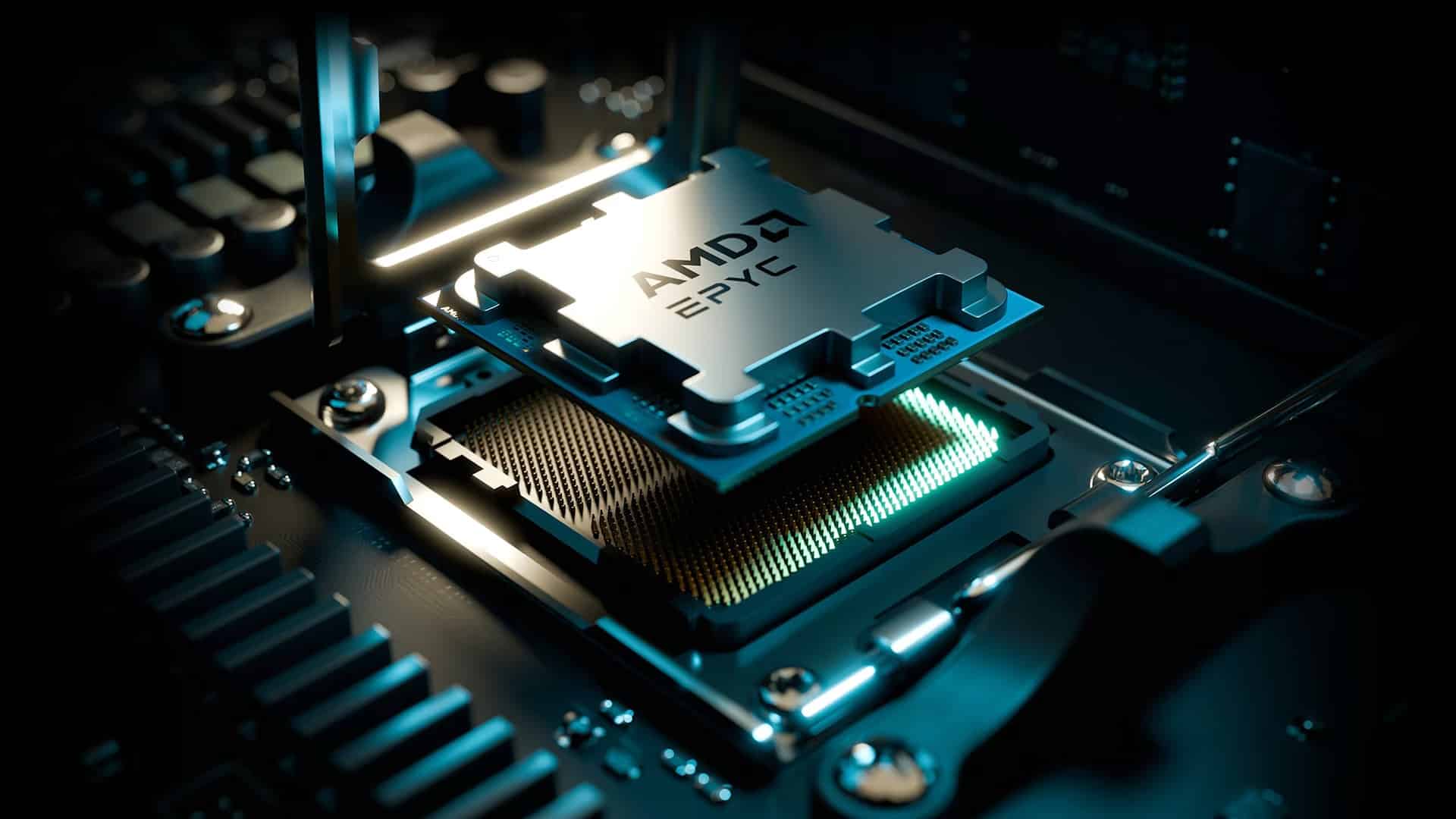
The AI chip market is no longer solely a contest over performance per watt or cluster size. Increasingly, the battle is also decided by the ability to finance the infrastructure that makes training and serving models at scale possible. Against this backdrop, AMD has taken a somewhat unusual step for a semiconductor manufacturer: securing a $300 million loan for the cloud startup Crusoe, aiming to accelerate the purchase and deployment of AMD AI accelerators in a new data center.
The deal, first reported by The Information and covered by Reuters, is structured by Goldman Sachs and uses the chips and related equipment as collateral. The key element of the agreement is the “safety net” AMD provides: if Crusoe fails to generate enough demand to rent out that capacity to customers (such as AI developers), AMD commits to repurchasing those chips, reducing the lender’s risk and enabling more attractive financing terms for the startup.
A loan collateralized by GPU assets and an AMD-backed “Plan B”
The most notable detail is the backup mechanism. Instead of just selling hardware, AMD participates indirectly in the financial arrangement: if the business doesn’t grow as expected, the company would accept leasing the capacity (or hardware) back to prevent underutilization. This approach is associated with “demand assurance” strategies prevalent in the industry.
According to available reports, this backing allowed the loan to be set at an interest rate of 6%, a level not trivial for a capital-intensive company in the midst of a data center investment cycle. Essentially, the hardware becomes a financial asset: it’s not only the product being sold but also the collateral supporting the loan.
Ohio as the deployment hub and Brookfield behind the scenes
The rollout of these accelerators links to a new data center in Ohio developed by Canadian firm 5C with support from Brookfield, according to Reuters coverage. Crusoe has long positioned itself as an “energy-first” operator focused on scaling AI infrastructure with an emphasis on efficiency and energy use.
This isn’t Crusoe’s first significant financial lever: it previously announced a $750 million credit facility with Brookfield to accelerate what it calls “AI factories,” and it also disclosed a Series E funding round of $1.375 billion with a valuation exceeding $10 billion. In other words, this is a large-scale project, not a small experiment, reflecting a major budget commitment.
Why this move resembles NVIDIA’s playbook
The similarity to NVIDIA’s strategies arises from a specific precedent: in 2025, Reuters reported an agreement in which NVIDIA committed to buying unused capacity from CoreWeave (up to $6.3 billion)—a buffer to reduce demand risk for the GPU-focused cloud operator. Such schemes—where chip providers help stabilize clients’ revenue streams to enable continued hardware purchases and deployments—are seen as ways to accelerate the growth of “GPU cloud” services when demand is strong but capital expenditure (CAPEX) is huge.
In AMD and Crusoe’s case, the structure shifts (guarantees and back leasing instead of capacity purchase), but the logic remains: reducing risk to accelerate deployment.
The uncomfortable truth: “financial engineering” amid the AI boom
This type of arrangement isn’t without debate. Reuters notes that some investors and analysts are watching “circular deals,” where the financial chain closes on itself—chips finance the loan, the loan buys chips, and the manufacturer reduces risk with additional commitments. The main argument in favor is speed: it enables faster infrastructure buildout and expands AI compute capacity. Critics, however, point out that it shifts operational risk from the operator to the hardware provider, albeit conditionally.
For AMD, the motivation is clear: establish a stronger foothold in a market dominated by NVIDIA, where each cloud deployment has multiplying effects (more options for developers, a richer ecosystem, more commercial references). But the downside involves taking on commitments that, if the market cools, could turn into operational costs or inventory/capacity obligations.
Implications for companies and developers: more supply, more options, more pricing pressure
Beyond the financial debate, the practical impact could manifest in two key areas:
- Increased AMD GPU cloud capacity: If Crusoe scales deployment, tech teams will have a new vendor with muscle to run inference and training workloads on AMD accelerators, benefitting those seeking alternatives to saturation or cost issues within the dominant ecosystem.
- Real competition in “AI cloud”: when operators raise funds to acquire specific hardware, they are betting on creating a resource pool that over time can pressure prices and improve availability for end-users.
The strategic takeaway is that the silicon war is shifting towards the installed capacity race: whoever manages to put more racks into production first—and keep them busy—gains a competitive edge.
Frequently Asked Questions
What does it mean that AMD “guarantees” a loan for Crusoe?
It means AMD provides an extra layer of backing for the loan—specifically through a commitment to lease back the chips if Crusoe fails to secure enough customers—reducing the perceived risk for the bank and enabling better loan conditions.
Why is hardware used as collateral in a data center AI loan?
Because accelerators and related equipment are high-value, relatively liquid assets in the industry. They serve as collateral to finance their purchase and deployment.
Could this impact the price or availability of GPUs for AI training?
Potentially. More cloud deployments generally increase compute supply. Additionally, heightened competition among providers could pressure prices, improve performance, and boost availability.
What risks do “circular deals” pose in the AI industry?
The main risk is that if demand falls or concentrates among few clients, operational risk shifts to hardware manufacturers and financiers. However, these arrangements also enable faster deployment during market growth.