
AMD has launched ROCm 10, a new generation of its software platform for accelerated computing that arrives alongside ROCm.AI, an environment designed to let AI agents themselves help configure, diagnose, and optimize workloads on AMD hardware. The company says its optimizations have delivered, in its own tests, an average improvement of 3.3x in inference and 2.4x in training on the same hardware, though these figures come from specific configurations and models and should not be read as an automatic speedup for any application.
AMD ROCm 10 in 20 seconds
- ROCm.AI reaches general availability as part of the ROCm 10 launch.
- Hyperloom uses agents to locate bottlenecks and modify GPU configurations and kernels.
- AMD Skills brings ROCm-specific knowledge to Claude Code, Codex, and Cursor.
- AMD reports average improvements of 3.3x in inference and 2.4x in training in its own tests on Instinct MI355X GPUs.
ROCm is also turning ten years old at a particularly important moment for AMD. The company has spent several generations trying to turn its Instinct accelerators into a more competitive alternative in an AI industry where hardware matters a great deal, but the software that lets you use it efficiently can determine which platform a developer ends up choosing.
ROCm 10 is aimed squarely at that part of the problem. AMD isn’t just updating libraries and compilers: it’s introducing tools that let AI agents work directly on its platform, diagnose problems, and take part in code optimization.
Hyperloom Puts AI Agents to Work Optimizing GPU Performance
The most technically interesting piece is ROCm Hyperloom, which AMD describes as an autonomous agent system for end-to-end optimization of inference workloads.
It follows a cycle any performance engineer would recognize. Hyperloom first establishes a baseline for the application’s performance, then analyzes the workload to find bottlenecks and studies possible changes. It can then adjust the serving configuration, generate or rewrite GPU kernels, and finally check whether the changes actually deliver an improvement without compromising the correctness of the results.
The difference is that part of that process can now be handled by an agent.
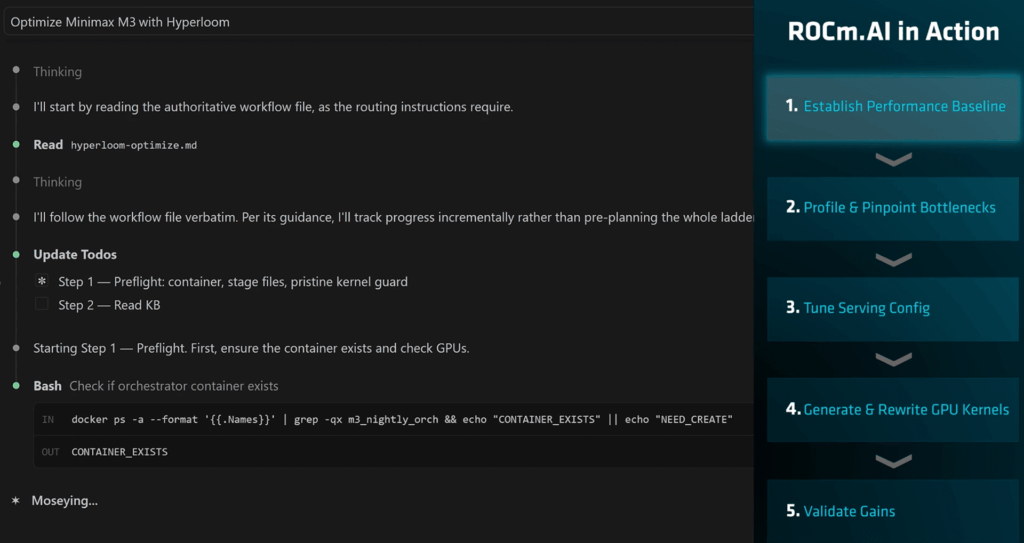
Hyperloom can work on host code and GPU kernels, and with ROCm 10 it extends its compatibility to AMD Instinct accelerators and inference engines such as vLLM and SGLang. The optimizations can touch HIP, Triton, and FlyDSL.
AMD specifically points to improvements in kernels, memory management, parallelism, and workload scheduling.
The figures the company provides are striking, but they need context.
AMD says it obtained an average improvement of 3.3x in inference comparing ROCm 7.0 against a preliminary ROCm.AI configuration based on ROCm 7.2.2 plus various optimizations. The tests used a Supermicro server equipped with eight AMD Instinct MI355X GPUs and the GLM-5, Kimi-K2.5, and DeepSeek-R1-0528 models.
So this isn’t a comparison between ROCm 10 and ROCm 7 simply run with their default configurations. AMD is comparing different versions and environments that include additional kernels, engines, and tuning. The company itself warns that results can vary depending on configuration, software, vLLM version, drivers, and the optimizations used.
Something similar applies to the 2.4x figure announced for training. The internal tests used Megatron-LM on an eight-GPU platform with the DeepSeek-V2-Lite, DeepSeek-V3-16B, and Qwen3-30B-A3B models.
These are meaningful results for showing how far software optimization can go, but they don’t mean that installing ROCm 10 automatically multiplies a GPU’s performance by 3.3x.
Claude Code, Codex, and Cursor Will Be Able to Tap AMD-Specific Knowledge
ROCm.AI also includes AMD Skills, arguably one of the most interesting decisions from the standpoint of day-to-day development.
AMD has prepared platform-specific knowledge and workflows that coding agents such as Claude Code, Codex, and Cursor can use.
Instead of asking a generic assistant to figure out on its own how to diagnose or improve an application for an Instinct GPU, the agent can draw on procedures that AMD has already prepared and validated.
The company currently splits these capabilities into three groups. The client-facing ones cover local AI and application integration; the ones that cut across different software layers include diagnostics, analysis, and optimization; and the server-oriented ones work with Instinct GPUs and EPYC processors on tasks such as serving, profiling, and performance analysis.
The Skills previously unveiled at Advancing AI 2026 are now available through the Claude Code, Codex, and Cursor marketplaces, as well as an open catalog published by AMD.
This approach reflects an interesting shift in developer tooling. Traditional documentation is still necessary, but manufacturers such as AMD are starting to prepare their platforms directly so that the consumer of that documentation can also be an AI agent.
ROCm CLI Wants to Simplify a Platform That Has Historically Been Complex
The third component is ROCm CLI, still presented as a Technology Preview.
It’s a unified command-line interface for installing, managing, diagnosing, and running AI workloads on AMD hardware. It can be used directly by a person, by a coding agent, or within continuous integration systems.
Among other things, it lets you inspect the system, manage ROCm environments, serve models, run diagnostics, update components, and control runtimes.
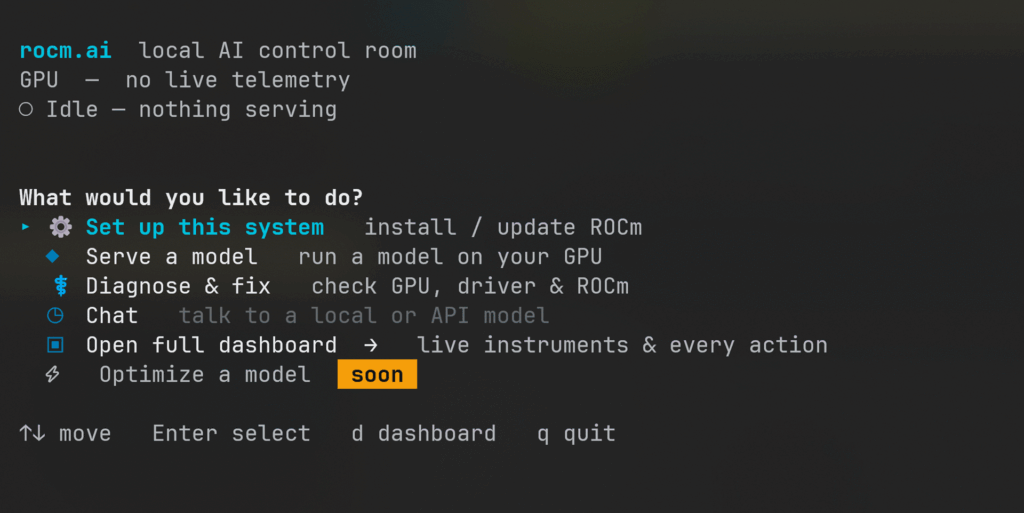
It can also keep multiple runtime versions running in parallel, activate them, and roll them back. The CLI is available as a precompiled binary for both Linux and Windows and doesn’t require a prior ROCm installation.
ROCm Console, previously known as “dash,” adds real-time monitoring. On supported Instinct systems, it can show GPU utilization, HBM memory, power consumption, model activity, and metrics such as tokens per watt.
With this, AMD is trying to shrink one of its platform’s long-standing obstacles: the gap between having a competitive GPU and getting a real application to run and reach adequate performance on it.
The Battle With NVIDIA Is Also Being Fought in Software
ROCm 10 arrives at a time when the competition between AMD and NVIDIA can no longer be analyzed by comparing TFLOPS, HBM memory, or bandwidth alone.
NVIDIA has spent years building an enormous set of libraries, tools, and accumulated knowledge around CUDA. That maturity makes it easier for researchers, developers, and companies to take a workload from development into production without constantly having to solve platform-related problems.
AMD needs to close that gap if it wants Instinct to gain ground in AI training and inference.
ROCm.AI introduces a different way to get there: using AI itself to reduce the specialized knowledge a person needs to get performance out of the hardware.
The modularization of the ROCm Core SDK goes in the same direction. ROCm 10 reorganizes the platform’s foundation and adds updates across libraries, compilers, tools, frameworks, supported models, and hardware support.
The result could be especially interesting for data centers weighing whether to add a second acceleration platform alongside NVIDIA. A GPU’s price and specs matter, but so does the time a team needs to get a model into production, fix errors, and reach acceptable performance.
If agents can take on a growing share of that work, the barrier to entry for an alternative architecture drops.
AMD still has to prove how far Hyperloom can reproduce its gains across a much wider range of real-world models, configurations, and applications. But ROCm 10 makes one direction clear: the next battle between AI platforms will also come down to which hardware is easier to program and optimize with the help of agents.
Frequently Asked Questions
What is AMD ROCm 10?
ROCm 10 is the new generation of AMD’s software platform for accelerated computing and artificial intelligence. It includes changes to the SDK, libraries, compilers, tools, frameworks, and model and hardware support.
What is ROCm.AI?
ROCm.AI is an AI-oriented development platform that brings together AMD Skills, ROCm CLI, and Hyperloom. Its goal is to make it easier to run, diagnose, and optimize workloads on AMD hardware, including with the help of AI agents.
Does ROCm 10 make AMD GPUs 3.3x faster?
Not across the board. AMD obtained an average 3.3x improvement in inference in specific internal tests using eight Instinct MI355X GPUs, several models, and various software optimizations. The result depends on the workload, configuration, inference engines, drivers, and other components.
Which coding assistants work with AMD Skills?
AMD currently lists Claude Code, Codex, and Cursor among the tools compatible with its Skills. The catalog can also be browsed openly on GitHub.
Source: newsroom.amd
