
AMD took the CES 2026 showcase as an opportunity to send a clear message to the PC market: AI is no longer a “bonus,” it’s the new core of the product. And their response comes on three fronts simultaneously: new processors for laptops and professional devices, a proprietary mini-PC platform designed for local AI development, and a new “X3D” processor for those who just want more FPS—no excuses.
Ryzen AI 400 and Ryzen AI PRO 400: more NPU, greater reach (power and enterprise)
The main announcement was the Ryzen AI 400 Series family and its Ryzen AI PRO 400 Series variant, built on “Zen 5” architecture and featuring second-generation XDNA 2 NPUs. AMD claims these lines achieve up to 60 TOPS of computing power in the NPU, aiming to enable on-device AI experiences (reducing reliance on the cloud) and covering everything from consumer laptops to enterprise equipment.
Practically speaking, AMD emphasizes that the entire family exceeds the requirements of so-called “Copilot+ PCs,” and supports this with a familiar premium recipe: up to 12 CPU cores, integrated graphics Radeon 800M, and efficiency enhancements to maintain performance without turning the laptop into a radiator.
Meanwhile, the PRO suffix reiterates its role: AMD positions the Ryzen AI PRO 400 series as a choice for enterprise fleets, with a focus on security, management, and long-term platform stability, while offering the same AI features as the consumer line.
Ryzen AI Max+: the leap to “desktop-class” graphics in ultra-light and compact systems
The second part of the announcement expands the Ryzen AI Max+ family with new models Ryzen AI Max+ 392 and Ryzen AI Max+ 388. AMD positions these chips for ultra-slim laptops, workstations, and compact PCs, combining Zen 5 cores, integrated graphics Radeon 8060S, and XDNA 2 NPUs in a single package designed for creation, gaming, and AI workloads—eliminating the need to upgrade to a dedicated GPU.
Here, the focus isn’t just “more power,” but versatility: the same device used for video editing or rendering can also serve as a testing station for local models or AI-assisted creative workflows—especially if the software ecosystem supports it.
Ryzen AI Halo: an AMD “mini-PC” for local AI development (no setup drama)
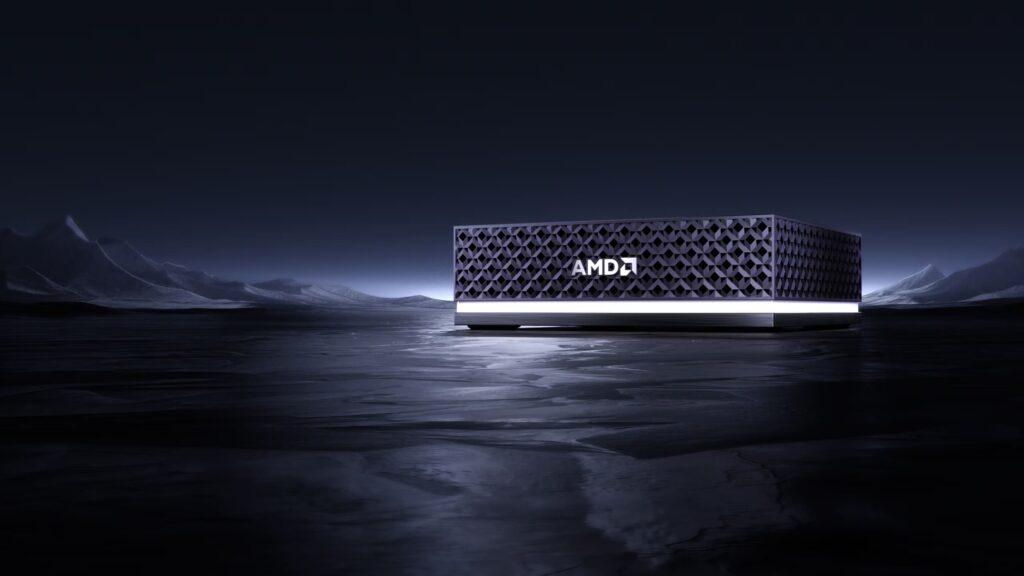
The most symbolic surprise was Ryzen AI Halo, AMD’s own mini-PC platform aimed explicitly at developers. Described as an “out-of-the-box” experience to accelerate AI innovation at the edge, it’s based on Ryzen AI Max+ and centered around a key idea: run large models locally with less friction.
According to AMD, this platform can be configured with up to 128 GB of unified memory, delivers up to 60 TFLOPS in RDNA 3.5 graphics, and supports both Windows and Linux. In its most ambitious claim, AMD states it can handle models with up to 200 billion parameters locally—a direct nod to those wanting to experiment without relying on remote servers.
Ryzen 7 9850X3D: the message to gamers remains “cache, cache, cache”
While PCs continue to fill with AI-related acronyms, AMD hasn’t relinquished emotional ground in gaming. Their new Ryzen 7 9850X3D succeeds the X3D line, featuring Zen 5 architecture and 3D V-Cache. Specs include up to 5.6 GHz boost, 104 MB of total cache, and a TDP of 120 W.
AMD supports the launch with a bold comparison: up to 27% more gaming performance versus an Intel Core Ultra 9 285K, based on their own tests. This figure fuels headlines and graphics card wars, but also highlights that, by 2026, AMD aims to remain “the easy choice” for those prioritizing gaming performance above all.
ROCm 7.2, ComfyUI, and the AI “bundle”: software is no longer the weak point
One of the most interesting parts of the announcement concerns software: AMD confirmed ROCm 7.2 for Windows and Linux, with support for Ryzen AI 400 and integration into ComfyUI, plus an AI Bundle within AMD Software: Adrenalin Edition aimed at simplifying the setup of local AI tools.
In other words, AMD is working to reduce the “time to first result” for users and creators interested in local models, image generation, or creative workflows—without heavy dependencies. Additionally, the company mentioned progress in its graphics stack with FSR “Redstone” and improvements related to ML technologies for gaming.
Availability: laptops in January, more waves throughout 2026
AMD plans to launch the first systems with Ryzen AI 400 and Ryzen AI PRO 400 in Q1 2026, through manufacturers such as Acer, ASUS, Dell, HP, GIGABYTE, and Lenovo. Desktop models featuring Ryzen AI 400 are expected in Q2. Ryzen AI Max+ will also debut in Q1, and Ryzen AI Halo is scheduled for Q2 2026.
Frequently Asked Questions
What’s the difference between Ryzen AI 400 and Ryzen AI PRO 400 in an enterprise laptop?
The PRO line is designed for corporate deployments: adds focus on security, management, and long-term platform stability, while maintaining the same AI capabilities as the consumer line.
Who benefits from Ryzen AI Max+ over a laptop with a dedicated GPU?
It’s ideal for those seeking an ultra-slim or compact system that blends creation, gaming, and AI tasks with powerful integrated graphics—reducing power consumption, weight, and complexity without sacrificing performance.
Why is it important that ROCm arrives well on Windows and integrates with tools like ComfyUI?
Because it lowers the entry barrier to local AI: less manual setup, greater compatibility, and a more direct path for creators and developers to experiment with models on their own PCs.
What does a processor like the Ryzen 7 9850X3D bring to actual gaming performance?
3D V-Cache improves performance in many games by reducing memory bottlenecks, especially in CPU-limited scenarios (high frame rates, competitive gaming, or resolutions where the GPU isn’t the bottleneck).
via: amd