
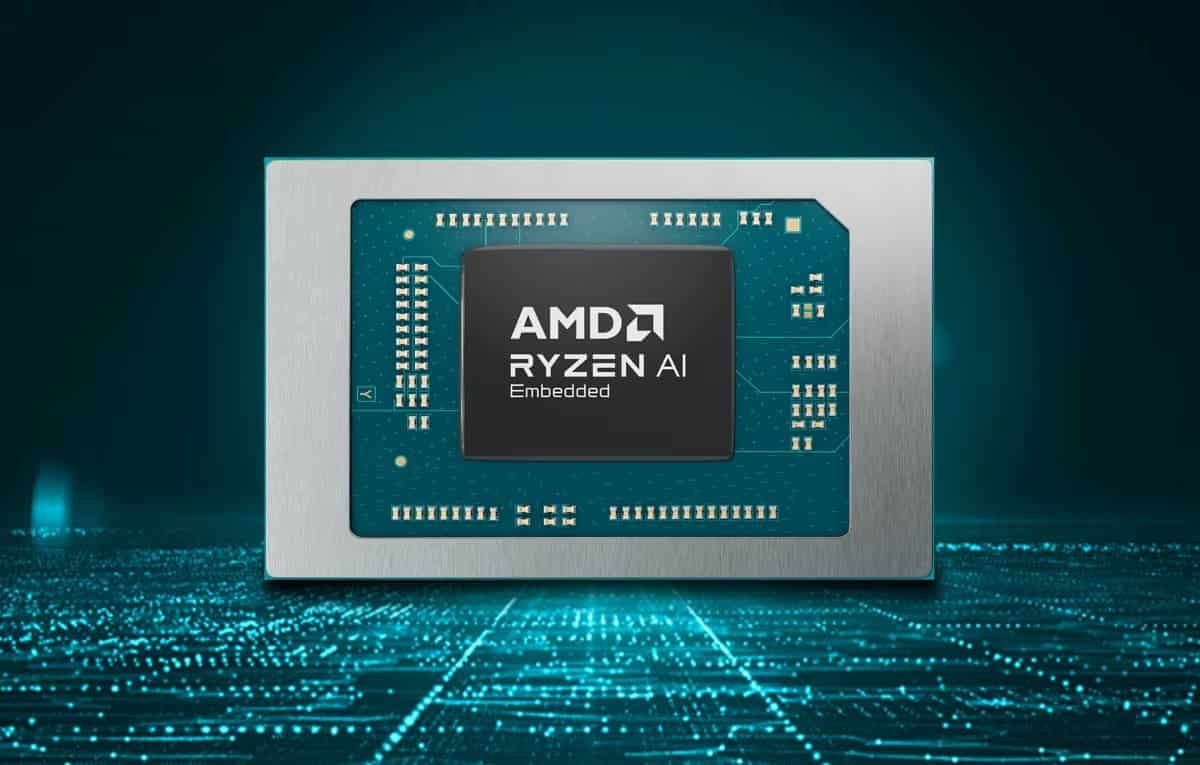
AMD has taken the opportunity at Mobile World Congress 2026 in Barcelona to deliver a direct message to the PC industry: the era of the “AI PC” is no longer limited to premium laptops. With the announcement of the Ryzen AI 400 Series and Ryzen AI PRO 400 Series for desktop systems, the company aims to push “on-device” Artificial Intelligence into a territory traditionally dominated by other priorities: sustained power, scalability, and ease of deployment in enterprise environments.
The core technical headline is straightforward: AMD claims that its new desktop processors are the first designed to enable Copilot+ PC experiences on the desktop, thanks to an NPU (Neural Processing Unit) with up to 50 TOPS of AI compute. Behind this figure is a clear strategy: to allow assistants, productivity tools, and language models to run locally, reducing latency and keeping more data “inside the PC” rather than sending it to the cloud.
This move comes at a time when Microsoft has already set a benchmark for Copilot+ PCs: an NPU capable of 40+ TOPS, along with basic requirements like memory and storage. The takeaway is clear: if the market shifts toward this “label” as a standard, chip makers and OEMs need parts that meet those specs—and are viable for volume and price.
What’s inside: Zen 5 + RDNA 3.5 + XDNA 2
AMD describes the Ryzen AI 400 series for desktops as an “all-in-one” platform for modern workloads: a CPU featuring Zen 5 cores, integrated graphics AMD RDNA 3.5, and a dedicated AMD XDNA 2 NPU. The combination aims to pragmatically enable the PC to allocate tasks among CPU, GPU, and NPU based on the workload — from collaboration and multitasking to software development, data analysis, or AI-assisted workflows.
Practically, AMD is trying to normalize a concept gaining traction in the sector: the PC ceases to be just a “thing running apps” and starts acting as a local assistant that accelerates tasks without relying heavily on external services.
Desktop lineup: AM5, two TDP levels, and six models (including PRO)
The announced desktop family leverages AM5 systems and is structured around two power configurations: 65 W and 35 W, common choices to cover from traditional desktops to compact or enterprise systems with thermal and acoustic considerations. AMD has listed three base chips — Ryzen AI 7 450G and Ryzen AI 5 440G/435G — with “E” versions (35 W) and their PRO counterparts.
A notable detail for component buyers: much of the technical coverage suggests these Ryzen AI 400 desktop models won’t come as “boxed” CPUs for DIY channels but are aimed at OEM systems. This aligns with AMD’s stated goal: to produce “AI PCs” ready for business and consumers, through closed designs from partners like HP, Lenovo, and others.
Summary table: Ryzen AI 400 Series (desktop, AM5)
| Model | Cores / Threads | Turbo / Base Frequency | TDP | Total Cache | Integrated Graphics | CUs | NPU (TOPS) |
|---|---|---|---|---|---|---|---|
| Ryzen AI 7 450G | 8 / 16 | up to 5.1 GHz / 2.0 GHz | 65 W | 24 MB | Radeon 860M | 8 | up to 50 |
| Ryzen AI 5 440G | 6 / 12 | up to 4.8 GHz / 2.0 GHz | 65 W | 22 MB | Radeon 840M | 4 | up to 50 |
| Ryzen AI 5 435G | 6 / 12 | up to 4.5 GHz / 2.0 GHz | 65 W | 14 MB | Radeon 840M | 4 | up to 50 |
| Ryzen AI 7 450GE | 8 / 16 | up to 5.1 GHz / 2.0 GHz | 35 W | 24 MB | Radeon 860M | 8 | up to 50 |
| Ryzen AI 5 440GE | 6 / 12 | up to 4.8 GHz / 2.0 GHz | 35 W | 22 MB | Radeon 840M | 4 | up to 50 |
| Ryzen AI 5 435GE | 6 / 12 | up to 4.5 GHz / 2.0 GHz | 35 W | 14 MB | Radeon 840M | 4 | up to 50 |
| Ryzen AI 7 PRO 450G / 450GE | 8 / 16 | up to 5.1 GHz / 2.0 GHz | 65 W / 35 W | 24 MB | Radeon 860M | 8 | up to 50 |
| Ryzen AI 5 PRO 440G / 440GE | 6 / 12 | up to 4.8 GHz / 2.0 GHz | 65 W / 35 W | 22 MB | Radeon 840M | 4 | up to 50 |
| Ryzen AI 5 PRO 435G / 435GE | 6 / 12 | up to 4.5 GHz / 2.0 GHz | 65 W / 35 W | 14 MB | Radeon 840M | 4 | up to 50 |
Laptops and Workstations: The PRO Leap with up to 60 TOPS
The announcement isn’t limited to desktops. AMD also reinforces its enterprise narrative with the Ryzen AI PRO 400 Series mobile processors, extending local AI acceleration to enterprise laptops and mobile workstations, where power, professional software certification (ISVs), and platform stability are critical.
AMD highlights the Ryzen AI 9 HX PRO 470 as a performance benchmark, claiming it can deliver up to 30% more multi-core performance compared to a specific Intel competitor (based on internal tests). Additionally, the mobility NPU benchmark is raised to 60 TOPS of AI compute, enabling next-generation local experiences oriented toward productivity.
Expected availability from AMD places these systems in Q2 2026, with leading OEMs such as Dell Technologies, HP, and Lenovo delivering mobile workstations, and a broader range of commercial laptops also on the horizon.
AMD PRO: The Message Targeting IT (and Not Just Consumers)
The PRO suffix isn’t just empty marketing in the corporate market: it typically signals remote management, longer predictable lifecycle, and a security and management package designed for large-scale deployments. AMD emphasizes that its AMD PRO platform enhances security, management capabilities, and resilience for distributed “AI PC” fleets, including improved remote management to diagnose, recover, and maintain devices without physical visits.
For IT departments, this is almost as vital as the TOPS figure: in large deployments, the total cost isn’t only driven by performance but also support time and fleet governance.
Why has Copilot+ PC become a “seal” (and what’s its role here)?
Microsoft has long been promoting the concept of Copilot+ PC as a hardware category prepared for local AI functions. Its technical guidelines specify that many of these capabilities require an NPU with 40+ TOPS. With 50 TOPS in desktop and up to 60 TOPS in mobile (per AMD’s data), the Ryzen AI 400 family is well positioned to meet or exceed that threshold in terms of NPU compute power.
Underlying this is AMD’s attempt to open a new chapter: if laptops with Copilot+ are the initial front, desktops could be the second, especially in professional environments where sustained power and local data control matter more than “ultra-portability.”
Availability: Q2 2026 and OEM focus
AMD sets the launch for Q2 2026: desktop AM5 systems featuring Ryzen AI 400 from partners like HP and Lenovo, and mobile workstations with Ryzen AI PRO 400 from Dell, HP, and Lenovo, among others. In other words, the company aims for volume through the OEM channel rather than a traditional DIY release typical of other Ryzen lines.
Frequently Asked Questions
What does “50 TOPS” in the NPU mean for a Ryzen AI 400?
It’s a measure of the theoretical maximum performance of the NPU (trillions of operations per second) under optimal scenarios; serves as a reference for “on-device” AI workloads, although actual performance depends on the model and software.
Why does AMD say these are the first desktop Copilot+ processors?
AMD claims they are the first designed to enable Copilot+ PC experiences on desktop, thanks to the XDNA 2 NPU with up to 50 TOPS—surpassing Microsoft’s 40+ TOPS threshold for these capabilities.
When will PCs with Ryzen AI 400 and Ryzen AI PRO 400 be available?
AMD indicates availability starting in Q2 2026, with systems from vendors like HP and Lenovo (desktops) and Dell, HP, and Lenovo (laptops).
What does the AMD PRO platform bring to companies deploying “AI PCs”?
It offers enhanced security, management features, and remote administration functions to support distributed fleets, providing greater visibility and recovery capabilities without onsite visits.