
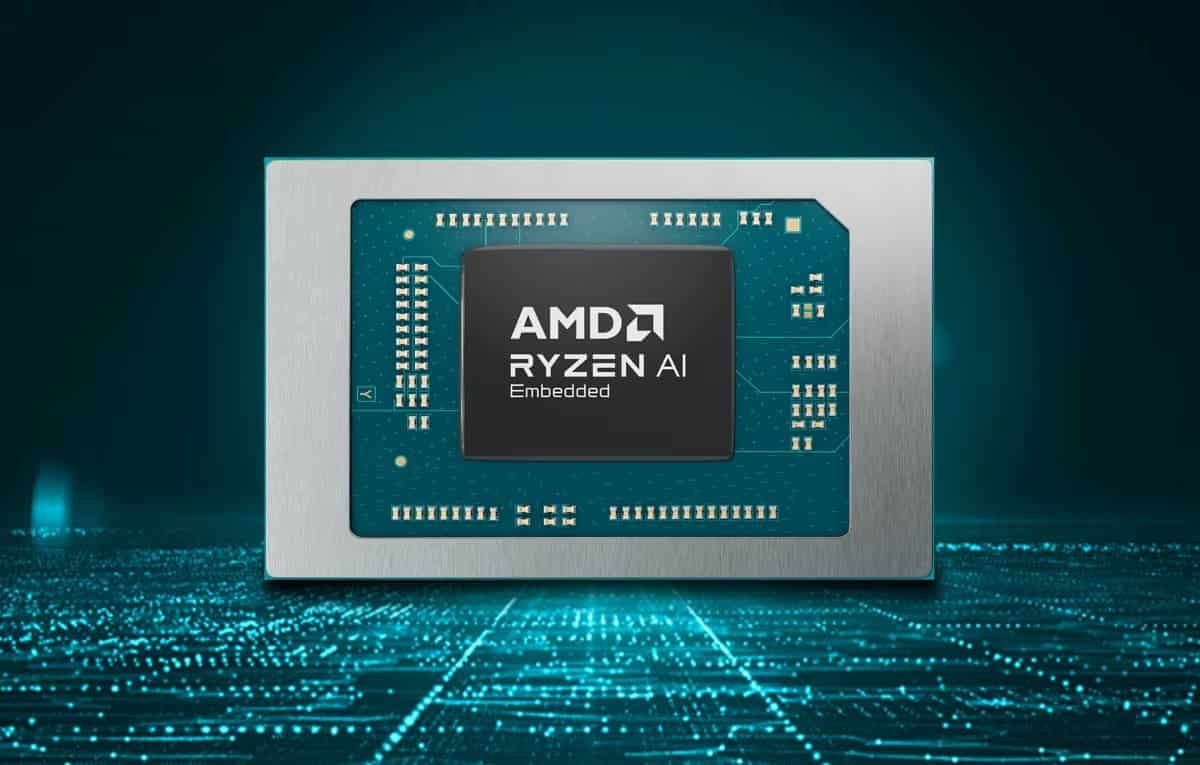
AMD has unveiled a new family of embedded x86 processors designed to run AI workloads directly at the edge, where data is generated and where latency and energy efficiency are critical: in the car, production line, or autonomous system that must react in real-time. Based in Santa Clara, California, the company announced the AMD Ryzen AI Embedded portfolio, which kicks off with the P100 and X100 series. These integrate in a single chip three components that until recently required separate solutions: a “Zen 5” CPU, a RDNA 3.5 GPU, and an XDNA 2 NPU.
The promise, according to AMD’s own description, is clear: more performance and more AI capability “on the device” without increasing system complexity. In automotive and industrial applications, that nuance is significant. In a modern digital cockpit—with instrumentation, infotainment, voice assistants, and multiple screens—and in an industrial setup where artificial vision, deterministic control, and real-time graphics coexist, each additional component adds cost, integration challenges, and potential points of failure.
Salil Raje, senior vice president and general manager of AMD Embedded, summarized it concisely: as industries push toward more immersive experiences and local intelligence, they need power without more complicated architectures. The Ryzen AI Embedded aims to meet this need by integrating general compute, graphics, and AI acceleration in a compact format designed for demanding deployments.
Two series, one approach: local AI with deterministic control
The announcement divides into two families:
- Ryzen AI Embedded P100 Series, targeting in-vehicle experiences and industrial automation.
- Ryzen AI Embedded X100 Series, featuring more cores and greater capacity for “physical AI” scenarios and more demanding autonomous systems.
Practically, AMD is signaling a shift: AI is no longer just something that happens in data centers or the cloud, but also within systems that need to see, decide, and act with low latency, even without connectivity or with intermittent links. In this realm, a dedicated NPU—such as XDNA 2—becomes crucial to sustain inferences with low power consumption.
P100: digital cockpits, HMI, and 4K displays at 120 fps
The first to arrive is the P100 Series with 4 to 6 cores, optimized for next-generation digital cockpits and HMI (human-machine interface) systems. AMD highlights a performance boost over the previous generation: the platform can deliver up to 2.2× better performance in single- and multi-threaded tasks compared to the earlier generation, aiming to maintain deterministic control—a typical requirement when critical components operate alongside graphics-rich applications.
In terms of physical and operational specs, the focus is on integrators facing real-world constraints:
- 25 × 40 mm BGA package, designed for space-limited systems.
- Power range of 15–54 W, relevant for thermal-limited designs.
- Support for operating environments from -40 °C to +105 °C, common in industrial and automotive applications.
- Designed for long lifecycle cycles, with references up to 10 years.
Where the announcement becomes especially tangible is in graphics. The integrated RDNA 3.5 GPU, according to AMD estimates, offers a 35% performance increase in rendering compared to the Ryzen Embedded V2A46 in internal tests. It’s capable of driving up to four 4K displays (or two 8K displays) at 120 frames per second simultaneously. For vehicles with multiple displays—instrument cluster, central screen, co-driver display, and auxiliary panels—this means more headroom for smooth interfaces and complex graphics without overloading other systems.
Additionally, AMD’s video codec engine, oriented toward low-latency playback and streaming, enables efficient multimedia processing without taxing the CPU—ideal for infotainment and advanced signage experiences.
XDNA 2: up to 50 TOPS for low-latency inference
The third core component of the chip, and the defining feature of the lineup, is the NPU. AMD claims that XDNA 2 can deliver up to 50 TOPS (trillions of operations per second) and achieve up to 3× more inference performance compared to the previous Ryzen Embedded 8000 family, in terms of maximum TOPS.
Beyond raw numbers, AMD emphasizes that its approach is centered on concrete use cases: compatible models such as vision transformers, compact LLMs, and CNNs, designed to fuse signals like voice, gestures, and environmental cues. In vehicle applications, this translates into more responsive assistants and multimodal interaction within the cabin. In factories, it enables real-time visual analytics, anomaly detection, and automated inspection without sending every frame to the cloud. In the realm of “physical AI,” it supports perception and response in robots and autonomous systems.
Open virtualization with Xen to separate worlds without system breakage
One of the most striking aspects of the announcement isn’t the silicon itself but the software. AMD states that the Ryzen AI Embedded devices rely on a consistent development environment with a unified stack across CPU, GPU, and NPU: optimized GPU libraries, open APIs, and a native runtime for XDNA via Ryzen AI Software.
Architecturally, the company highlights an open source virtualization framework based on the Xen hypervisor. This setup isolates multiple OS domains safely, enabling different system components—such as Yocto or Ubuntu for HMI, FreeRTOS for real-time control, and Android or Windows for richer applications—to run concurrently and securely. This architecture aims to simplify designs where safety, real-time constraints, and rich multimedia coexist. AMD also mentions that its architecture can support ASIL-B and references to AEC-Q100, qualifying it for automotive supply chains with guarantees of functional safety and reliability.
Schedule: sampling underway, production expected in Q2
Regarding availability, AMD states that the P100 series with 4 to 6 cores are already in sampling with early access customers, with tools and documentation available, and production shipments planned for Q2. The P100 series with 8 to 12 cores, aimed at industrial automation, is expected to begin sampling in the first quarter. The X100 series, with up to 16 cores, is anticipated to start sampling in the first half of the year.
Overall, the message is that AMD aims to carve out a growing niche: embedded processors that not only control and visualize but also reason locally. In edge applications, where milliseconds and watts matter, integrating CPU, GPU, and NPU into a single chip can be as crucial as raw performance.
Frequently Asked Questions
What is the purpose of a Ryzen AI Embedded processor in a digital car cockpit?
It’s designed to run real-time graphics for multiple screens (instrumentation and infotainment) and perform local AI functions such as voice interaction or contextual analysis, all on a single chip optimized for automotive thermal ranges and lifecycle.
What does it mean that the XDNA 2 NPU reaches 50 TOPS in an embedded system?
It indicates dedicated acceleration capacity for low-latency inference of AI models, suitable for tasks like computer vision, local assistants, and real-time analysis without reliance on cloud connectivity.
What are the benefits of virtualization with Xen in automotive and industrial contexts?
It allows multiple operating systems and domains (like Linux for HMI, FreeRTOS for control, Android/Windows for applications) to run securely in parallel, reducing the risk that one component affects others.
When are the first shipments expected, and what’s the difference between P100 and X100?
The 4-6 core P100 models are already in sampling, with planned production for Q2. The X100 series, focusing on “physical AI” and more demanding autonomous systems with up to 16 cores, will begin sampling in the first half of the year.
via: amd