
For years, the debate around vRAN (virtualized radio access network) oscillated between technological promise and operational caution: more flexibility, more vendor competition, and greater agility for network evolution. By 2026, according to AMD’s analysis, the sector has entered a new phase. The question is no longer “why vRAN,” but how to sustain it commercially as it moves from pilot projects to large-scale deployments. And here, the company states, the biggest enemy is no longer technology: it’s economics.
In a publication signed by Derek Dicker (Corporate Vice President, Enterprise and HPC Business Group), AMD identifies the current barriers to vRAN as very tangible factors: rising energy costs, pressure for cloud-native architectures, the need to automate operations, and most importantly, the difficulty of maintaining consistent performance in highly distributed infrastructure. In networks with thousands of locations, small inefficiencies multiply costs, complicate operations, and erode business cases.
The strategic “new lever”: server computing
AMD suggests that transitioning to vRAN changes a key piece of the puzzle: RAN no longer relies solely on custom silicon systems, but instead depends on general-purpose server computing. This shift opens the door to flexibility but also makes server hardware a direct factor in total cost of ownership, power consumption, and deployment speed.
In this context, the metric that counts is not peak performance but performance per watt and per euro. The company emphasizes a recurring theme in telecom: when deployments are scaled up, what seems “small” at a single node can become enormous in aggregate. That’s why AMD highlights that many operators are increasingly evaluating single-socket configurations capable of meeting processing requirements with lower power consumption and a more compact design.
EPYC 8005 “Sorano”: up to 84 cores in a 225 W package
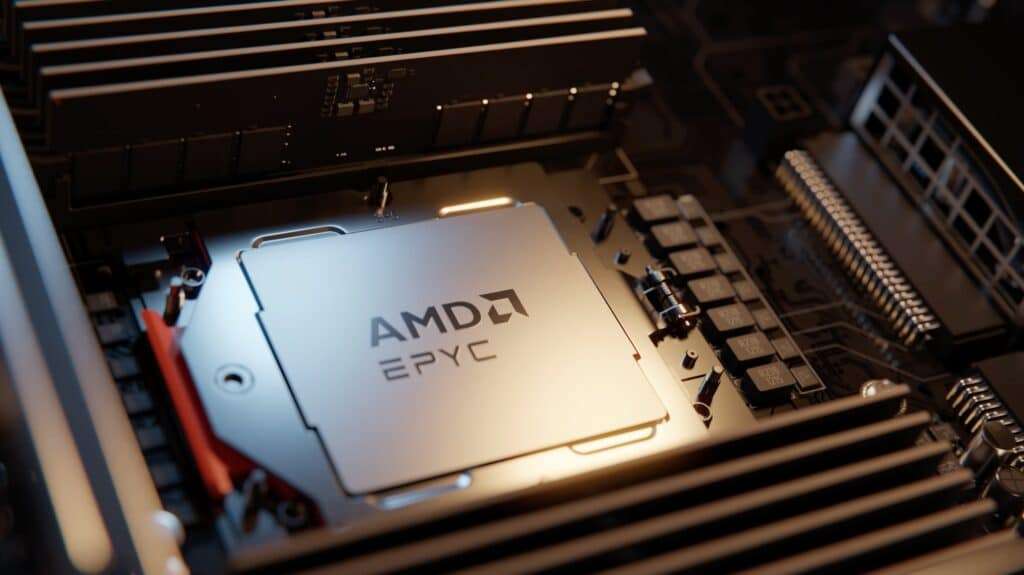
This is where AMD introduces its proposal: the AMD EPYC 8005 (codenamed “Sorano”) CPUs are designed for challenging edge environments, aiming to deliver leadership in performance per watt and per euro in telecommunications deployments. Specifically, AMD states these processors enable up to 84 cores in a single socket with high computational density within a package of up to 225 W, tailored to meet vRAN requirements, including intensive processing of Layer 1 (L1).
The message aligns with operational realities: many telecom sites are not data centers; they are locations with limited power, tight space, and complex environmental conditions. In such scenarios, increasing capacity is not just about “adding hardware” — it’s about doing so without exceeding power, dissipation, or remote operation limits.
Business priorities: “expensive” power and space, determinism, and telco platforms
AMD frames EPYC 8005 as a solution for deployments where power and space are premium resources, from outdoor sites to dense edge locations. In this transition, two criteria become increasingly important: energy efficiency and performance determinism (avoiding variability and maintaining predictable behavior).
Within the attributes AMD highlights for EPYC 8005 are three concepts highly relevant to the telecom world:
- Wide temperature ranges to meet environmental requirements.
- Capability to enable NEBS-compliant platforms, suitable for ruggedized or outdoor deployments.
- High core density per socket, enabling more compact form factors.
The core idea is that, if the goal is to scale vRAN sustainably, the platform must balance cost and flexibility without compromising operational consistency.
LDPC and 5G: optimizations to “get more” from the physical layer
The most technical aspect of the announcement relates to AMD’s specific performance improvements for Layer 1 (L1) in vRAN: the company states it has introduced targeted optimizations for LDPC (Low-Density Parity Check) decoding in EPYC 8005, aimed at reducing latency and accelerating error correction processing for 5G loads — a key component of overall throughput.
AMD ties these improvements to internal design elements: the “Zen 5” execution pipeline, enhanced vector units, and tuned memory access. The dual goals are: to improve LDPC efficiency without sacrificing deterministic behavior, and to increase upload throughput while providing more margin for deployments like Massive MIMO.
An operational detail AMD emphasizes — and that matters for site planning — is that more efficient LDPC decoding frees computing resources for other L1 and L2 functions, allowing “more functions per server” and thereby improving economic metrics.
Ecosystem: Ericsson, Samsung, Supermicro, and Wind River reinforce the message
AMD supports its proposition with messages from ecosystem partners, emphasizing a common pattern: cloud-native RAN demands determinism, efficiency, and flexible integration, and collaboration among vendors is key to maturing these architectures.
Among the highlighted partners:
- Ericsson notes that cloud-native RAN increases demands on computing platforms.
- Samsung points out the combination of AMD’s latest processor with “commercially proven” vRAN software to improve efficiency and computing options.
- Supermicro discusses its edge server with EPYC 8005 optimized for vRAN, suitable for dense and efficient designs.
- Wind River emphasizes operators’ push to scale Open RAN and edge solutions (including AI at the edge) with strict control of cost, power, and operational complexity.
The industry takeaway is clear: vRAN is moving into an “exploitation” phase, where reducing risk and simplifying operations take precedence over just boosting benchmarks.
A shift in tone in 2026: from “why” to “how much does it cost to sustain”
AMD’s article doesn’t announce a revolutionary concept for vRAN; rather, it recalibrates the dialogue. If vRAN has already demonstrated value in flexibility, the next step is transforming it into a system that can be operated and financed at scale without being consumed by complexity and energy costs.
In this context, EPYC 8005 “Sorano” is presented as a key component addressing the dominant telecom question today: how to grow capacity without losing control of power, cost, and performance — especially when infrastructure is deployed outside the comfort zone of traditional data centers.
Frequently Asked Questions (FAQ)
What does “vRAN economics” mean, and why is it critical in commercial deployments?
It refers to the total cost of ownership of vRAN (energy, hardware, operations, automation, and scalability). At scale, small inefficiencies per node can multiply significantly and threaten the business case.
What benefits does a single-socket design with up to 84 cores offer for x86-based vRAN?
According to AMD, it provides high compute density with lower platform complexity and a more modest power profile, which is crucial for sites with limited power and space.
Why is LDPC important in 5G vRAN, and what is AMD aiming to improve with EPYC 8005?
LDPC is a key error correction block in 5G; AMD claims to have optimized its decoding to reduce latency and boost throughput, freeing resources for more Layer 1 and 2 functions per server.
What does NEBS-compliant mean for outdoor and edge telco deployments?
It indicates compliance with telco standards for robustness and deployment in harsh environments, important for ruggedized sites and outdoor locations where infrastructure is more exposed.