
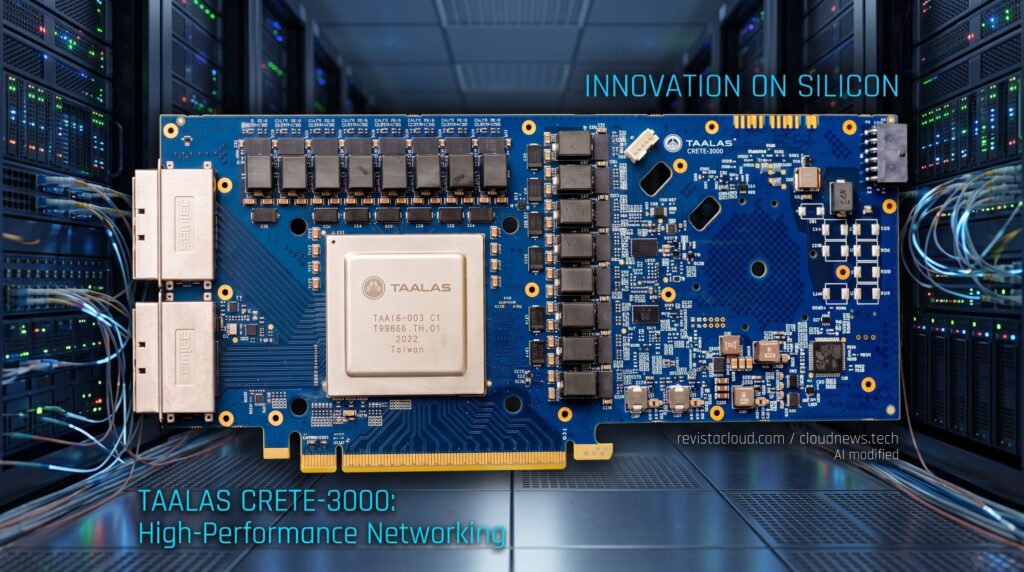
AMD has bought Taalas, a small Canadian company chasing a very different idea from today’s GPUs: baking AI model weights straight into the silicon. Its HC1 demonstrator hit roughly 16,960 tokens per second running Llama 3.1 8B, a number that’s hard to reach with conventional accelerators and that helps explain AMD’s interest.
AMD’s purchase of Taalas in 20 seconds
- AMD announced the Taalas acquisition on August 6, without disclosing financial terms.
- Its HC1 demonstrator runs Llama 3.1 8B at about 16,960 tokens per second, per Taalas.
- The company builds the model weights directly into the silicon to cut data movement.
- The trade-off is less flexibility: changing the model much means making new hardware.
- AMD plans to pair this specialized technology with its Instinct accelerators.
AMD didn’t just buy another accelerator designer. Taalas takes a different swing at one of the big cost problems in language model inference: shuttling huge amounts of data between memory and compute over and over.
The deal also hints at where AI data centers might go. Instead of running every inference phase on the same GPU, stable models could eventually run on hardware built just for them.
16,960 tokens per second on a 6-nanometer chip
Taalas showed HC1 in February 2026 as a proof of its architecture. The chip is made on a 6-nanometer TSMC process, well behind the leading-edge nodes in some of the newest AI accelerators.
The standout is elsewhere.
HC1 was built specifically to run Llama 3.1 8B, Meta’s roughly 8-billion-parameter model from 2024.
Taalas reported a top speed near 17,000 tokens per second per user. Follow-up tests on the public demo clocked around 15,000 tokens per second, more evidence that the system works in that range.
The gap with other accelerators is huge.
When Cerebras launched its inference service for Llama 3.1 8B, it reported more than 1,800 tokens per second, with later docs putting typical performance around 2,200 tokens/sec.
Taalas framed HC1 as about 8.5 times faster than Cerebras and 48 times faster than certain NVIDIA configurations in its comparison.
Keep these as vendor comparisons. Tokens per second isn’t a universal benchmark on its own: accuracy, context length, batching, latency, model, configuration, and number of users all move the result.
The interesting part is what sits behind the numbers.
The model stops traveling from memory
In a normal accelerator, compute and memory are physically separate.
Modern GPUs try to soften that with enormous amounts of HBM (High Bandwidth Memory), and NVIDIA, AMD, and others have pushed capacity and bandwidth up every generation.
But in some inference phases, especially sequential token generation, moving weights can become a main bottleneck.
Taalas cuts into that problem hard: the weights are physically embedded in the chip.
Its architecture uses a region it calls mask-ROM recall fabric. Anything that has to stay changeable, like KV caches and LoRA adaptations, uses SRAM.
Put simply, the processor no longer keeps asking external memory for the weights it needs, because much of that information is part of its physical structure.
The payoff is big for both speed and power.
The cost is flexibility.
A GPU can run Llama today, Qwen tomorrow, and something else the day after just by loading different weights.
The Taalas chip can’t.
Big changes to the model need another silicon run. Taalas says its method allows some tweaks through metal-layer adjustments, but there’s still a physical manufacturing step.
That drags a variable normally tied to software into the semiconductor cycle: the model’s lifespan.
AMD wants to combine Taalas with Instinct, not replace its GPUs
This helps explain the purchase.
AMD hasn’t said Taalas will replace Instinct. The opposite: it wants to fold the technology into its accelerator strategy and build system-level solutions alongside AMD Instinct.
That opens an interesting option: splitting the inference stages apart.
Processing the initial prompt and generating the tokens that follow have different compute profiles. Running both on the exact same hardware isn’t always the most economical choice.
Future infrastructure could use programmable accelerators like Instinct for the flexible phases and specialized chips for running the most stable parts over and over.
The infrastructure question would then move beyond:
How many GPUs does this model need?
to also ask:
Which parts of the workload should run on each type of accelerator?
You can see the same shift in other specialized inference architectures. Cerebras and Groq have shown there’s room outside conventional GPUs when low latency and high generation speed come first.
The economic risk: how long the model stays viable
There is a less technical issue that may matter more.
A server with a GPU keeps some economic flexibility. If a model goes stale, you can repurpose the accelerator.
An ASIC built around one specific model is in a different spot.
If the model leaves production before the hardware pays for itself, its reusability drops sharply.
That can even affect how you finance infrastructure. A general-purpose GPU has a secondary market and can take on many workloads. Valuing a chip whose usefulness rides on one model architecture a few years out is much harder.
That’s probably why Taalas makes the most sense first where models barely change and inference volume is enormous.
Fraud detection, classification, industrial vision, some recommendation systems, or heavily stabilized enterprise models fit that profile better than a generative service that swaps models every few weeks.
The Taalas deal raises a question well beyond 16,960 tokens per second.
For years the industry has chased ever more programmable accelerators that can run almost any model. Taalas explores the other end: giving up some flexibility to erase the costs that flexibility creates.
AMD seems to think both approaches can live together.
If that bet works, designing an AI inference platform may stop meaning picking one GPU family. The workload would spread across different accelerators based on how much compute, memory, flexibility, and speed each phase needs.
Frequently Asked Questions
What speed does the Taalas HC1 chip reach?
Taalas reports about 16,960 tokens per second running Llama 3.1 8B. That’s the manufacturer’s figure, though tests on the public demo have landed in the same range.
Why can Taalas generate tokens so fast?
Its architecture embeds the model weights directly into the silicon, cutting the data movement between external memory and compute that becomes a bottleneck in certain inference processes.
Can HC1 run any AI model?
No. HC1 is built specifically around Llama 3.1 8B. The architecture allows some changes and adapters like LoRA, but major modifications to the model need new hardware.
Will AMD replace its Instinct GPUs with Taalas chips?
That’s not the plan. AMD says it intends to integrate Taalas technology into system solutions alongside its Instinct GPUs, pointing toward more specialized inference architectures.
