
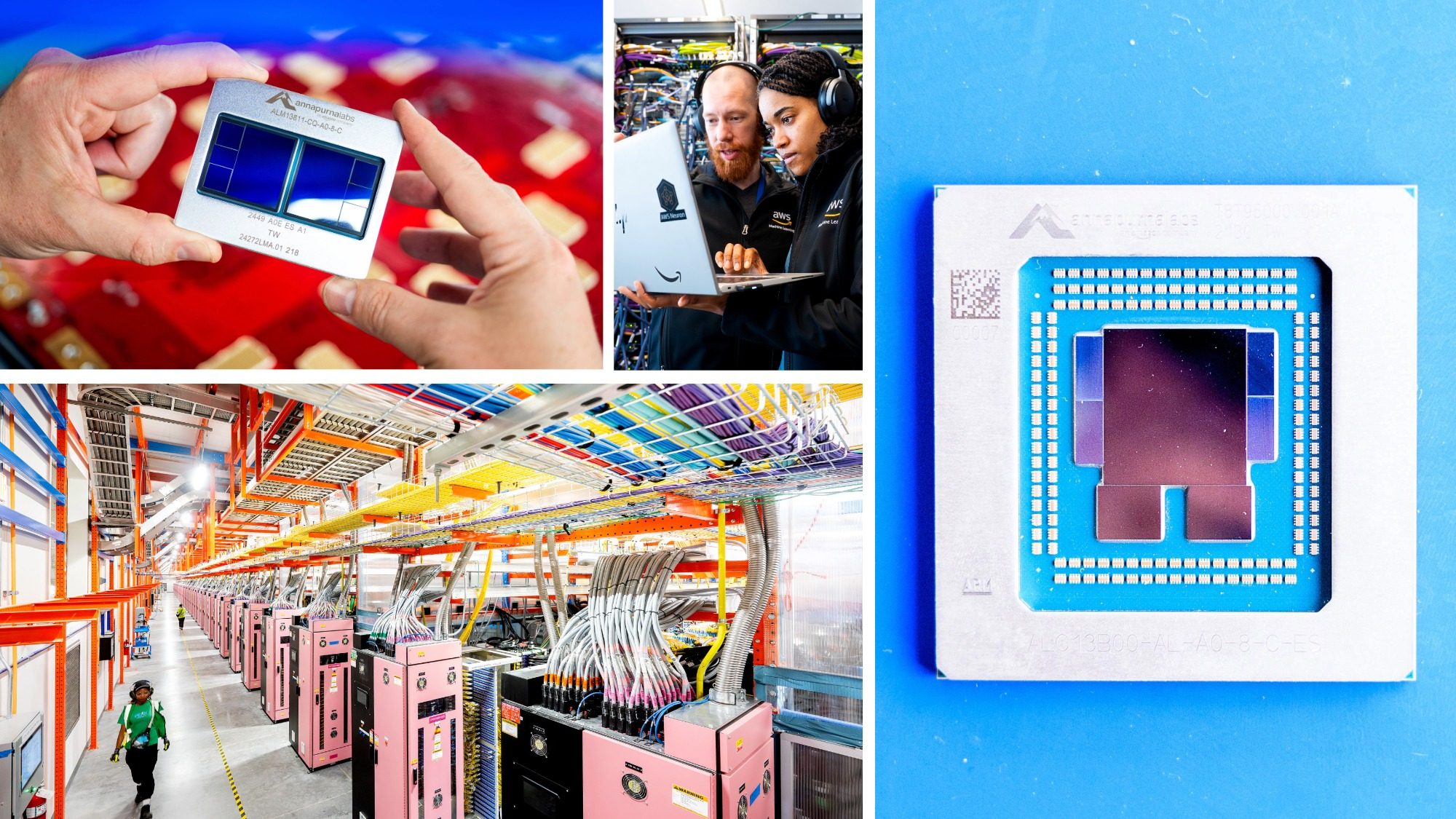
Amazon has been designing its own processors for over a decade, but it’s the rise of artificial intelligence that has turned this investment into one of the fastest-growing tech businesses within the company. AWS has revealed that its custom silicon division now surpasses an annual revenue rate of $25 billion, driven by the growth of the Trainium, Graviton, and Nitro families, which today form the backbone of much of its cloud infrastructure.
Far from competing directly with NVIDIA in the traditional accelerators market, Amazon is building a fully integrated ecosystem where it controls hardware, software, and data centers. The goal isn’t to sell chips but to offer an optimized infrastructure for AI and cloud computing.
The key points about Amazon’s chips in 30 seconds
- AWS exceeds an annual revenue rate of $25 billion thanks to its own chips.
- Trainium drives AI model training and inference, while Graviton dominates general-purpose workloads.
- 98% of the top 1,000 Amazon EC2 customers already use Graviton-based instances.
- Anthropic, OpenAI, and Meta have announced infrastructure commitments on Amazon’s platform.
- Amazon aims to control the entire technology stack, from silicon to cloud services.
This figure reflects the shift occurring in the AI infrastructure market. For years, major cloud providers depended almost exclusively on processors from Intel, AMD, or NVIDIA accelerators. Today, Amazon, Google, and Microsoft are increasingly designing their own components to cut costs, improve performance, and differentiate their platforms.
A strategy that began before the AI boom
The story started long before ChatGPT.
In 2015, Amazon acquired the Israeli company Annapurna Labs, specialized in processor design. The deal passed relatively unnoticed but marked the beginning of a strategy that has now become a competitive advantage for AWS.
The approach was simple: if Amazon knew better than anyone the workloads its cloud customers ran, it could also design processors specifically optimized for them.
Since then, it has developed three major families of chips.
| Family | Main Function |
|---|---|
| Trainium | Training and inference of AI models |
| Graviton | General processing on AWS based on Arm architecture |
| Nitro | Virtualization, storage, networking, and security for cloud infrastructure |
Instead of selling these processors as standalone products, Amazon integrates them into its own cloud services.
Trainium aims to compete where NVIDIA dominates
AI has sparked demand for specialized accelerators.
While NVIDIA maintains a dominant position with its H100, H200, or Blackwell GPUs, Amazon is developing Trainium as an alternative for customers running models directly on AWS.
The company claims that Trainium3, announced for late 2025, provides up to a 40% performance-per-dollar increase over Trainium2 and multiplies energy efficiency—an increasingly important factor as data center electricity consumption grows.
Additionally, the new Trn3 UltraServers can house up to 144 Trainium3 chips within a single system, multiplying the training capacity for large models.
Graviton has become AWS’s standard processor
Although Trainium garners much media attention, the real business volume comes from Graviton.
Amazon states that:
- 98% of its top 1,000 EC2 customers use Graviton instances;
- more than 130,000 customers run workloads on this architecture;
- over half of all new AWS compute capacity now uses its own processors.
The fifth generation, Graviton5, improves up to 25% in performance per dollar over the previous one and is especially optimized for AI agents and distributed applications.
Major AI labs are already betting on Amazon
One of the most significant data points isn’t technical but commercial.
Amazon confirmed during its earnings report that several leading AI developers have already committed infrastructure capacity based on its chips.
| Company | Announced Commitment |
|---|---|
| Anthropic | Up to 5 GW of Trainium-based infrastructure for Claude |
| OpenAI | 2 GW of Trainium capacity from 2027 |
| Meta | Scores of millions of Graviton cores for AI workloads |
| Uber | Using Graviton and testing Trainium3 |
| Trainium-based infrastructure |
These agreements show that the market is beginning to accept alternatives to traditional GPUs when cost and energy efficiency are key factors.
Amazon doesn’t want to sell chips; it wants to control all of the infrastructure
Unlike NVIDIA, whose main business is supplying hardware to third parties, Amazon’s goal is different.
It designs processors, develops servers, builds data centers, operates the cloud, and offers AI services.
This vertical integration allows for optimizing each layer of the infrastructure and reducing reliance on external suppliers.
Amazon CEO Andy Jassy recently summarized this strategy, stating the company is “particularly well positioned for the new wave of AI” thanks to having both its own AI accelerators and general-purpose processors.
The next battle won’t just be about AI models anymore
Over the past two years, the conversation has centered on GPT, Claude, Gemini, or Llama.
However, the real bottleneck remains infrastructure.
Who controls the silicon will control much of the AI economy.
Google has its TPU, Microsoft is working on Maia and Cobalt, Meta is developing MTIA, and Amazon continues to expand Trainium and Graviton while preparing new generations and projects like Project Rainier, one of the world’s largest AI computing clusters.
The competition is no longer just about building the best language model. It’s also about creating the infrastructure capable of running it at the lowest possible cost.
Comparison of leading AI chip platforms
| Company | Own chips | Main use | Business model |
|---|---|---|---|
| Amazon AWS | Trainium, Graviton, Nitro | Cloud and AI | Amazon’s own infrastructure |
| Google Cloud | TPU | AI and Gemini | Own cloud |
| Microsoft Azure | Maia, Cobalt | AI and Azure | Own cloud |
| Meta | MTIA | Inference and internal services | Internal use |
| NVIDIA | Blackwell, Hopper | General AI | Hardware and systems sales |
Frequently Asked Questions
How much does Amazon generate from its own chips?
AWS has indicated that its custom silicon business now exceeds an annual revenue of $25 billion, with triple-digit year-over-year growth.
What is the difference between Trainium and Graviton?
Trainium is designed for training and inference of AI models, whereas Graviton is used for general cloud workloads based on Arm architecture.
Does Amazon compete directly with NVIDIA?
Yes, but from a different angle. Amazon uses its chips within AWS to reduce costs and optimize the performance of its cloud services, while NVIDIA sells hardware across the entire market.
Who currently uses Trainium chips?
Among Amazon’s announced clients are Anthropic, OpenAI, Uber, Pinterest, and several startups focused on AI.
