
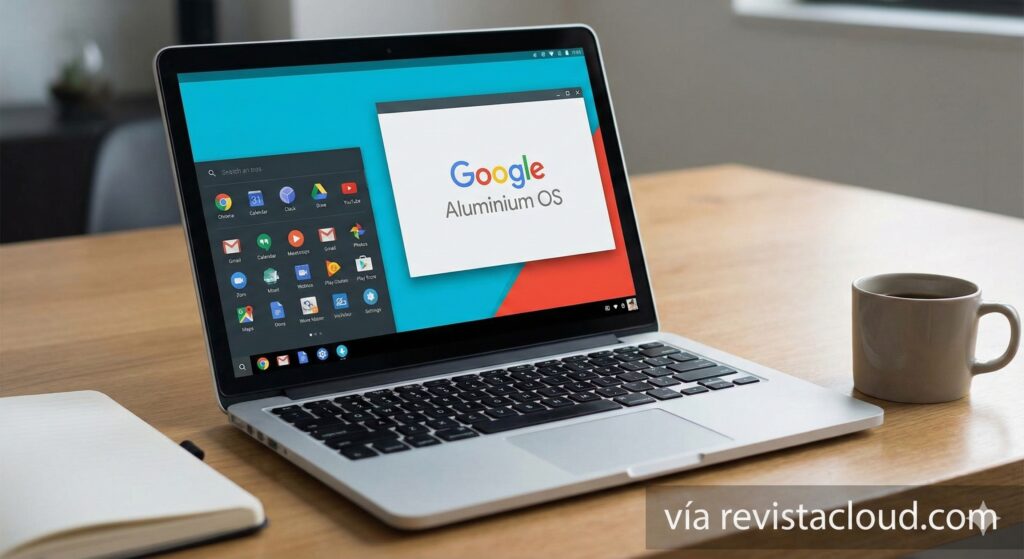
Google is preparing to make a new leap in the world of desktop operating systems. After more than a decade of betting on ChromeOS in Chromebooks, the company is now working on Aluminum/Aluminium OS, a new platform based on Android and designed to run on laptops, tablets, and desktop PCs, with Gemini artificial intelligence at its core.
Although the project has not yet been officially revealed to the public, several leaks and job postings published by Google itself have outlined the main features of this new operating system, which aims to compete directly with Windows 11 and macOS in the next generation of ARM-based computers.
From ChromeOS to Aluminum OS: the fusion of Android and the desktop
Currently, the PC operating system market is dominated by three major players: Windows, macOS, and Linux. Alongside these, Google has maintained ChromeOS for 15 years, mainly found on educational Chromebooks and entry-level laptops. ChromeOS is based on Linux and the Chrome browser, with a strong focus on cloud computing and web applications.
However, this approach has had clear limitations:
- Difficulty in attracting advanced users and professionals.
- Heavy dependence on the web versus traditional native applications.
- Limited traction in mid- and high-range devices, compared to Windows and macOS.
Aluminum OS (sometimes referred to as “Aluminium OS”) aims to break down those barriers. From known information, it is a system:
- Based on Android, not just a browser layer on Linux.
- Designed from the ground up for PCs, laptops, convertibles, and mini PCs.
- Intended to unify the ecosystem: Android apps, Google services, and features that until now were segregated between Android and ChromeOS.
Practically, Google is pursuing something similar to what Apple has built with iOS, iPadOS, and macOS: a unified environment where apps and experiences shift more seamlessly among mobile, tablet, and desktop devices.
An “AI First” operating system centered around Gemini
One of the key pillars of Aluminum OS will be the deep integration of Google’s Gemini AI family of language models. Internal documents and leaks describe it as a system “built with AI at its core”, a philosophy similar to what the company itself is pursuing with Android XR and other recent projects.
While a definitive list of features is not yet available, Gemini is expected to provide capabilities such as:
- Contextual assistants to help across the system: from writing emails to summarizing documents or generating content.
- Unified search across local files, apps, and the web, using natural language.
- Task automation: smart workflows connecting apps, services, and data without user programming.
- Enhanced offline functions, leveraging models that run locally on the device when hardware permits.
In this regard, Aluminum OS aligns with industry trends: “AI native” or “AI first” operating systems seen in both Microsoft and Apple, where artificial intelligence is no longer just an app but a pervasive layer throughout the system.
Partnering with Qualcomm and new ARM-based PCs
The other major pillar of the project focuses on hardware. Google is working hand-in-hand with Qualcomm, leveraging the new generation of Snapdragon X Elite and X2 Elite processors, aimed at laptops and PCs with ARM architecture.
These chips promise:
- Competitive performance against Intel and AMD CPUs in many scenarios.
- Integrated graphics (Adreno) capable of rivaling traditional integrated solutions, with significant energy savings.
- A strong focus on hardware-accelerated AI, ideal for Gemini’s system-wide functions.
The rationale is clear: a desktop Android environment on ARM chips enables native execution of mobile apps without complex emulation layers. If Google delivers a good desktop experience — including windows, multitasking, peripheral support, and professional applications — it could become a genuine alternative to Windows for new ARM-based PCs.
What we know so far: internal name, strategy, and timelines
Although an official launch has not been announced, several pieces of information already align:
- The name “Aluminium OS” appears in Google job listings, explicitly mentioning a new Android-based OS for laptops and tablets, with AI as a central feature.
- The same sources indicate a broad strategy that includes entry-level, mid-range, and premium devices, implying Google wants to go beyond cheap Chromebooks and compete also with MacBook Air, Surface Laptop, and other high-end laptops.
- Various tech outlets suggest a temporary coexistence of ChromeOS and Aluminum OS, with a gradual transition where some devices continue with ChromeOS while others adopt the new system.
- The timeline circulating among multiple sources projects a commercial launch sometime in 2026, coinciding with the maturity of first Snapdragon X PCs and Gemini integration across Google’s ecosystem.
The playful naming — many leaks use the British spelling “Aluminium OS” — is seen by some as a nod to Chromium (the open-source base of ChromeOS), while others see “Aluminum OS” as the possible name for the U.S. market.
Challenges for Google: from education and low-end to advanced PCs
While the idea is ambitious, the move faces notable challenges. Google enters the desktop arena where:
- Windows still dominates the majority of the PC market.
- macOS maintains a loyal base in creative and professional sectors.
- Linux holds a niche among developers and servers, gaining visibility with more user-friendly distributions.
ChromeOS has been successful mainly in education and low-cost devices, but attempts at high-end Chromebooks have not gained widespread traction. Aluminum OS aims to break the “cheap and limited” image and become a viable option in premium laptops, mini desktops, and 2-in-1 formats.
Remaining questions include:
- The level of compatibility with current Chromebooks.
- The specific app store model for desktop applications.
- How classic productivity apps and professional workflows will integrate with the established Windows and macOS ecosystems.
What Aluminum OS could mean for users and developers
If Google successfully executes its plan, Aluminum OS could have several significant implications:
- For users: more options when choosing a laptop or PC focused on AI, good battery life, and not limited to Windows or macOS.
- For manufacturers: a new pathway to release ARM-based devices leveraging Android, Play Store, and existing mobile apps but with a desktop-adapted interface.
- For developers: a unified ecosystem where a single Android base serves mobile, tablet, and desktop, reducing fragmentation and easing application adaptation for larger screens.
The key will be whether Google can persuade manufacturers, enterprises, and consumers that this project is serious — something it previously attempted with projects like Andromeda OS without success. The current differences are the maturity of PC ARM chips and the growing importance of AI as added value.
Frequently Asked Questions about Aluminum / Aluminium OS
1. Will Aluminum OS completely replace ChromeOS?
Current information suggests a coexistence for some time, with ChromeOS remaining on certain devices while Aluminum OS is introduced in new product lines. The ultimate goal, according to leaks, is a gradual transition from ChromeOS to the new Android-based platform.
2. Will it be limited to ARM processors like Snapdragon X?
The initial focus is on PCs with ARM chips, where Android can perform optimally without emulation. There’s no confirmed support for other architectures yet. The success of the system partly depends on the range of hardware Google decides to support.
3. What role will Gemini play within the OS?
Gemini will serve not merely as a chatbot but as an integrated AI layer throughout the system, aiding in search, productivity, and contextual assistance. It is expected to help organize information, automate tasks, generate content, and provide smart features online as well as locally via specialized hardware.
4. When will users be able to test Aluminum OS on their PCs?
No official date has been confirmed, but various sources suggest a launch sometime in 2026, coinciding with the arrival of new Android-based laptops and Snapdragon X PCs from Qualcomm. Until then, Google is likely to unveil more details through conferences and developer events.
via: notebookcheck