
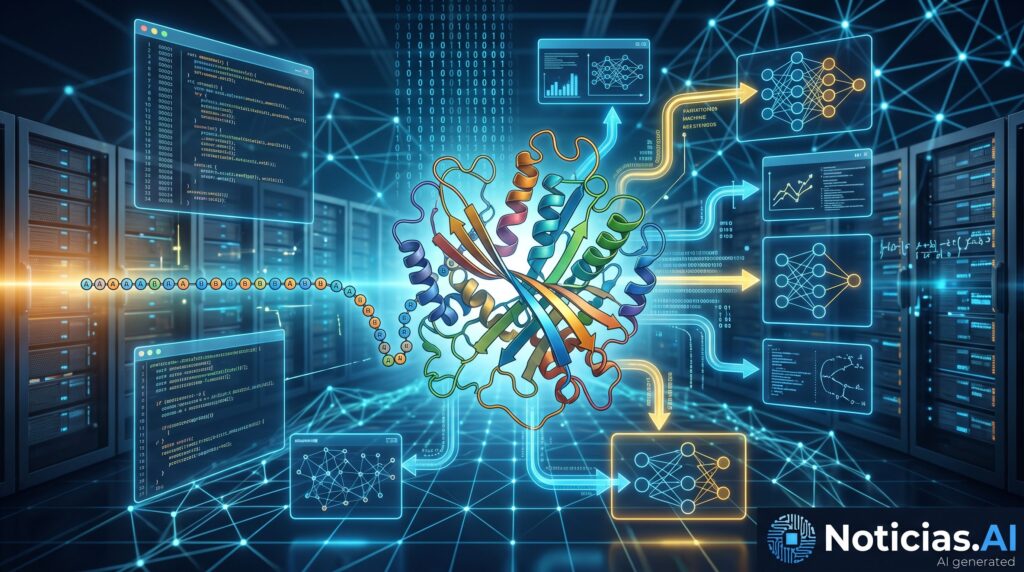
AlphaFold 1 was DeepMind’s first big success in protein structure prediction, and looking back from 2026 it’s also a particularly instructive example of how to combine deep learning, bioinformatics, statistics, and numerical optimization in one system. Before AlphaFold 2 transformed the field in 2020, the first version had already shown at CASP13 that a neural network could learn distance distributions between residues and then use them to rebuild 3D structures far more accurately than competing methods.
AlphaFold 1 in 20 seconds
- DeepMind started on protein structure in 2016 and presented AlphaFold at CASP13 in 2018.
- The first version predicts distance distributions between residue pairs from sequence and evolutionary signals.
- It then turns those probabilities into a differentiable potential and searches for compatible structures through optimization.
- At CASP13 it produced high-accuracy models in 24 of 43 free modeling domains, against 14 for the next best method.
- AlphaFold 2 later replaced much of this pipeline with a more integrated neural architecture.
For a technical reader, AlphaFold 1 has a teaching advantage over its successors: its components are fairly easy to tell apart. The system doesn’t try to learn three-dimensional geometry end to end. It first builds representations from the sequence and related proteins, then uses a neural network to estimate structural constraints, and finally feeds those constraints into an optimization step.
In some ways it’s a hybrid architecture.
From AlphaGo to CASP13: how AlphaFold started
Google DeepMind dates the project to March 2016, after AlphaGo’s win over Lee Sedol. The company put together a small team to see whether machine learning could tackle one of biology’s classic problems: predicting a protein’s 3D structure from its sequence.
Two years later came a major public demonstration.
AlphaFold entered CASP13 in 2018. CASP, Critical Assessment of protein Structure Prediction, is a blind evaluation created in 1994 where teams get sequences whose structures haven’t been published and are asked to predict them.
AlphaFold finished first.
The technical paper appeared later in Nature in January 2020, titled Improved protein structure prediction using potentials from deep learning. It describes the CASP13 system and points to a clear difference: AlphaFold got models with TM-scores ≥ 0.7 in 24 of 43 free modeling domains, versus 14 for the second-best method.
That mattered because free modeling targets are exactly the ones with no close structural template to copy or adapt.
The input is still a string of characters
From a computational view, a protein can start out looking surprisingly simple.
Each protein is an amino acid sequence. The 20 standard amino acids usually get single-letter codes:
A, C, D, E, F, G, H, I, K, L, M, N, P, Q, R, S, T, V, W, Y
A small protein might look like this:
NLYIQWLKDGGPSSGRPPPS
That’s the sequence of Trp-cage, a small peptide often used as a folding example.
The challenge is turning this one-dimensional string into a three-dimensional structure.
AlphaFold 1 doesn’t just predict XYZ coordinates for each atom. Its core idea is to first infer what distances should exist between residue pairs.
For a protein of length L, that naturally leads to an L × L matrix of relationships.
Each position (i,j) holds information about the possible geometric relationship between amino acid i and amino acid j.
MSA turns evolution into training data
A key component is the Multiple Sequence Alignment (MSA).
For a target protein, AlphaFold searches large sequence databases for evolutionarily related proteins. DeepMind used resources like Uniclust30 and other sequence collections, plus tools such as HHblits.
The core idea is elegant.
Say a particular position in a protein changes over evolution. If another position tends to change at the same time, there may be a relationship between them.
Like:
A L K G T A L K G T B L R C T B L R C T
The first and fourth positions seem to evolve together.
That can happen because the residues end up close in space. If a mutation changes the chemistry of one, a compensating mutation in the other may be needed to keep the structure stable.
Not every correlation means contact, but millions of sequences carry enough statistical signal to make these relationships useful.
AlphaFold 1 uses this coevolution data to build pairwise features. In the original paper, couplings between 20 amino acids plus a gap state produce 21 × 21 matrices, 441 values for each pair of positions.
The protein as an image with hundreds of channels
That brings a very handy analogy for machine learning engineers.
The protein can be represented as a kind of square image:
L × L × features
Each cell (i,j) encodes information about residue pair i,j, with channels holding data from the MSA, sequence profiles, and other signals.
AlphaFold 1 processes this representation with a deep residual convolutional neural network with dilated convolutions.
That makes sense if you think of the matrix as an image.
A CNN can pull together local information and, through depth and dilation, carry signals over long distances within the pair matrix.
The most important output is a distogram.
Instead of predicting a single distance, the model predicts a distribution over distance intervals for each residue pair.
Conceptually:
residue 21 ↔ residue 874-5 Å 0.045-6 Å 0.116-7 Å 0.487-8 Å 0.248-9 Å 0.08...
The network shows which geometries are much more plausible than others.
That’s far more informative than the binary contact/non-contact prediction of earlier methods. The Nature paper stresses that predicting distances gives more structural insight than contact prediction alone.
A second output helps with torsion angles
AlphaFold 1 also predicts backbone torsion angles.
The backbone bonds can’t rotate freely. Two key degrees of freedom are the φ (phi) and ψ (psi) angles.
Instead of predicting them independently, the model can learn distributions that reflect which angle combinations are chemically common or plausible.
These predictions are starting points for the next step, not the final structure.
And that points to a basic difference with AlphaFold 2.
The network doesn’t finish the job: L-BFGS steps in
After getting the distance distributions, AlphaFold 1 builds a statistical potential.
The idea is simple.
If the network predicts two residues should be about 7 Å apart, a structure that puts them at 25 Å pays a high cost.
Putting them in a high-probability zone costs less.
For each pair (i,j), you can derive a function like this:
V_{ij}(d) = -log P_{ij}(d)
where P_{ij}(d) is the predicted probability that residues i and j are separated by distance d.
Since the original distributions are discrete, AlphaFold interpolates to get continuous functions suitable for gradient-based optimization.
The contributions from many pairs are summed, along with other structural terms, into an overall potential:
minimize V(φ, ψ)
That means finding the set of angles that yields a structure with the lowest potential value.
The system uses L-BFGS, a quasi-Newton optimization algorithm built for large problems that doesn’t need a full Hessian matrix.
For machine learning practitioners, this architecture is appealing because it separates two problems:
- The network learns which geometries look probable.
- The optimizer searches for a structure that satisfies those probabilities.
Not everything is solved inside the neural network.
The potential corrects background biases
Here’s an interesting technical detail.
Residues in a protein don’t have a completely random distance distribution even without sequence information. Chain connectivity and physical constraints add biases.
AlphaFold 1 accounts for some of that by comparing the learned distribution for a specific protein against a reference distribution based on general properties like sequence length.
It’s roughly like measuring how much more likely a particular distance d is given that sequence versus what you’d expect from overall protein geometry.
This helps turn the neural predictions into a signal the optimizer can use better.
Training on 31,247 proteins
The original work used known structures from the Protein Data Bank (PDB), carefully splitting the datasets so overly similar proteins wouldn’t contaminate the evaluations.
The Nature paper details the PDB versions, CATH classifications, and sequence databases used, including the specific splits for the experiments.
This matters a lot in computational biology.
A random split can mislead, because proteins from the same family may share similar structures. The evaluation has to measure whether the model generalizes to unseen folds that are just different sequences.
CASP adds an external validation layer: predictions are made before the experimental structures become public.
AlphaFold 2 wasn’t just a bigger AlphaFold 1
After CASP13, DeepMind redesigned almost the whole system.
AlphaFold 2 entered CASP14 in 2020 and made a much bigger leap. DeepMind noted the techniques were new compared to version 1.
The architectural differences can be summed up as:
AlphaFold 1
MSA → features → residual CNN → distances + torsions → potential → numerical optimization → structure
AlphaFold 2
MSA + pairwise representation → Evoformer / attention → Structure Module → 3D coordinates → recycling
In AlphaFold 2, geometry is much more integrated inside the neural model itself.
The Evoformer passes information between sequence and pair representations, the Structure Module generates 3D structures directly, and the system can recycle its predictions to refine them.
That approach led CASP14 to declare AlphaFold had reached unprecedented accuracy, and it became the breakthrough for which Demis Hassabis and John Jumper would later receive half of the Nobel Prize in Chemistry in 2024, shared for protein structure prediction.
A quick AlphaFold timeline
The highlights:
2016. After AlphaGo, DeepMind forms a small team to explore protein structure prediction.
2018. AlphaFold takes part in CASP13 and finishes first.
2020. Nature publishes the CASP13 architecture: deep residual networks predicting distance distributions turned into potentials.
2020. AlphaFold 2 debuts at CASP14 with a redesigned, more accurate architecture.
2021. AlphaFold 2 is published in Nature, with open-source code and models released.
2021-2022. DeepMind and EMBL-EBI launch the AlphaFold Protein Structure Database, with predictions for over 200 million proteins.
2024. AlphaFold 3 expands to protein complexes, nucleic acids, ligands, and ions.
2024. Demis Hassabis and John Jumper share half of the Nobel Prize in Chemistry for protein structure prediction. David Baker receives the other half for computational protein design.
Why AlphaFold 1 is still worth studying
No one in 2026 would pick AlphaFold 1 over AlphaFold 2 or 3 for structure prediction.
Its value is elsewhere.
For a developer, it’s an almost ideal architecture for seeing how a scientific problem can be broken down with different tools.
There are biological databases, sequence searches, feature engineering, probabilistic models, deep residual CNN architectures, differentiable geometry, L-BFGS optimization, and physical knowledge baked into the objective function.
AlphaFold 1 also shows that scientific AI doesn’t have to replace all prior knowledge with one giant network.
Deep learning works here because it builds on decades of bioinformatics, turning evolution’s regularities into usable mathematical constraints.
That combination was enough to win CASP13.
Two years later, DeepMind rebuilt it almost from scratch and, with AlphaFold 2, reached the breakthrough the Nobel later described as the practical solution to a half-century-old problem.
Frequently Asked Questions
What exactly was AlphaFold 1?
It was the system DeepMind presented at CASP13 in 2018. It used deep neural networks to predict distance distributions between residues and turned those into potentials for 3D reconstruction.
Did AlphaFold 1 use Transformers?
Not the way AlphaFold 2 does. The first version leaned mainly on deep residual convolutional networks and features from multiple sequence alignments.
Why was predicting distances better than contacts?
A contact prediction only says whether residues are likely close, while a distance distribution carries richer information about geometry, which gives more precise constraints for modeling the structure.
Was AlphaFold 1 the system that won the Nobel?
No. The 2024 Nobel in Chemistry honored Demis Hassabis and John Jumper for protein structure prediction, with particular emphasis on AlphaFold 2’s contributions in 2020. AlphaFold 1 was the precursor that won CASP13 and set the stage.
Source: Noticias Inteligencia Artificial
