
In autonomous driving, the real challenge isn’t just cruising on the highway in good weather. It’s everything that occurs rarely, but when it does, it changes everything: a lane disappears due to poorly marked construction, a stopped vehicle forces an unexpected maneuver, a pedestrian appears behind an obstacle, or a combination of rain, reflections, and worn road markings. The industry summarizes this with a familiar term: the long tail, the “long tail” of rare and complex scenarios that continue to complicate the leap toward robust Level 4 deployments.
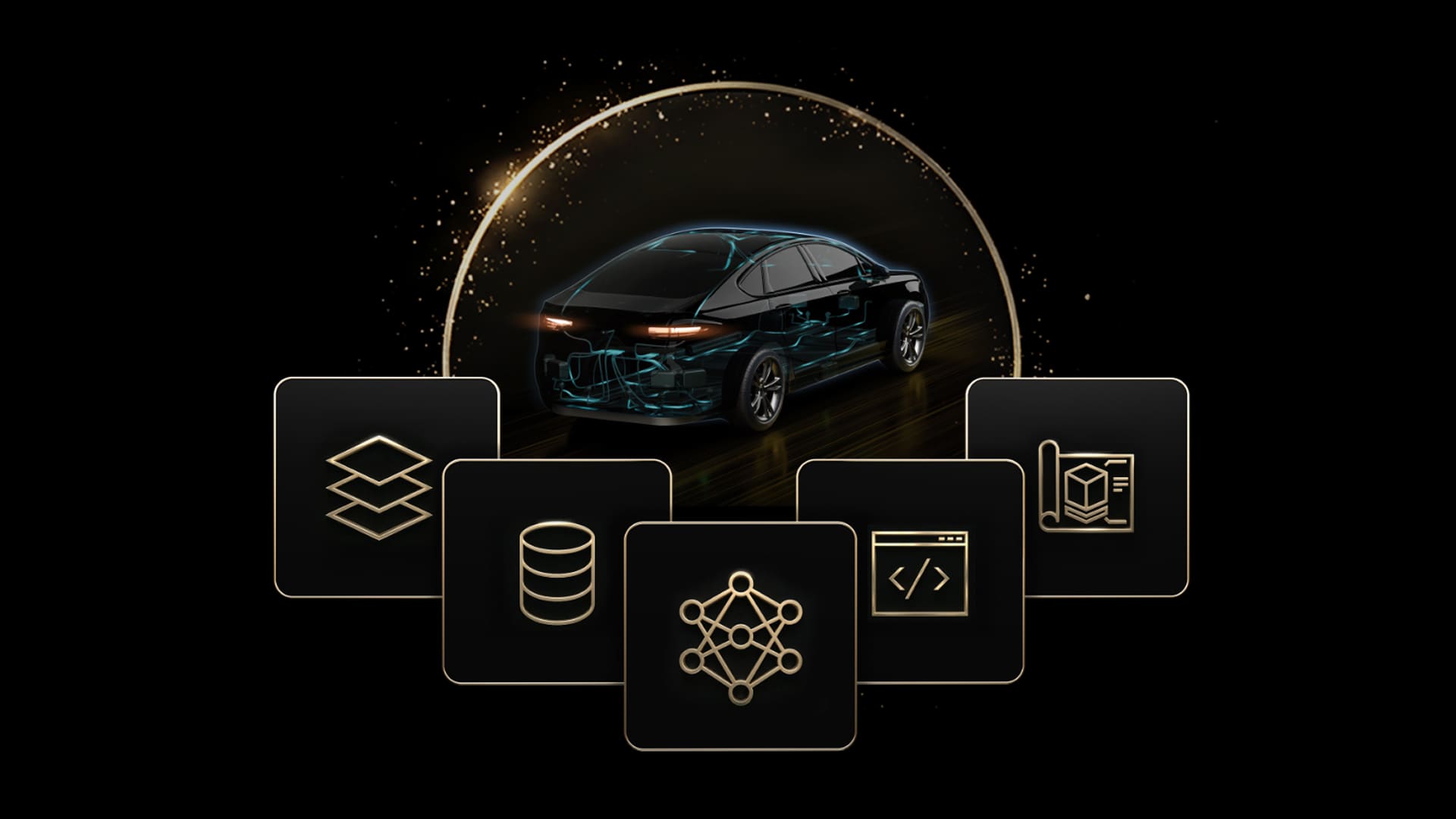
At CES, NVIDIA has decided to tackle this gray zone with an approach that blends openness and pragmatism: Alpamayo, a suite of models, tools, and datasets designed to accelerate the development of systems that not only perceive but also reason explicitly about what happens on the road. The announcement isn’t a “new autopilot,” but a proposal for a technical infrastructure that enables manufacturers, integrators, and labs to better train and validate behaviors in edge cases.
From perception to reasoning: why VLA with chain-of-thought matters
Alpamayo is based on the concept of VLA (Vision-Language-Action): models that combine video/images, semantic representations, and action outputs (trajectories, decisions). The key difference here is step-by-step reasoning (chain-of-thought), geared toward decision-making in rarely seen conditions.
Practically, this addresses a long-standing sector challenge: many traditional stacks separate perception from planning. While this separation works well in “normal” scenarios, it can become fragile when rare cases emerge that don’t fit into the learned catalog of situations. Explicit reasoning aims to reduce that fragility: if the system can “explain” its decision (even as an internal trace during training), it becomes easier to debug, evaluate, and improve.
Alpamayo 1: an open model to teach smaller models
The core component is Alpamayo 1, described as a 10 billion parameter model that uses video input to generate trajectories along with reasoning traces. Most importantly, NVIDIA positions it as a teacher model. That is, its role isn’t necessarily to run directly inside the vehicle but to serve as a “teacher” for:
- Refining models with proprietary data (fleets, test benches, local scenarios).
- Distilling capabilities into smaller, more efficient runtime models.
- Building auxiliary tools: reasoning-based evaluators, auto-labeling systems, and policy validation tools.
This nuance is crucial for understanding the approach: in autonomy, having “a big model” isn’t enough. What’s needed is a repeatable workflow that transforms high-level knowledge into operational, auditable, and maintainable components.
AlpaSim: open simulation for large-scale closed-loop testing
The second pillar is AlpaSim, an open source simulation framework aimed at high-fidelity testing with sensors, configurable traffic dynamics, and closed-loop validation (closed-loop). In autonomy, simulation isn’t just a fancy demo—it’s the most efficient way to:
- Multiply variations of the same incident.
- Measure regressions after each model or rule change.
- Force extreme conditions (lighting, weather, sensor noise) without physical risks.
- Train policies with shorter iteration cycles.
With AlpaSim, NVIDIA pushes towards an ecosystem where training and validation are no longer solely dependent on real roads but gain a reproducible “laboratory.”
Datasets: 1,700+ hours focused on challenging scenarios
The third pillar is the Physical AI Open Datasets, an open set comprising more than 1,700 hours of driving data across multiple geographies and conditions, including rare and complex cases. Practically, this dataset approach targets two goals:
- Increasing real diversity (not just volume).
- Providing specific material to train and evaluate behavior in situations that tend to break systems.
There’s also a strategic layer: if the model, simulation, and data are all open, it becomes easier for universities and small teams to contribute improvements that can later be integrated into the broader ecosystem, fostering distributed innovation.
Openness… with an industrial focus: a message to OEMs and platforms
NVIDIA accompanies Alpamayo with a message strongly oriented toward industrial adoption: describing a “ChatGPT moment” for physical AI, and positioning robotaxis as one of the first beneficiaries. Additionally, this announcement is integrated into NVIDIA’s broader stack: tools and models from Cosmos and Omniverse, integration with DRIVE Hyperion, hardware like DRIVE AGX Thor, and a security framework called Halos, designed to reinforce confidence and scalability in advanced deployments.
From a narrative perspective, it’s notable that the sector has long recognized that “more data and more networks” don’t guarantee linear jumps in the long tail. Alpamayo aims to ensure progress depends less on simply adding miles and more on learning better the reasons why when the real world deviates from the script.
Frequently Asked Questions
What does it mean that Alpamayo is a “teacher model”?
It’s designed to teach: used for fine-tuning, evaluating, and distilling capabilities into smaller models that can operate with appropriate latency, power, and cost in a production system.
Why is closed-loop simulation so critical in autonomy?
Because it allows repeating and varying an incident thousands of times, measuring how the system’s decisions change when the environment responds. It’s the most efficient way to validate robustness without relying solely on real roads.
What does reasoning (chain-of-thought) bring to autonomous driving?
It provides traceability during training and evaluation: helping to understand why a policy makes certain decisions in rare cases, thus speeding up debugging, validation, and improvement.
Will this accelerate Level 4 deployment “tomorrow”?
Not a magic shortcut. It’s an effort to speed up the development cycle: better tools, better testing, and better “teachers” to help runtime systems generalize better in rare scenarios—where the leap to mass deployment often stalls today.
Sources: Nvidia Alpamayo and Noticias inteligencia artificial