
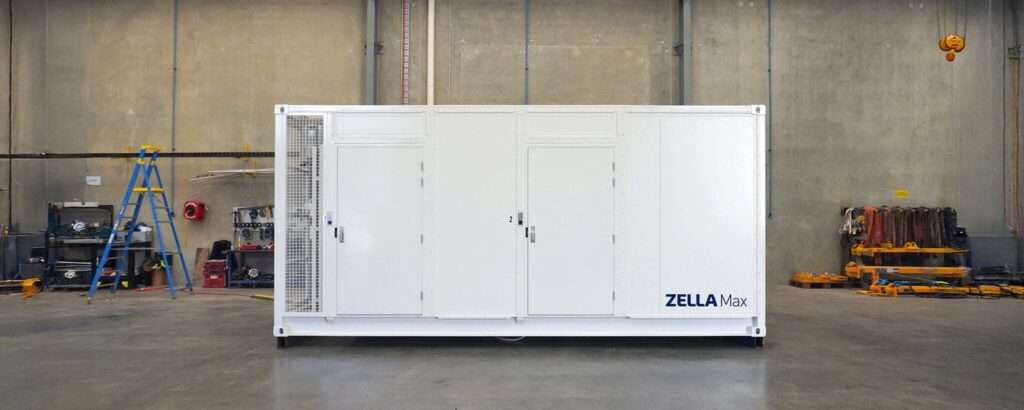
Alibaba Cloud claims to have reduced the time required to deploy large AI data centers by up to 100 days using CUBE 5.0, their prefabricated modular architecture. The company also states that this model can lower construction costs by around 10% compared to traditional methods and expects to more than double its module production efficiency this year as it races to expand capacity for AI.
The key points of Alibaba’s CUBE 5.0 in 30 seconds
- Alibaba Cloud targets 100 days for deploying large AI data centers with CUBE 5.0.
- The company attributes roughly a 10% reduction in construction costs to the modular model.
- Modularization increased from 30% to 90% in five major systems.
- It has been tested in facilities in Inner Mongolia and Ningxia.
- Alibaba affirms that the architecture is certified for deployment in Europe and Southeast Asia.
Alibaba’s comparison is based on typical timelines of six to twelve months in China and twelve to eighteen months in the United States for conventional developments. These are reference points from publicly shared information and do not imply that all traditional data centers require exactly those amounts of time.
The core of CUBE 5.0 is minimizing the sequential work on-site. Instead of installing electrical, cooling, security, management, and fire protection systems one after another, many of these components are manufactured in parallel at industrial facilities and then transported to the final site for assembly.
From traditional buildings to modular data centers
Conventional data center construction involves coordinating numerous interconnected phases.
First, the building and infrastructure are prepared. Then electrical, cooling, security, wiring, power distribution, fire protection systems, and much of the technological equipment are installed.
The modular model aims to change this sequence.
CUBE 5.0 splits the infrastructure into prefabricated units conceptually similar to large industrial blocks. While the site is being prepared, different components can be manufactured simultaneously in a factory, tested, and then transported to the data center for assembly.
The main advantage is time savings.
According to China Securities Journal, Alibaba Cloud has managed to reduce the delivery cycle of large-scale AI data centers to about 100 days using this architecture.
The company also states that total construction costs can be reduced by around 10%.
This percentage is Alibaba’s estimate based on its deployment model. The actual cost of a data center depends on variables such as location, land prices, available electrical capacity, cooling needs, rack density, network equipment, and redundancy requirements.
CUBE 5.0 achieves up to 90% modularization
Alibaba introduced CUBE 5.0 in 2024 as an evolution of its previous designs.
The new generation has increased the modularization level from 30% to 90% across five key systems: power supply, cooling, security, intelligent management, and fire protection.
This leap is significant because modularization now affects a substantial part of the physical infrastructure necessary for operation, beyond small auxiliary components.
In such a design, electrical modules, cooling systems, and other components can be built in controlled industrial environments before arriving on-site.
It also allows for design standardization.
Instead of developing each installation from scratch, the provider can standardize certain modules and use similar configurations across multiple locations.
This approach aligns data center construction more closely with principles of industrial manufacturing: producing repeatable units, testing pre-transport, and reducing on-site integration.
Alibaba Cloud expects to more than double its production efficiency in 2026, measured by the volume of modular centers it can deliver within the same period.
AI is transforming data center construction
Speed now holds greater value than in previous years.
A conventional enterprise data center might be planned with gradual demand growth in mind. AI, however, has created much more concentrated needs.
New GPU clusters can include thousands or tens of thousands of accelerators and consume tens or hundreds of megawatts. Plus, the rapid pace of new hardware generations appears.
A company taking two years to establish infrastructure may find itself with an outdated technological and commercial landscape when deployment finally completes.
This is why different operators are attempting to industrialize data center construction.
Prefabrication is not exclusive to Alibaba. Google has worked with modular data center concepts for years, and Microsoft and Meta also use different prefabricated systems to accelerate their cloud and AI platform expansions.
The scale demanded by AI is the key difference.
For hyperscalers, saving several months per new installation means earlier capacity to rent GPUs, train models, or meet client demand.
Inner Mongolia and Ningxia serve as initial testbeds
Alibaba has already used CUBE 5.0 in projects in Ulanqab, Inner Mongolia, and Zhongwei, Ningxia Autonomous Region, according to published information.
Both regions are distant from China’s major coastal hubs and are part of efforts to develop digital infrastructure in areas where conditions are more suitable for deploying large energy and computation facilities.
China has been promoting the shift of processing loads westward for several years through projects leveraging different energy, space, and climate advantages compared to cities like Beijing, Shanghai, or Shenzhen.
Alibaba also statesthat CUBE 5.0 has obtained certification for deployment in Europe and Southeast Asia.
The company hasn’t specified which European facilities will specifically use CUBE 5.0 architectures, so it’s not guaranteed that its new international centers will adopt exactly the same design.
Alibaba commits 380 billion yuan to AI and cloud
This effort is part of a much larger investment.
In 2025, Alibaba announced it will allocate at least 380 billion yuan, approximately $56.3 billion, over three years toward AI and cloud infrastructure.
This amount exceeds the total expenditure on such technologies over the previous decade, according to the company at the time.
Much of that funding will go toward expanding data center, server, and cloud service capacities necessary for running AI models.
Alibaba Cloud is also expanding internationally, recently opening its first data centers in France as part of a strategy to boost its global infrastructure.
Modular construction could be particularly helpful here if it allows design reuse and reduces regional customization work.
However, replicating a data center isn’t just about transporting modules.
Each market has different requirements for electrical supply, regulations, fire safety, construction standards, telecom connections, and sustainability. Thus, regional certification and design adaptation remain crucial, even when much of the infrastructure is prefabricated.
The bottleneck is no longer just GPUs
In the early days of AI boom, the main challenge to scaling was acquiring enough GPUs.
While that bottleneck persists, the situation is broader now.
Having accelerators available is useless without a data center capable of providing power, cooling, connectivity, and storage.
The rise of ultra-high-density racks also pressures traditional cooling systems. Modern AI platforms increasingly use liquid cooling and require electrical infrastructure capable of supporting much heavier loads per rack.
Therefore, the time to build and prepare the building has become another competitive factor.
CUBE 5.0 addresses this issue by manufacturing large parts of the data center as industrial products and assembling on-site later.
If the 100-day goal can be maintained in large-scale projects across different regions, the time savings could surpass even the 10% cost reduction.
For Alibaba, earlier capacity means deploying more GPUs sooner and delivering AI services faster. For the entire industry, this evolution indicates a broader shift: the AI race isn’t only about chips but also about who can build the surrounding infrastructure faster.
FAQs
What is Alibaba Cloud’s CUBE 5.0?
CUBE 5.0 is a modular architecture for data centers that prefabricates much of the electrical, cooling, security, management, and fire protection systems before transporting and assembling them at the final site.
How long does Alibaba take to build a data center with CUBE 5.0?
Alibaba Cloud claims to have reduced the delivery cycle of certain large-scale AI data centers to about 100 days using this architecture.
How much can modular construction save?
The company estimates approximately a 10% reduction in construction costs compared to traditional methods. Actual savings depend on each project’s specifics, location, and infrastructure needs.
Will Alibaba use CUBE 5.0 outside China?
Alibaba states that the architecture is certified for deployment in Europe and Southeast Asia. It has already been tested in Ulanqab and Zhongwei facilities in China.
via: scmp
