
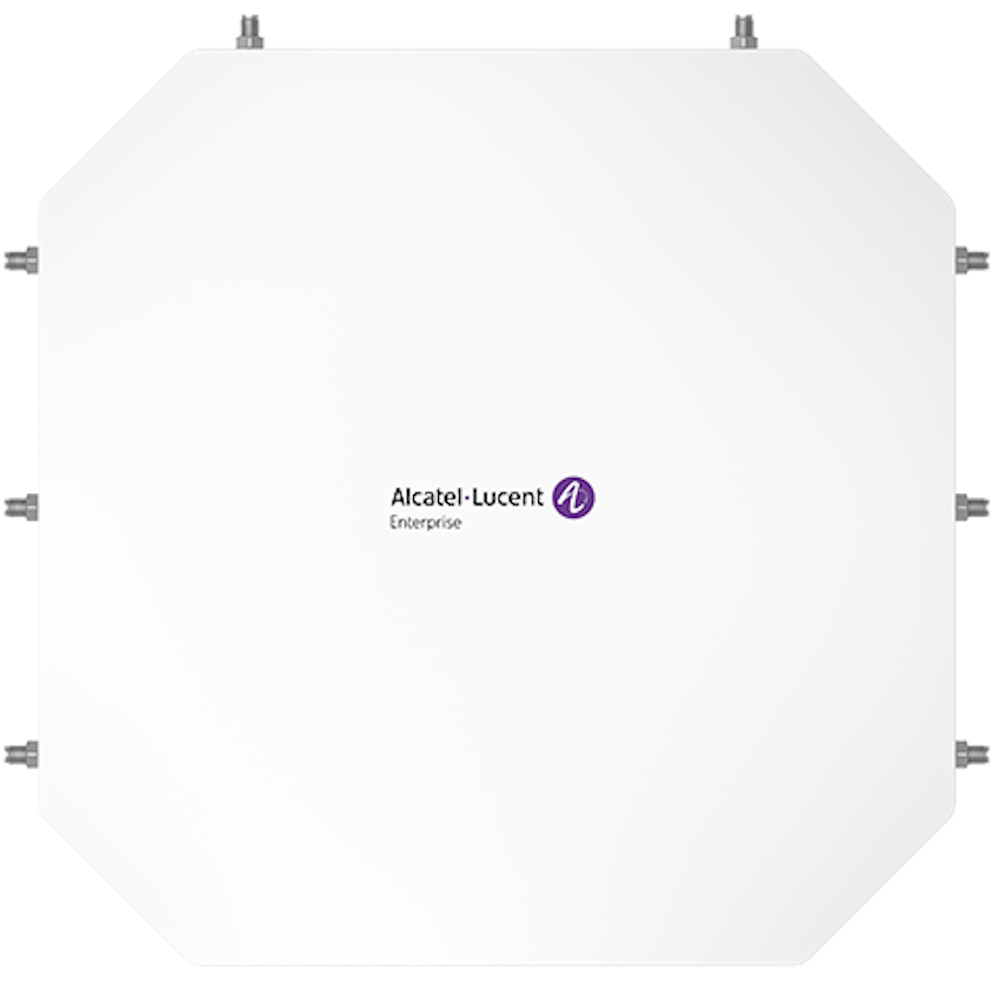
Alcatel-Lucent Enterprise has expanded its OmniAccess Stellar family with the launch of the AP1540, a new series of indoor Wi-Fi 7 access points designed for enterprises with high user density, demanding applications, and the need for more stable wireless networks. This announcement positions the company in an increasingly competitive field: enterprise Wi-Fi networks suitable for modern offices, campuses, hotels, hospitals, educational facilities, industrial spaces, and environments with numerous connected devices.
The new series comes in two variants. The AP1541 features built-in omnidirectional antennas, while the AP1542 offers eight connectors for external antennas, catering to more complex radio frequency scenarios or deployments requiring a more customized coverage design. The difference is significant: in enterprise networks, the choice of antennas can impact service quality just as much as the wireless standard used.
Wi-Fi 7 Comes to the High-End Enterprise Range
The AP1540 supports Wi-Fi 7, also known as IEEE 802.11be, a standard designed to increase capacity, reduce latency, and improve efficiency in high-demand environments. Its most notable improvements include wider channels, 4K-QAM modulation, and Multi-Link Operation, technology that enables multiple links to be used in a coordinated manner to enhance performance and reliability.
In practice, Wi-Fi 7 shouldn’t be viewed solely as offering higher maximum speeds. Its value in a business context lies in how it better manages congestion, reduces response times, and helps maintain a more stable experience when many users, IoT devices, cloud applications, video conferencing, immersive collaboration, or connected industrial systems are involved.
The AP1540 features a multi-radio architecture, intelligent radio frequency management, support for Multi-Link Operation, and dual 10-gigabit uplinks. This last point is crucial because a leap in wireless capacity must be complemented by a robust wired connection to prevent bottlenecks. A very fast access point can become a bottleneck if its uplink doesn’t keep pace.
| Feature | AP1541 | AP1542 | Technical note |
|---|---|---|---|
| Wireless standard | Wi-Fi 7 / 802.11be | Wi-Fi 7 / 802.11be | Targeted at next-generation networks with increased capacity and lower latency |
| Primary use | Enterprise indoor environments | Complex enterprise indoor environments | Offices, campuses, hospitality, education, healthcare, or high-density spaces |
| Antenna type | Built-in omnidirectional antennas | Eight connectors for external antennas | AP1542 allows for more customized RF designs |
| Architecture | Multi-radio | Multi-radio | Enhances simultaneous traffic and band management |
| Multi-Link Operation | Yes | Yes | Uses coordinated links to improve performance and reliability |
| Uplinks | Dual 10 GbE | Dual 10 GbE | Reduces risk of wired bottlenecks |
| Security | WPA3 and MACsec | WPA3 and MACsec | Strengthens protection for wireless access and network links |
| Management | OmniVista Network Management | OmniVista Network Management | Unified management for on-premises or cloud deployments |
Distributed Control and Unified Management
One of the key points highlighted by Alcatel-Lucent Enterprise in this series is its distributed control architecture. This approach avoids reliance on a traditional centralized controller, potentially reducing complexity and total cost of ownership in certain deployments. It doesn’t mean that the network stops being centrally managed; rather, the operation of wireless services can be distributed among the access points themselves.
Management leverages OmniVista Network Management, a unified platform with analytical capabilities that allows administrators to manage OmniAccess Stellar access points and OmniSwitch switches. The ability to deploy this management system either locally or in the cloud aligns with common enterprise needs: maintaining flexibility based on security, compliance, data sovereignty, or operational model requirements.
The launch also enhances the company’s Wi-Fi 7 portfolio. The AP1540 series complements previously introduced models such as the AP1501, AP1511, AP1521 for indoor use, and the AP1561 and AP1570 for outdoor environments. Through this, Alcatel-Lucent Enterprise aims to cover everything from more economical deployments to high-density networks demanding maximum capacity and reliability.
This comprehensive portfolio approach matters because many organizations don’t deploy a homogeneous network. A headquarters may need premium access points in high-occupancy zones, mid-range models for standard offices, and specialized equipment for outdoor or industrial areas. Ensuring management coherence across all devices is often as important as their individual capabilities.
More Bandwidth, but Also More Planning
Wi-Fi 7 arrives at a time when wireless networks have transitioned from a convenience to a critical infrastructure. Laptops, corporate smartphones, sensors, cameras, location systems, point-of-sale terminals, medical devices, industrial equipment, and cloud applications increasingly depend on stable connectivity. In many buildings, user experience is no longer just about having Wi-Fi but about whether the network can handle video calls, collaborative work, roaming, high density, and security policies without degradation.
The technical improvements of Wi-Fi 7 don’t eliminate the need for careful planning. Wider channels, new bands, more radios, and MLO can boost performance but also require spectrum planning, proper cabling, appropriate switching, sufficient PoE, network segmentation, security measures, and observability. In complex environments, the access point is only one part of a broader architecture.
The device ecosystem also plays a role. To realize the full benefits of Wi-Fi 7, client devices must support the new standard. For years, Wi-Fi 5, Wi-Fi 6, Wi-Fi 6E, and Wi-Fi 7 clients will coexist, so the actual benefits will depend on the refresh cycle of laptops, smartphones, tablets, IoT devices, and specialized hardware.
Security remains central. The AP1540 supports WPA3 and MACsec, two important enterprise technologies. WPA3 enhances wireless access security compared to previous generations, while MACsec provides encryption over Ethernet links—adding an extra layer of protection within the network infrastructure.
The announcement also comes amidst cost pressures, especially due to rising prices of memory and components. Alcatel-Lucent Enterprise asserts that it will maintain its Wi-Fi OmniAccess Stellar access point prices unchanged—a message intended to convey stability to customers and partners in a market where many network upgrades are planned over several years.
From a technological perspective, it’s clear: Wi-Fi 7 is no longer just a promise for home use or early adopters. It’s entering the enterprise network with proposals focusing on capacity, low latency, security, and advanced management. The AP1540 embodies this transition towards a more demanding WLAN, where wireless performance must be complemented by switching, security, automation, and smarter operations.
Frequently Asked Questions
What is the Alcatel-Lucent OmniAccess Stellar AP1540?
It is a new series of indoor Wi-Fi 7 access points designed for high-density enterprise environments needing greater capacity, lower latency, and more stable wireless connectivity.
What are the differences between the AP1541 and the AP1542?
The AP1541 includes built-in omnidirectional antennas. The AP1542 features eight connectors for external antennas, allowing for better customization of coverage in complex or specific RF scenarios.
What advantages does Wi-Fi 7 offer over previous generations?
Wi-Fi 7 introduces enhancements such as Multi-Link Operation, wider channels, and more advanced modulation. Its goal is to increase capacity, reduce latency, and improve performance in networks with many users and devices.
Which types of organizations benefit most from the AP1540?
Organizations with high user density, intensive cloud applications, video conferencing, IoT deployment, internal mobility, critical networks, or environments where wireless connectivity is integral to daily operations will find it particularly valuable.
