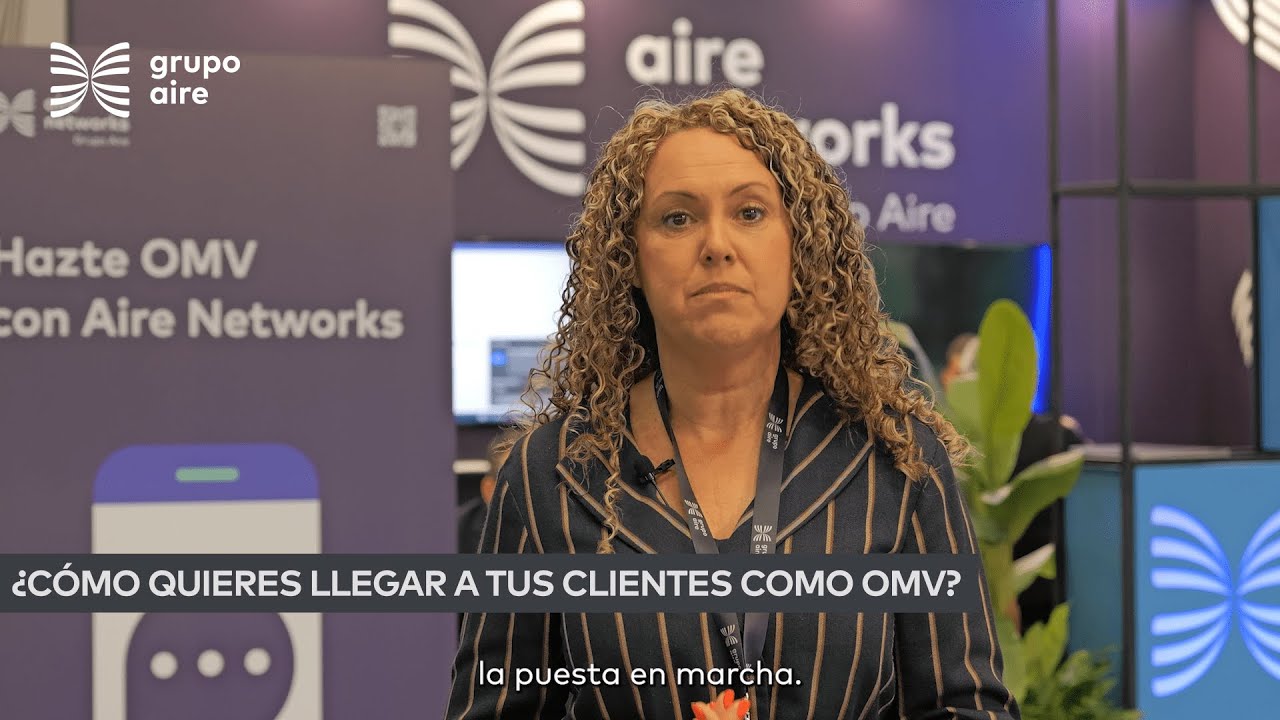
Becoming a mobile operator no longer requires, at least on paper, the level of investment, infrastructure, and technical complexity that traditionally closed the door to almost any company outside the telecom sector. This is the thesis that AIRE, formerly Grupo Aire, is trying to introduce to the market with its OMV Enabler proposal—a model designed to make it easier for companies from other sectors to launch their own mobile service in Spain within approximately three months.
The idea isn’t entirely new, but it gains significance now as many companies seek to strengthen customer relationships, diversify revenue streams, and create bundled offerings around connectivity, energy, digital services, insurance, or retail. In this context, mobile telephony is no longer viewed solely as a business for traditional operators but also as a commercial lever for loyalty and customer control.
According to AIRE’s plan this year, the model rests on a turnkey solution that enables a company to operate as a service provider MVNO, without needing to deploy its own infrastructure or start with a dedicated mobile network team. The approach is that the enabler handles the technical, regulatory, and operational complexity, while the new brand focuses on product development, marketing, customer service, and growth strategy.
From Own Infrastructure to Operator as a Service
For years, the main obstacle in creating a mobile operator wasn’t just the network investment but also the combination of technical and administrative barriers: core network, numbering, IMSIs, porting, interconnection, support, regulatory compliance, and many others. This reality hasn’t disappeared but can now be outsourced.
This is where the OMV Enabler concept comes in. In AIRE’s case, the company states that it provides third parties with a pre-built environment based on its infrastructure, featuring a secure, redundant network across multiple data centers, along with the necessary processes to manage porting, number allocation, line management platforms, and ongoing support services. The key message is clear: reduce entry costs and dramatically shorten the time-to-market.
Reducing this time to market is one of the model’s main strengths. AIRE argues that, with proper legal and technical support, a company can go from idea to launch in about three months. Naturally, the specific timeframe depends on the project, the level of customization, and how quickly the client makes decisions, but the core idea is that the mobile market no longer has to be considered a domain reserved for telco companies.
The Real Advantage: Commercial Control and Customer Ownership
Beyond the technological aspects, the true appeal of becoming an MVNO lies in business control. A brand launching its own mobile service doesn’t just add another line to its portfolio; it gains the ability to design tariffs, promotions, bundles, and ancillary services aligned with its strategy. Most importantly, it changes the nature of its contractual relationship with the customer.
This detail is crucial. Compared to simpler resale or distribution models, an MVNO allows the legal and commercial relationship with the end-user to be directly linked to the brand itself. For companies aiming to increase the value of their customer base, this can be far more attractive than acting solely as a sales channel for a third party. In sectors where recurrence and loyalty are strategic, owning a SIM card becomes a powerful tool for retention that surpasses limited promotional offers.
Thus, it’s understandable that AIRE targets verticals like utilities, retail, or tech firms seeking to complete their service ecosystem. An energy company might use mobile connectivity to strengthen engagement; a retailer could leverage cross-benefits; a digital services provider could enhance recurrence and daily presence. The key isn’t just selling connectivity but integrating it into a broader value proposition.
What Does It Take to Launch an MVNO in Spain?
While the model is presented as “democratized,” regulatory requirements still apply. In Spain, providing electronic communications services necessitates registering with the CNMC and the Register of Operators. Additionally, depending on the service, there are requirements associated with numbering, portability, and technical relationships with other market players.
The CNMC’s publicly available documentation acknowledges entities like the service provider MVNO, with sub-allocated mobile numbers, and recognizes other levels within the mobile ecosystem. The role of the AOPM, the Association of Operators for Mobile Number Portability, is also important, as its membership and procedures are essential parts of the process for managing numeric portability in Spain.
This is precisely where an enabler can make a difference—not by eliminating regulation but by packaging much of the technical and documentary process that often intimidates companies considering market entry. AIRE claims to have its own legal and processing department to streamline this part, accelerating the overall process. In a sector where administrative delays can negate commercial advantages, this support is just as crucial as the infrastructure itself.
A Genuine Opportunity but Not for Everyone
The proposal makes sense, but it’s important not to see it as a magic bullet. Launching an MVNO still requires a clear strategy, strong commercial capabilities, good customer service, and a differentiated offering. Access to infrastructure and support alone doesn’t guarantee a market—or a profitable project.
Another reality is that the Spanish telecom market is mature, highly competitive, and operating with thin margins in many segments. This means any new entrant needs a compelling reason for existence. The model is better suited for companies that already have an established customer base, a recognizable brand, and the ability to bundle services, rather than for impromptu projects focused solely on selling lines without differentiation.
Nevertheless, AIRE’s initiative is notable because it aligns with a broader trend: convergence among telecommunications, cloud, managed services, and sector-specific vertical solutions. If a company already offers enterprise connectivity, cybersecurity, UCaaS, cloud, and wholesale services, turning its mobile layer into a platform for third parties makes practical sense, especially as the market increasingly demands greater commercial sovereignty and control over customer relationships.
Ultimately, the OMV Enabler does not completely overhaul market rules but significantly lowers entry barriers for companies that, until recently, might not have considered becoming a mobile operator. The main question now is less about whether it’s technically feasible and more about which businesses will find enough business rationale to pursue it successfully.
Frequently Asked Questions
What is an OMV Enabler, and what is it used for?
It is a provider that supplies the infrastructure, technical layer, and part of the regulatory support necessary for another company to launch its own virtual mobile operator without building the entire platform from scratch.
How long can it take a company to launch an MVNO in Spain using this model?
According to AIRE, it can be around three months for a turnkey solution, though the actual timeline depends on the project specifics, level of customization, and processing speed.
Is own infrastructure required to be an MVNO in Spain?
Not always. In models like the service provider MVNO, a company can rely on an enabler that provides network, platforms, and operational processes, even as it meets regulatory and commercial requirements.
Which types of companies benefit most from launching their own MVNO?
Particularly those with an existing customer base seeking to enhance loyalty, recurrence, and commercial control, such as utilities, retail chains, tech firms, or brands with broad service ecosystems.