
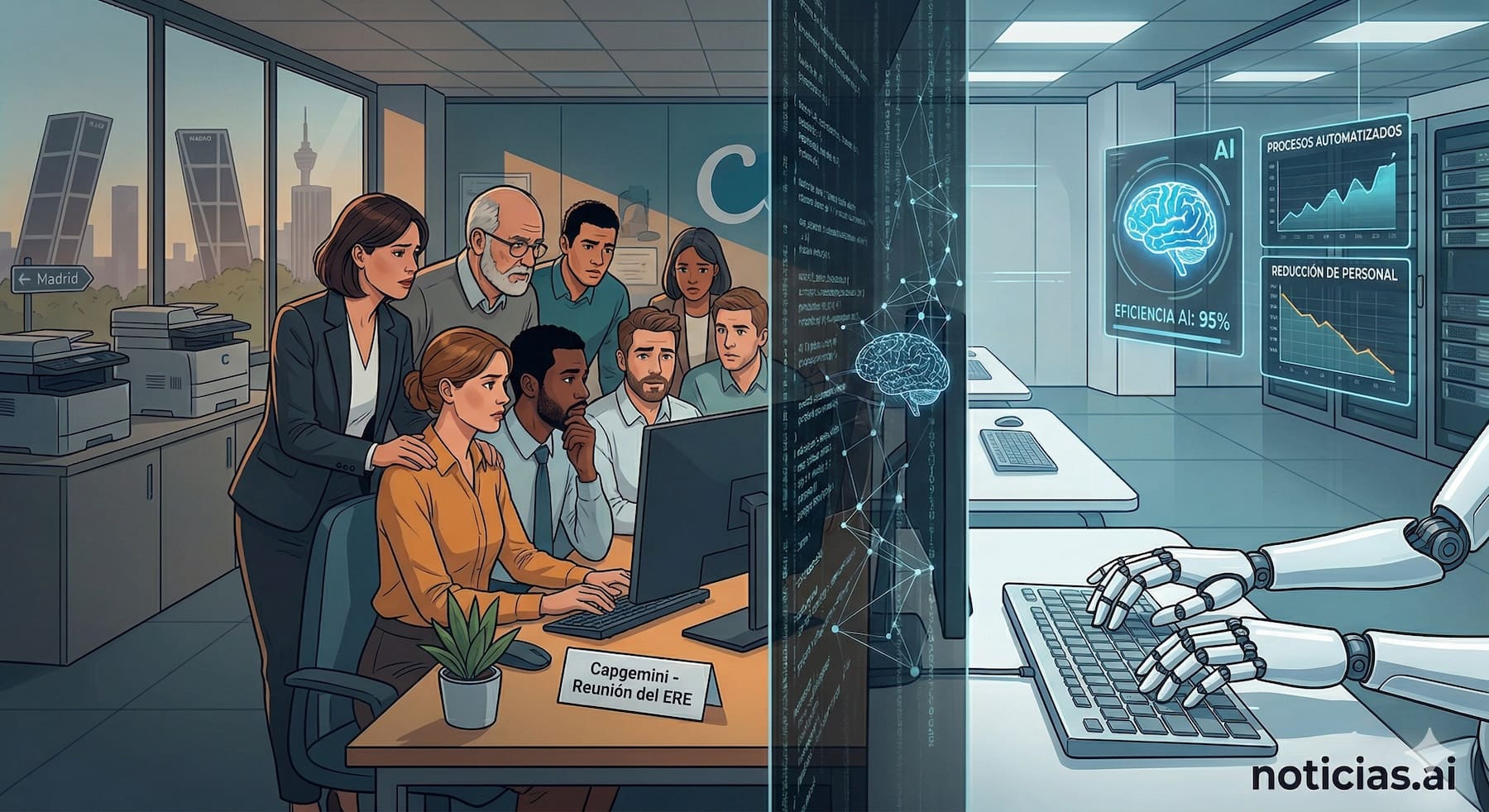
The decision by Capgemini to initiate a collective layoff in Spain has brought attention to a shift that has been hinted at in the industry for months, but which is now becoming more visible: Artificial Intelligence is no longer just used to sell new projects to clients, but is also being employed to justify internal reorganizations within large tech consulting firms.
The company has notified its labor representatives of its intention to start a layoff process in its Spanish subsidiary and has scheduled the first formal meeting for April 23. At this point, it has not disclosed how many employees might be affected. However, it is known how extensive its presence in the country is: more than 11,000 employees and operations in 14 cities. The announcement comes at a particularly sensitive moment, because it does not coincide with a typical corporate crisis, but rather with a period during which the group remains profitable and continues to emphasize growth driven by AI.
A reorganization with benefits and AI in the background
Capgemini finished 2025 with revenues of €22.465 billion, a net profit attributable of €1.601 billion, and an operating margin of 13.3%. These figures do not conform to the traditional image of a company forced to cut back due to a sudden decline in business. Instead, they reflect a different logic: that of a multinational seeking to cut costs, redesign capabilities, and adapt to a new market phase.
This nuance is important. Technology consulting has been growing for years alongside digital transformation, cloud computing, cybersecurity, and software development. But the advent of generative AI and, more recently, AI agents has begun to change the distribution of work. Repetitive tasks, intermediate functions, and parts of documentation, support, analysis, or basic programming are now more automatable than just two years ago. This does not mean immediate and total replacement, but it does alter how large firms plan their future structure.
In Capgemini’s case, moreover, the adjustment in Spain does not appear to be an isolated episode. In January 2026, the group announced in France a plan to cut up to 2,400 jobs—approximately 6% of its workforce in that country—in a context of decreased demand in sectors like automotive. That process involved voluntary departures and internal reskilling. The move in Spain is thus better interpreted as part of a broader reorganization within the group rather than a local anomaly.
It also coincides with a leadership change in Spain. Laurent Perea took over as CEO of Capgemini Spain on February 1, replacing Luis Abad, with a profile strongly linked to innovation, technological transformation, and advanced services. The fact that just a few weeks later an ERE is announced suggests that the new phase in the Spanish market is not only about commercial growth but also about accelerating internal transformation.
Not just Capgemini: AI already moves billions in the sector
The case gains relevance because it does not occur in a declining sector. Quite the opposite. Major consulting firms have been presenting AI as one of their main drivers of business for months. For example, Accenture finished their fiscal year 2025 with $69.670 billion in revenue and announced $5.900 billion in new hiring related to generative AI over the year, in addition to $2.700 billion in related project revenues. IBM, for its part, stated early 2026 that its AI-related business volume had already surpassed $12.5 billion.
This contrast helps explain why Capgemini’s news goes beyond a single company. The issue isn’t whether AI is generating business — it clearly is — but what is happening internally within organizations selling that transformation. If the largest consultancies are winning AI contracts but are also reducing staff or reordering roles, the message is clear: growth will not necessarily translate into the same types of jobs or the same labor structure as before.
This raises a fundamental tension. For years, technology consulting has been one of the major sources of skilled employment, including in Spain. Thousands of engineers, analysts, developers, and functional profiles have found pathways to entry or professional consolidation through these firms. But the new wave of automation is coming from within the sector itself. That is, the very companies selling efficiency through AI to clients are starting to apply it internally.
Fewer repetitive tasks, more pressure on the middle profile
The impact will not be uniform. AI will not eliminate entire professions overnight, but it can reduce the need for certain lower-value jobs or intermediate roles that were previously more time- and person-intensive. In practice, this may mean less support, basic testing, technical documentation, routine maintenance, or repetitive analysis roles, and increased demand for profiles capable of designing architecture, integrating automation, governing models, ensuring quality, supervising risks, and transforming complex processes.
International organizations have been warning about this shift for some time. The International Labour Organization noted in 2025 that one in four jobs worldwide is exposed to generative AI to some degree, although its most common impact will be task transformation rather than immediate job elimination. The World Economic Forum estimates that between now and 2030, there will be a significant simultaneous destruction and creation of jobs, with 92 million displaced positions and 170 million new ones worldwide. The key is not just how many jobs are lost, but which skills become less valuable and which become more essential.
In this scenario, technology consulting functions almost like a forward-looking lab. If firms with greater financial strength, more international clients, and higher investment capacity are already adjusting their structures for AI, it’s likely that the debate will extend to the rest of the sector. Not only in Spain, and not just among French or American multinationals, but also among service providers, integrators, and companies that relied on labor-intensive models.
That is why Capgemini’s layoff process matters even before its exact scope is known. Key data points—number affected, involved areas, selection criteria, and final conditions—are still missing. But the underlying message is clear: in 2026, AI is not only the promise of growth for consulting firms, but also becoming a direct argument for streamlining structures, defending margins, and redefining the types of workers needed in the next phase of business.
Frequently Asked Questions
How many employees could be affected by Capgemini’s layoff in Spain?
No official number has been announced yet. The company has announced the process and scheduled its first formal meeting with labor representatives for April 23.
Is Capgemini in an economic crisis?
Not in the traditional sense. The group closed 2025 with €22.465 billion in revenue, €1.601 billion in net attributable profit, and a 13.3% operating margin. This adjustment aligns more with a strategy of reorganizing and improving efficiency rather than facing losses.
Is AI causing layoffs in tech consulting firms?
AI alone does not account for all adjustments, but it is influencing sector-wide reorganization. It automates tasks, shifts client demands, and pushes firms to review roles, costs, and capabilities.
What roles might gain importance in consulting due to AI?
Profiles related to automation, architecture, AI integration, data governance, model supervision, cybersecurity, quality assurance, process redesign, and high-value services.
