
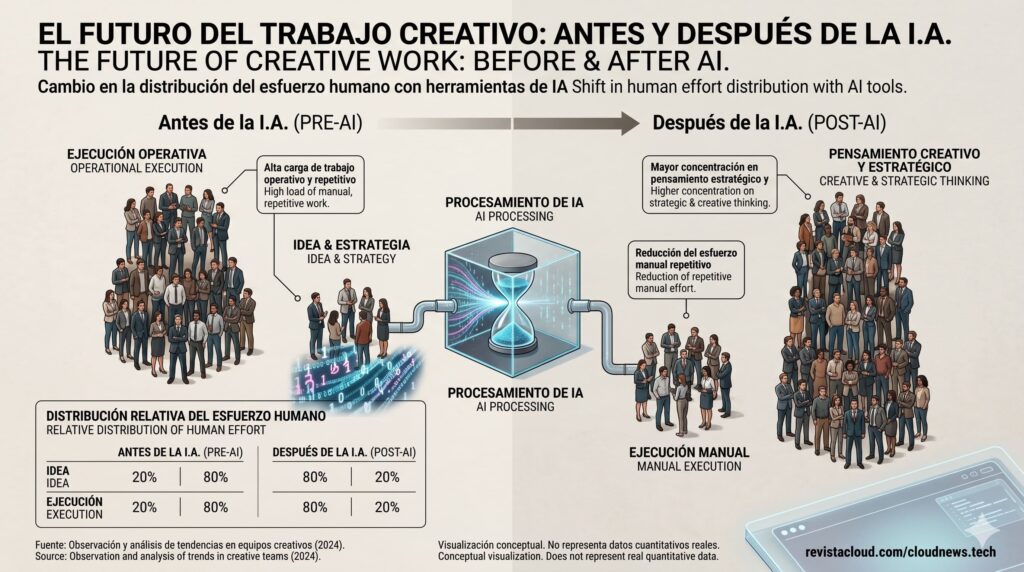
Generative Artificial Intelligence is not just changing the speed at which work is done. It is shifting the center of gravity of human effort. In creative, analytical, or knowledge-based tasks, a significant portion of the time traditionally spent on executing, drafting, searching, organizing, repeating formats, or producing versions is beginning to shrink. What gains prominence is another phase of work: better thinking about what needs to be achieved, based on what criteria, for whom, and at what level of quality.
The image of “before” and “after” AI works well as a conceptual visualization. Previously, much effort was concentrated on execution. Now, execution is not disappearing, but it is being reduced, accelerated, or transformed into supervision. Human value shifts toward the idea—understood not as spontaneous inspiration, but as strategic guidance, editorial judgment, problem formulation, critical evaluation, and responsibility for the final outcome.
Several studies help quantify this intuition. Shakked Noy and Whitney Zhang published an experiment in Science involving 453 university professionals performing writing tasks. Participants using ChatGPT took on average 40% less time and achieved results with 18% higher quality, according to independent evaluators. The tool did not replace the professional but clearly reduced the time needed to convert a task into a deliverable.
Execution is compressed, but not eliminated
Noy and Zhang’s study illustrates part of the change: when a tool can generate drafts, reorganize text, summarize information, or suggest versions, the cost of producing an initial output decreases. This does not mean the output is perfect. It means the starting point improves and arrives faster. The professional no longer begins from a blank page, but works on a base that can be corrected, refined, or discarded.
A similar pattern appears in the study by Erik Brynjolfsson, Danielle Li, and Lindsey R. Raymond on the use of an AI assistant for customer service. Based on over 5,000 agents, the research found productivity increases of about 14%. The effect was particularly strong among less experienced or less skilled workers, suggesting that AI can recognize good execution patterns and redistribute them within an organization.
This data is important because it helps understand why generative AI has such a significant impact on operational tasks. Often, work is not about inventing from scratch but about applying best practices: responding clearly, following procedures, preparing documents, adapting messages, consulting backgrounds, or transforming information into a useful format. AI accelerates precisely those repetitive layers.
| Study or report | Main finding |
|---|---|
| Noy and Zhang, Science | ChatGPT reduced average time by 40% and increased quality by 18% in professional writing tasks |
| Brynjolfsson, Li, and Raymond | An AI assistant increased productivity around 14% in customer service |
| McKinsey | Generative AI and other technologies could automate activities occupying between 60% and 70% of employee time |
| BCG and academic team | In creative product innovation tasks, consultants using GPT-4 performed 40% better than the non-AI group |
McKinsey broadens the scope of this phenomenon. Their analysis on the economic potential of generative AI estimates that this technology can automate activities that today take up between 60% and 70% of employees’ time. They do not refer to entire jobs but to specific activities within those jobs. This distinction matters. Work is not broken down into neat blocks of “automatable” vs. “human,” but into mixed tasks: some repetitive, others ambiguous, some context-dependent, and others clearly strategic.
The idea gains weight: criteria, context, and direction
If execution accelerates, the thinking phase becomes even more critical. AI can produce more, but that necessitates better decisions about what is worth producing. In an environment where creating texts, images, presentations, code, or preliminary analyses costs less, the risk is no longer just missing deadlines. It’s also producing too much, too similar, or insufficiently relevant output.
This concept aligns with the study by BCG and researchers from Harvard, Wharton, MIT, and Warwick. In creative product innovation tasks, nearly 90% of consultants improved their results using GPT-4, achieving a 40% higher performance than the group working without AI. The tool helped generate ideas, structure proposals, and expand possibilities. But the same work revealed an important limit: outside the “competence boundary” where AI performs well, results can worsen.
This “irregular frontier” concept is key. Generative AI can be very good at some tasks and convincingly fail at others. It can help write, synthesize, or offer alternatives, but it can also oversimplify, invent, homogenize solutions, or reduce diversity of thought if all teams use the same tools in the same way.
Therefore, human value is not diminished but changes. Professionals need to formulate better questions, detect errors, provide context, interpret nuances, safeguard originality, and decide when AI output is useful and when it isn’t. The work shifts from “doing everything manually” to managing, evaluating, and improving an assisted output.
| Before AI | After AI |
| More time spent drafting, versioning, and repeating formats | More time spent defining, selecting, and correcting |
| Starting from a blank page was standard | The automatic draft becomes a working material |
| Execution accounted for most effort | Supervision and judgment take center stage |
| Productivity heavily relied on individual experience | Good practices can be distributed more quickly |
| The bottleneck was production | The bottleneck shifts to deciding what to produce and with what quality |
More productivity doesn’t always mean better work
A superficial interpretation might think that AI allows doing more with fewer people. That may happen in some processes. But in creative, analytical, and knowledge work, the deeper change lies in redistributing effort. Less time on mechanical tasks doesn’t automatically translate into better results. Work only improves if the freed-up time is spent on better thinking.
The risk is using AI to fill your organization with mediocre drafts, unnecessary reports, undifferentiated campaigns, or code that no one reviews thoroughly. Apparent productivity can rise while actual quality declines. Many companies are already seeing this: more content, more deliverables, more automation, but also more review needs.
Generative AI necessitates developing a new discipline of work. It’s not enough to know how to ask tools for outputs. You must know how to build processes where AI plays a clear role, measure whether it truly improves results, and preserve spaces for human thinking untouched by the first automatic response.
In creative teams, this means reserving time for problem definition, exploring approaches, editorial review, and decision-making. In software development, it involves not confusing code generation with architecture, security, or maintenance. In customer service, it means balancing efficiency with empathy and judgment. In marketing or sales, it requires distinguishing between producing more messages and better connecting with an audience.
The phrase “AI shifts effort from execution to idea” encapsulates the trend well but should be read carefully. The idea isn’t just about creativity; it encompasses strategy, context, selection, responsibility, and standards. Execution doesn’t disappear; it transforms into system management, output review, and continuous improvement.
Human work remains essential. It becomes more visible at points where technology still cannot assume responsibility: deciding which problem to solve, verifying information, choosing appropriate tone, aligning outputs with brand standards, assessing risks, and determining when results are of sufficient quality to reach the world.
If the first phase of generative AI was learning to produce faster, the next will be learning to think better alongside machines. That will be the difference between teams that only automate tasks and teams that truly improve how they work.
FAQs
What does generative AI change in creative work?
It reduces the effort spent on execution tasks like drafting, summarizing, versioning, or preparing drafts, and increases the importance of conceptualization, criteria, and review.
Does AI always improve productivity?
Not always. Studies show clear improvements in certain tasks but also warn that outside the AI’s competence boundary, results can worsen or diversity of thought may decrease.
What does it mean that execution is compressed?
It means tasks that previously required considerable human time can be accelerated with AI. Professionals are still needed to guide, validate, correct, and decide on what results are useful.
Why does the idea phase become more important?
Because if producing becomes easier, the value shifts to knowing what, why, for whom, and according to what quality standards to produce.
via: science.org
