
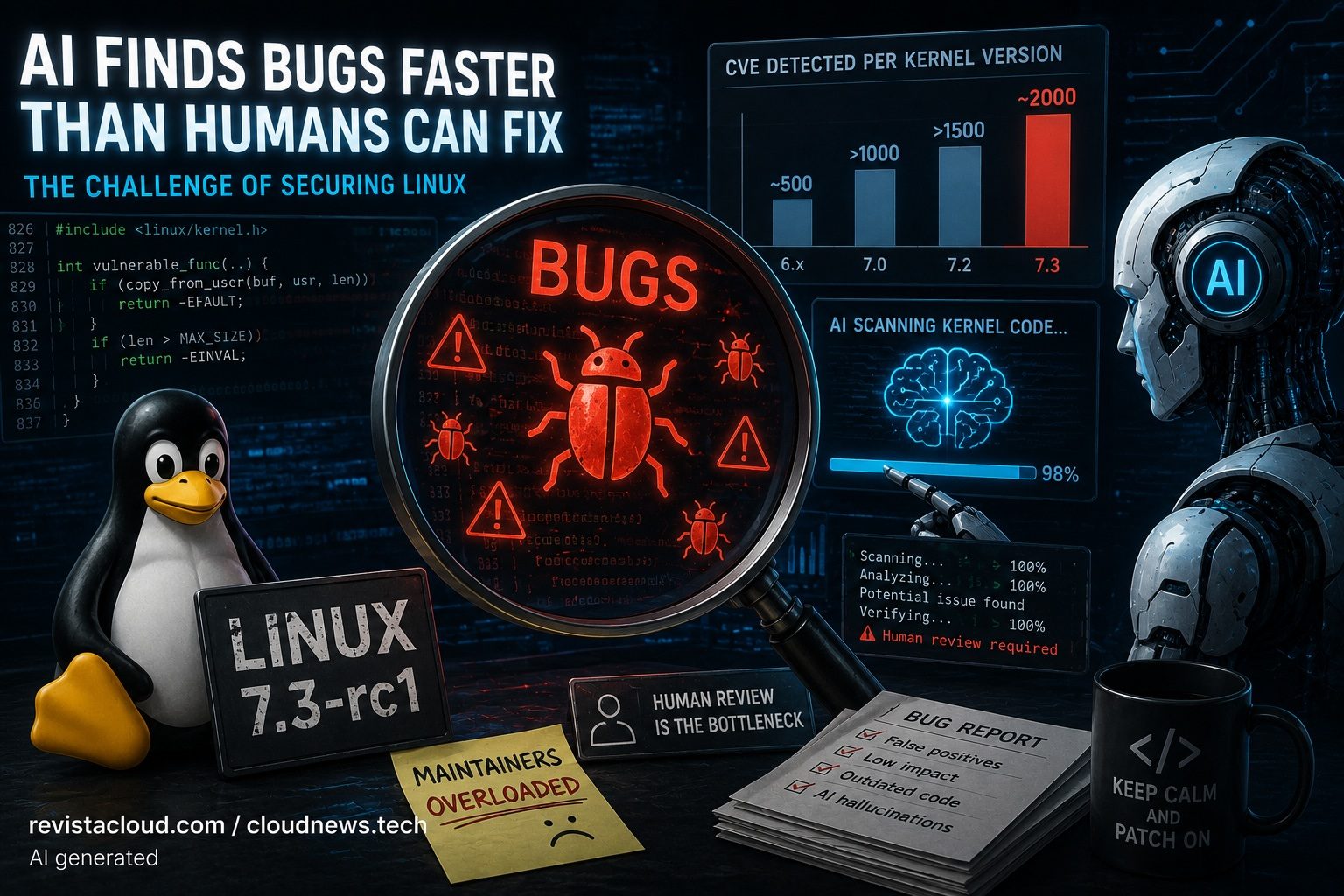
Artificial intelligence is changing vulnerability research across operating systems, but Linux is providing one of the clearest examples of the problem that follows: AI can now find suspicious code faster than maintainers can investigate it. The rising volume is not unique to the Linux kernel. Microsoft is using AI to uncover Windows vulnerabilities, FreeBSD has formally embraced AI-assisted security research, and similar techniques are being applied across open-source and proprietary software. What differs is how each project receives, validates and publishes those findings.
The key facts about AI-powered OS bug hunting in 30 seconds
- Linux is seeing a sharp rise in CVEs and AI-assisted patches, creating additional pressure on maintainers.
- Microsoft says an agentic security system found 16 Windows vulnerabilities, including four Critical remote-code-execution flaws.
- AI researchers have confirmed dozens of vulnerabilities in FreeBSD and produced working privilege-escalation proofs of concept.
- OpenBSD has also yielded old kernel bugs to AI-assisted analysis.
- Public evidence for AI-discovered macOS kernel flaws is less clear, making direct CVE comparisons with Linux misleading.
The important point is not that Linux has suddenly become dramatically less secure. Linux kernel documentation itself warns that AI-assisted analysis can uncover real problems while simultaneously producing low-value findings, incorrect security claims and non-working reproducers.
That distinction matters because vulnerability discovery is undergoing an economic change. Searching millions of lines of code used to consume large amounts of skilled human time. An AI agent can now repeat that work continuously and investigate obscure components that might otherwise go years without detailed scrutiny.
The expensive part is increasingly what happens afterwards.
Linux shows what happens when bug discovery becomes cheap
Linux provides an unusually visible view of the phenomenon because kernel development takes place in public.
Across much of the Linux 6.x generation, the number of CVEs fixed per release was around 500. Recent releases have moved substantially higher, with Linux 7.2 passing 1.500 and Linux 7.3 potentially approaching or exceeding 2.000 if the recent trend continues.
Those numbers need careful interpretation.
The Linux kernel’s approach to CVE assignment is relatively broad, and a higher number of recorded vulnerabilities does not map directly to a proportional increase in exploitable security problems.
AI adds another variable.
Large language models and automated analysis tools can inspect old drivers, unusual error paths, little-used filesystems and interfaces that rarely receive the same human attention as networking, memory management or actively developed hardware support.
They can find genuine defects there.
They can also produce plausible explanations for vulnerabilities that do not actually exist.
Linux therefore requires AI-assisted findings to be validated rather than simply forwarded to maintainers. The project’s security documentation asks researchers to reproduce problems on recent kernels and discourages speculative impact claims. A working reproducer and tested patch can dramatically increase the usefulness of a report.
The networking subsystem demonstrates the scale of the challenge.
During the Linux 7.3 development cycle, maintainers Jakub Kicinski and Paolo Abeni dealt with 632 patches for net and another 648 for net-next. Kicinski estimated that between one-third and one-half of the latter appeared to involve lower-priority fixes, cleanups or clarifications associated with AI-assisted work.
Even a correct patch requires human attention.
Someone still has to determine whether the bug matters, whether the proposed change is technically sound, whether it can introduce a regression and whether modifying an old subsystem is preferable to eventually removing it.
Linux is therefore exposing a broader software-engineering problem: AI scales the production of potential work much faster than it scales trusted human review.
Windows and FreeBSD show that this is much bigger than Linux
The same shift is already visible elsewhere, although the numbers cannot be compared directly because operating systems use different disclosure, development and CVE processes.
Microsoft publicly acknowledged this change in July, saying that advances in AI are making it possible to find more vulnerabilities, faster and across more code. The company is adapting its Windows vulnerability-management process around earlier discovery, faster engineering work and stronger validation.
There are already concrete results.
Microsoft disclosed in May that its multi-model agentic security system, codenamed MDASH, helped researchers discover 16 previously unknown vulnerabilities across Windows networking and authentication components.
Four were classified as Critical remote-code-execution vulnerabilities. The findings included problems affecting the Windows kernel TCP/IP stack and the IKEv2 service.
FreeBSD provides an even more interesting comparison with Linux because both projects expose large quantities of operating-system source code.
The FreeBSD Project now asks vulnerability reporters to explicitly state whether automated tools or AI systems were involved in discovering an issue, and which tools or models were used. Reports should also contain affected versions where possible and preferably a minimal proof of concept.
AI-assisted research against FreeBSD has already produced substantial results.
OpenAI’s Patch the Planet initiative reported that researchers confirmed 34 FreeBSD vulnerabilities and produced seven local privilege-escalation proof-of-concept exploits during a broader security campaign. The same initiative reported an AI-discovered use-after-free vulnerability in OpenBSD’s System V semaphore implementation that had apparently survived for 23 years and could allow a local unprivileged user to gain root privileges.
FreeBSD has gone further by creating an AI-assisted vulnerability discovery effort aimed specifically at reducing exploitable flaws in its source code.
The contrast with Linux is revealing.
Both projects can benefit when AI discovers obscure bugs. Both also need experienced humans to determine whether a machine-generated finding is meaningful and whether the proposed remediation belongs in the operating system.
The bottleneck moves from discovery toward triage, validation and maintenance.
| Operating system | Public evidence of AI-assisted vulnerability research | What it shows |
|---|---|---|
| Linux | Rapid growth in AI-assisted findings and patches | Maintainer review capacity is becoming a bottleneck |
| Windows | Microsoft says MDASH helped find 16 vulnerabilities, including four Critical RCE flaws | AI is being integrated into vendor security engineering |
| FreeBSD | 34 vulnerabilities confirmed in one broader AI-assisted campaign, with 7 LPE PoCs | Open-source kernels can be systematically searched at scale |
| OpenBSD | AI-assisted research uncovered a 23-year-old kernel use-after-free | Old, mature code can still contain overlooked flaws |
| macOS | Apple publishes many kernel CVEs, but comparable public attribution to AI discovery is limited | CVE totals should not be presented as equivalent AI-discovery metrics |
This final distinction is particularly important for macOS.
Apple’s security updates continue to fix conventional kernel vulnerabilities including use-after-free errors, memory corruption, information leaks, race conditions and out-of-bounds writes. For example, macOS Tahoe 26.6 included multiple kernel security fixes.
But Apple’s public advisory does not establish that those vulnerabilities were discovered by AI.
It would therefore be misleading to take the number of macOS CVEs, place it beside Linux’s figures and conclude that AI finds more or fewer vulnerabilities in one operating system than another.
The visibility of the development process is completely different.
Linux patches, discussions and subsystem pull requests are overwhelmingly public. Windows and macOS development happens primarily inside Microsoft and Apple. FreeBSD and OpenBSD are open source but have different project sizes, disclosure policies and CVE practices.
The available numbers measure different things.
The real problem is moving from finding bugs to proving them
The most important development may therefore be neither Linux reaching thousands of CVEs nor Microsoft finding 16 Windows vulnerabilities with an agentic system.
It is the emergence of machine-scale vulnerability research.
Anthropic provides an indication of where this could lead. The company says that since February 2026 it has used an early Claude Mythos system to search open-source projects for vulnerabilities, with external security researchers validating findings before disclosure.
By August 26, Anthropic reported 2.300 disclosed vulnerabilities across 392 open-source projects, of which 421 were known to have been patched. The ledger included 177 CVE records and 285 GitHub Security Advisories, although not every finding receives either identifier.
That scale fundamentally changes the security workflow.
The old constraint was often finding the bug.
The new constraint may increasingly be establishing whether the finding is real, constructing a reproducer, understanding exploitability, producing a safe patch, testing for regressions and convincing the appropriate maintainer to merge it.
AI security tools are consequently starting to focus on validation as much as discovery.
OpenAI describes the same problem in its work on AI-assisted open-source security: maintainers are being asked to sort through more reports without necessarily receiving more time or resources. Its Patch the Planet project therefore places security engineers between AI-generated findings and maintainers so that issues are reviewed before reaching projects.
This is also why simple vulnerability counts are becoming less useful.
A kernel with 2.000 reported CVEs is not automatically twice as insecure as one with 1.000. A proprietary operating system reporting fewer vulnerabilities is not automatically safer than an open-source kernel whose entire source tree is continuously inspected by researchers and automated systems.
Discovery intensity, disclosure policy, CVE assignment practices, codebase size and researcher access all affect the number.
AI magnifies those differences.
Linux happens to be one of the first places where the consequences can be watched almost in real time because both the code and much of the development process are open.
Windows demonstrates that commercial operating-system vendors are encountering the same acceleration. FreeBSD and OpenBSD show that AI can uncover exploitable flaws in mature Unix code that has survived years or decades of human review.
macOS will inevitably be exposed to the same broader generation of AI-assisted security tools, but currently available public evidence does not support assigning its recent kernel CVEs to AI at anything like the level documented for Linux, FreeBSD or Microsoft’s Windows research.
That leaves operating-system developers with a different security question for the next few years.
Finding more bugs is good. Finding them before attackers do is even better. But if an AI system can generate hundreds or thousands of credible findings, somebody still has to prove which ones matter and safely fix them.
For Linux, that human-review problem is already arriving.
Frequently asked questions
Is AI finding more vulnerabilities in Linux than in Windows?
There is no reliable basis for making that comparison. Linux and Windows use different development, disclosure and CVE processes, while Microsoft also performs substantial security research internally.
Has AI actually discovered Windows vulnerabilities?
Yes. Microsoft reported that its MDASH agentic security system helped researchers find 16 vulnerabilities in Windows networking and authentication components, including four Critical remote-code-execution flaws.
Has AI found vulnerabilities in FreeBSD and OpenBSD?
Yes. AI-assisted research has produced confirmed FreeBSD vulnerabilities and working privilege-escalation proofs of concept. OpenAI also reported an AI-discovered 23-year-old use-after-free flaw in the OpenBSD kernel.
Are macOS vulnerabilities also being discovered with AI?
AI-assisted vulnerability research can be applied to software surrounding the Apple platform, but Apple’s public macOS security advisories do not currently provide comparable evidence that recent kernel CVEs are being discovered by AI at the scale publicly documented for Linux, FreeBSD or Microsoft’s Windows research.
