
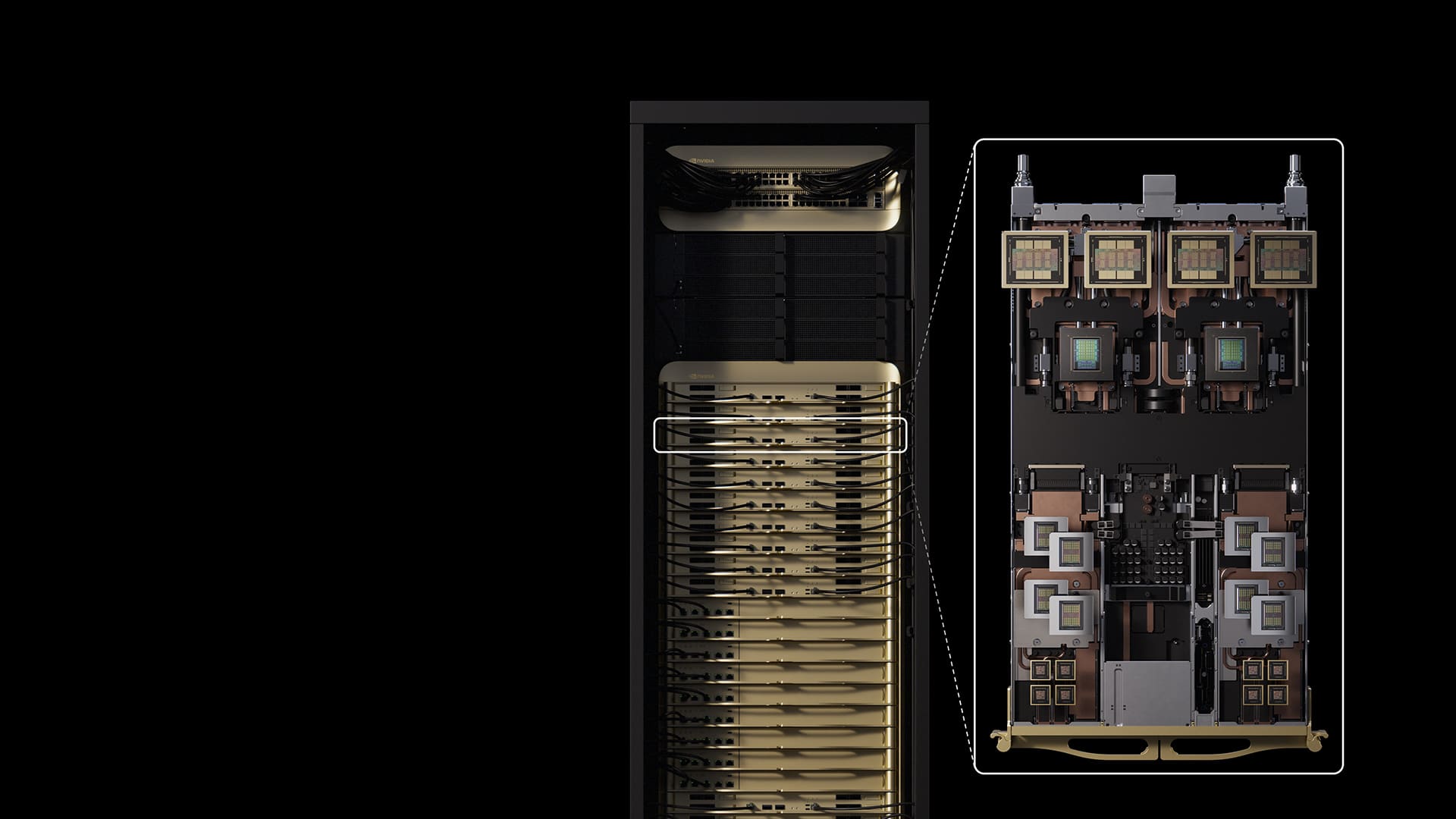
The race to build artificial intelligence data centers is no longer just a contest of GPUs, networking, or HBM memory. Electricity has become a central part of the challenge. Next-generation racks are increasing so rapidly in energy density that traditional power architectures are starting to fall short. That’s why NVIDIA, Google, and several electrical suppliers are preparing to leap to 800 VDC infrastructure, known as 800 VDC or 800 HVDC.
The change is significant. For years, many server racks have operated with internal distribution around 48 V or 54 V DC, enough for loads of tens of kilowatts. But new AI platforms are moving toward hundreds of kilowatts per rack, and in some designs, toward a megawatt. At this scale, every electrical conversion, kilo of copper, and centimeter within the rack counts.
NVIDIA has already explained that its 800 VDC architecture is designed to power “AI factories” with racks of 1 MW and more, with large-scale production linked to its Kyber systems starting in 2027. Simultaneously, TrendForce places NVIDIA and Google among the first adopters of this new high-voltage power generation, with component shipments scheduled for the third quarter of 2026.
Why 54 V is no longer enough for AI
The physical problem is straightforward. Higher power with lower voltage means higher current. And higher current results in more losses, more heat, more copper, and more cable volume. In traditional racks, this could be managed with copper bars, internal power supplies, and multiple conversions from mains input to the chip. But at hundreds of kilowatts per AI rack, this model starts to become too penalizing.
NVIDIA provides a clear example: using 54 V distribution in a 1 MW rack could require up to 200 kilograms of copper just in internal bars. In a 1 GW data center, that could mean up to 200,000 kilograms of copper. Additionally, the space occupied by power supplies inside the rack reduces the available space for computing hardware.
| Architecture | Typical Use | Main Limitation |
|---|---|---|
| 48 V / 54 V DC | High-density current racks | High current, more copper, more space occupied |
| Traditional 415 V AC | Data hall and row distribution | More conversions and accumulated losses |
| 800 VDC | Next-generation AI racks | Requires new standards, safety protocols, and training |
| 1 MW per rack | Future “AI factories” | Requires redesign of power, cooling, and protection systems |
The 800 VDC architecture aims to reduce this bottleneck. The idea is to convert grid power to 800 V DC in a central or peripheral zone within the data center and distribute it more directly to rows and racks. Then, inside the rack, the necessary conversion is performed to feed the final components.
The benefit lies in simplifying the electrical chain. Fewer conversions mean fewer losses and fewer failure points. Additionally, increasing voltage reduces the current needed to transmit the same power, allowing for less copper, smaller cabling, and lower thermal losses.
What does the 800 VDC architecture promise?
NVIDIA claims that moving to 800 VDC can improve end-to-end electrical efficiency by up to 5% compared to current systems based on 54 V. They also state that switching from 415 VAC to 800 VDC distribution enables transmitting 85% more power with the same conductor size and reduces copper needs by up to 45%.
| Metrics Cited by NVIDIA | Value |
| Target power per rack | 1 MW or more |
| End-to-end efficiency improvement | Up to 5% |
| More power with the same conductor | +85% |
| Copper reduction | Up to 45% |
| Potential maintenance cost reduction | Up to 70% |
| Potential TCO reduction | Up to 30% |
| Scale production linked to Kyber | 2027 |
These figures are significant but should be regarded as architectural estimates rather than guaranteed results in every installation. Each data center’s performance will depend on its electrical design, cooling, rack density, load type, redundancy, local regulations, and energy costs.
Nonetheless, the core message is clear. If a rack generation jumps from 100 or 200 kW to 600 kW, 800 kW, or 1 MW, power delivery ceases to be auxiliary and becomes a fundamental part of the system design—on par with grid, liquid cooling, or storage.
This transition also benefits new suppliers and power electronics technologies. 800 VDC systems rely on wide-bandgap semiconductors based on silicon carbide (SiC) and gallium nitride (GaN), solid-state relays, isolated sensors, high-voltage protection systems, and more efficient conversion modules. Companies like Texas Instruments, Infineon, STMicroelectronics, Navitas, ROHM, Renesas, Onsemi, and others are part of the collaborative environment described by NVIDIA.
Delta, BBUs, and liquid cooling
The shift to 800 VDC involves more than chip manufacturers. It also impacts suppliers of power sources, power systems, batteries, cooling, and data hall equipment. TrendForce indicates that Delta Electronics could benefit from the demand for 800 V HVDC systems, backup units with batteries (BBU), and energy management platforms.
According to reports from Taiwan, Delta plans to begin small shipments of its 800 V HVDC architecture to NVIDIA in the upcoming quarter, with products in verification phase. The company has also showcased modular solutions for high-density AI data centers and claims to reduce deployment times by up to 60% with prefabricated designs.
| Supplier or Group | Role in Transition |
| NVIDIA | Design of 800 VDC architecture for AI racks |
| Early adopter announced by TrendForce | |
| Delta Electronics | HVDC systems, BBUs, energy, cooling |
| Eaton, Schneider Electric, Vertiv | Data center electrical systems |
| TI, Infineon, Navitas, ROHM, STMicroelectronics | Semiconductors and power electronics |
| Flex Power, LiteOn, Megmeet | Components and power systems |
Cooling is inseparable from the electrical shift. At these densities, simply delivering more power to the rack isn’t enough; heat must also be removed efficiently. Consequently, suppliers combine high-voltage power supplies with liquid cooling, cold plates, high-voltage DC fans, and row-based solutions.
Electrical and thermal designs are beginning to be integrated. An AI rack cannot grow indefinitely unless the data hall can power, protect, cool, and safely maintain it.
Rubin, Kyber, and the arrival of hundreds-of-kilowatt racks
NVIDIA’s roadmap helps explain the pressure. The Rubin Ultra generation will be associated with Kyber racks featuring liquid cooling and significantly higher densities than today. Some industry estimates put these racks around 600 kW, with later generations possibly approaching 600 kW to 1 MW per rack.
While these figures should be approached cautiously until official specifications and commercial deployments are finalized, they highlight a clear trend: AI data center design is moving away from traditional servers toward integrated infrastructure systems where rack, power, cooling, networking, and accelerators form a more compact unit.
| Generation or Element | Technical Overview |
| GB200 / GB300 NVL72 | Current very high-density racks |
| Kyber | NVIDIA’s new rack-scale architecture |
| Rubin Ultra | Planned platform for 2027 |
| 800 VDC | Electrical base for 1 MW+ racks |
| BBU and energy storage | Handling quick load peaks |
| Liquid cooling | Practical requirement for extreme densities |
Batteries also increase in importance. AI loads can exhibit rapid consumption variations, especially during large-scale training and inference. NVIDIA notes that energy storage solutions will be part of the 800 VDC architecture to handle load peaks and sub-second GPU fluctuations.
This has implications for the power grid. AI data centers not only consume large amounts of energy but may also require more dynamic power profiles. Internal infrastructure must smooth these peaks to maintain stability, protect equipment, and optimize grid connection.
A technical shift with economic consequences
Adopting 800 VDC won’t solve the AI energy problem by itself. It doesn’t generate new electricity or eliminate the need to expand grids, contract capacity, or build additional generation. However, it can reduce losses, better utilize space, simplify power chains, and make higher-density racks more deployable than with older architectures.
For data center operators, this change might influence facility design, electrical equipment investment, maintenance, and supplier relationships. For power semiconductor manufacturers, it opens new demand in a market less visible than GPUs or HBM memory. For cloud and hyperscale customers, it may be a way to contain costs in infrastructure already moving toward hundreds of megawatts or even gigawatts.
The challenge lies in the transition. 800 VDC systems require new standards, technical training, safety protocols, fail-safe mechanisms, maintenance tools, and certified components. High-voltage DC cannot be treated as a mere evolution of server power supplies; it demands a redesign from the electrical connection to the rack.
There will also be a hybrid phase. For years, traditional architectures will coexist with new high-density AI-ready systems. Not every data center will need 800 VDC, just as not all require 1 MW racks. But those building infrastructure to train frontier models or host large clusters of accelerators will increasingly have less room to rely on legacy designs.
AI is forcing a focus on what many previously overlooked: electricity within the data center. Power availability, distribution methods, losses, copper, batteries, and cooling are no longer hidden engineering details; they will determine which models can be trained, where deployments are feasible, and at what cost.
Frequently Asked Questions
What is 800 VDC in data centers?
It is an electrical distribution architecture that uses 800 volts in direct current to power high-density racks, especially designed for AI and HPC loads.
Why does NVIDIA want to adopt 800 VDC?
Because AI racks are approaching hundreds of kilowatts and up to 1 MW. At 54 V, transmitting that energy requires too much current, copper, space, and conversions.
When will this technology reach production?
NVIDIA links mass production of 800 VDC data centers to its Kyber systems in 2027, while suppliers like Delta are preparing initial small-volume shipments beforehand.
What are the advantages over traditional power supplies?
It can reduce losses, simplify conversions, decrease copper use, free up space within the rack, and improve energy efficiency in ultra-high-density setups.
