
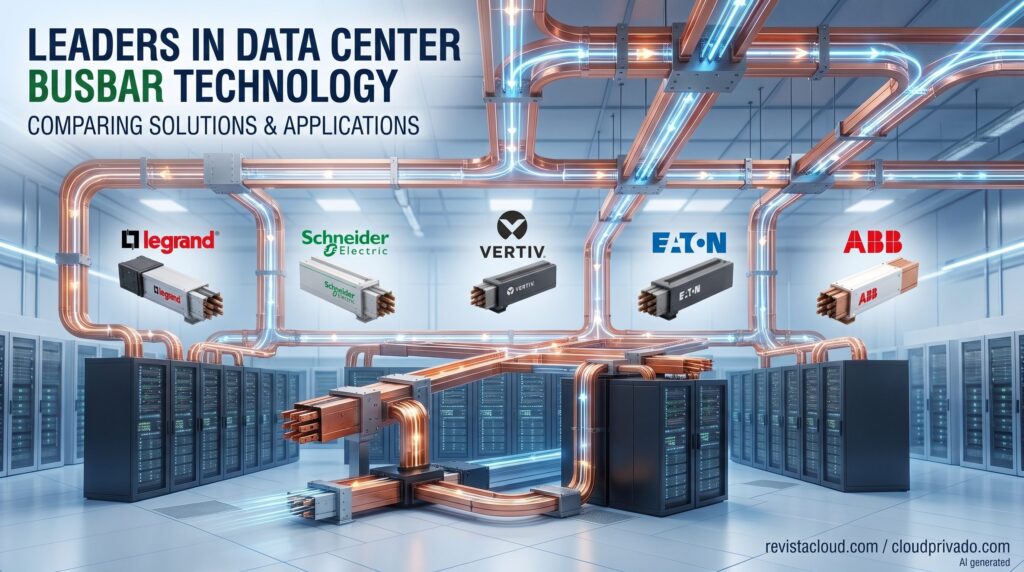
The growth of AI data centers is forcing a fresh look at a part of the infrastructure that gets far less attention than GPUs or cooling: how enormous amounts of electricity move around inside the data center itself. MarketsandMarkets estimates the global market for data center busbar systems will grow from $1.38 billion in 2026 to $3.01 billion in 2032, a 14% compound annual growth rate.
Busbars for data centers in 20 seconds
- The market is projected to grow from $1.38 billion to $3.01 billion between 2026 and 2032.
- AI-dedicated infrastructure will be the fastest-growing load segment, up 18.8% a year.
- Hyper-scale data centers will grow at 14.6% a year.
- More power per rack forces the distribution of higher currents.
- Asia-Pacific would be the fastest-growing region, at 16.4% a year.
Behind these forecasts is a fairly simple physical problem. Putting more AI accelerators in a rack raises compute capacity, but it also packs huge electrical demand into a very small space. That energy has to travel from transformers, uninterruptible power supplies (UPS), electrical panels, and other components to the computing equipment.
Conventional cables still play an essential role, but as currents rise and installations need to change configuration quickly, busbar systems, or busbars, are gaining prominence.
What a busbar is, and why AI is changing its role
A busbar is essentially an electrical distribution system based on conductive bars, usually copper or aluminum, held inside a protected, insulated structure. It can include connections, joints, and tap points to deliver power where it’s needed.
It’s not a new technology. It has been used for decades in industrial electrical installations, switchboards, and data centers. What’s changed now is the amount of electricity the new AI-focused infrastructure is starting to need.
MarketsandMarkets points specifically to rising rack electrical density and the build-out of AI clusters as the key demand drivers. The report estimates the AI-load segment will grow at an 18.8% CAGR through 2032, outpacing the overall market.
The International Energy Agency (IEA) has also warned about the fast rise in data center electricity needs. Its Energy and AI report estimates global consumption of these centers could pass 945 TWh by 2030, more than double the 2022 figures.
The internal electrical infrastructure has to evolve alongside it.
One advantage of busbars is that they can carry high current in a fairly compact setup. They can also include connection points that make it easier to add, remove, or move racks without rebuilding significant parts of the wiring.
That’s especially useful where the distribution of compute load may change over the building’s life.
The report also notes that busbars can cut the number of contact points and have low impedance, which helps limit electrical losses and local heating when handling high currents.
From traditional racks to installations over 100 MW
The scale is changing too.
MarketsandMarkets notes, citing IEA data, that certain hyper-scale AI data centers can exceed 100 MW of power. For perspective, that’s no longer just powering several server rooms but designing electrical infrastructure on par with large industrial facilities.
The hyper-scale segment is expected to be the fastest-growing part of the data center busbar market, with a forecast compound annual growth rate of 14.6% from 2026 to 2032.
Modularity is another key factor.
A traditional data center might be designed around a fairly stable rack configuration. AI installations bring much higher loads and fast technology change. Future generations of accelerators could shift power requirements again.
A modular system lets you add tap points and expand parts of the electrical distribution without replacing the whole thing.
It can also cut cable volume and support phased construction, which matters in large campuses where compute capacity is added over time.
The market is responding with products built for ever higher currents. The report mentions the September 2025 launch of Legrand’s ORv3 Vertical DC Busbar, compatible with the OCP’s ORv3 specification, with configurations of 400, 700, and up to 1,400 amps for high-density and AI installations.
The shift also touches direct current (DC). Much of data center electrical distribution still uses AC, but the search for architectures with fewer conversions is raising interest in DC distribution for certain parts of the infrastructure.
Copper, aluminum, and a new fight over electrical infrastructure
The growth of these systems raises another issue: materials.
Copper stays the dominant conductor thanks to its high conductivity and ability to handle large currents. MarketsandMarkets expects it to keep the largest market share over the forecast period.
But aluminum and hybrid solutions are expected to grow fastest.
Aluminum has lower conductivity than copper but weighs less and generally costs less. In large installations those traits can help, especially when you need a lot of conductor material.
Hybrid architectures combine both materials depending on the conductivity, weight, cost, and design needs of each part of the system.
The international standard IEC 61439-6 covers both copper and aluminum conductors for prefabricated busbar systems.
Depending on these raw materials also brings risk. Volatility in copper and aluminum prices can push up manufacturing costs and complicate budgets for projects that need a lot of conductor material.
Replacing conventional cabling with busbars isn’t always simple, either.
In operating data centers, changes might mean swapping electrical panels, distribution systems, ceiling structures, or even rack layouts. For 24/7 facilities, any work that needs downtime has to be carefully planned.
So growth will likely be easier in new facilities designed around these architectures from the start.
Asia-Pacific will grow faster, and Europe keeps major manufacturers
The expansion won’t be uniform.
MarketsandMarkets forecasts a 16.4% annual growth rate for Asia-Pacific, the highest of the regions analyzed. Building hyper-scale data centers, cloud growth, and AI infrastructure investment are raising electrical distribution demand in China, Japan, India, Australia, and other Asian markets.
The market also has a strong European presence among manufacturers.
The firm lists Legrand, Schneider Electric, and Vertiv as leading suppliers by market share and product range, alongside others like ABB, Eaton, Siemens, Mersen, Rittal, TE Connectivity, EAE Electric, Delta Power Solutions, and nVent.
The projected $3.01 billion market size in 2032 is an estimate, not a guaranteed figure. Whether it happens depends on the actual pace of data center build-out, AI investment, how rack electrical density evolves, and the distribution technologies operators end up choosing.
But the shift reaches beyond the busbar market. The drive for more compute is moving pressure from the chips to the whole physical chain that keeps them running: generation and electrical connections, transformers, UPS systems, internal distribution, cooling, and networks.
GPUs can pack more and more compute. Getting enough electricity to them safely, efficiently, and at scale becomes another major design challenge for AI data centers.
Frequently Asked Questions
What is a busbar in a data center?
A busbar is an electrical distribution system based on conductive bars, usually copper or aluminum. It can carry high currents and distribute electricity via tap points to racks and other equipment.
How much will the data center busbar market grow?
MarketsandMarkets estimates it will grow from $1.38 billion in 2026 to $3.01 billion in 2032, a 14% CAGR.
Why does AI raise demand for busbars?
AI GPUs concentrate high electrical power per rack, which calls for systems that can handle larger currents and adapt as compute capacity grows.
Which companies make busbars for data centers?
Manufacturers MarketsandMarkets lists include Legrand, Schneider Electric, Vertiv, ABB, Eaton, Siemens, Mersen, Rittal, TE Connectivity, and EAE Electric, among others.
Sources:
- MarketsandMarkets, Data Center Busbar Market by IT Load, Data Center Type, Conductor Type, Power Source, Power Ampacity, Space Type and Region – Global Forecast to 2032, August 2026.
- International Energy Agency (IEA), Energy and AI, forecasts on the electrical demand of data centers.
