
Artificial Intelligence promised to write code faster. It is doing so. But the uncomfortable part begins now: every generated line, every automatic pull request, and each agent executing background tasks consumes real infrastructure. Paying tokens or subscribing to Copilot, Cursor, Claude Code, or Codex is not enough. You also have to pay for everything that happens afterward: compilations, tests, runners, reviews, artifacts, logs, and pipelines.
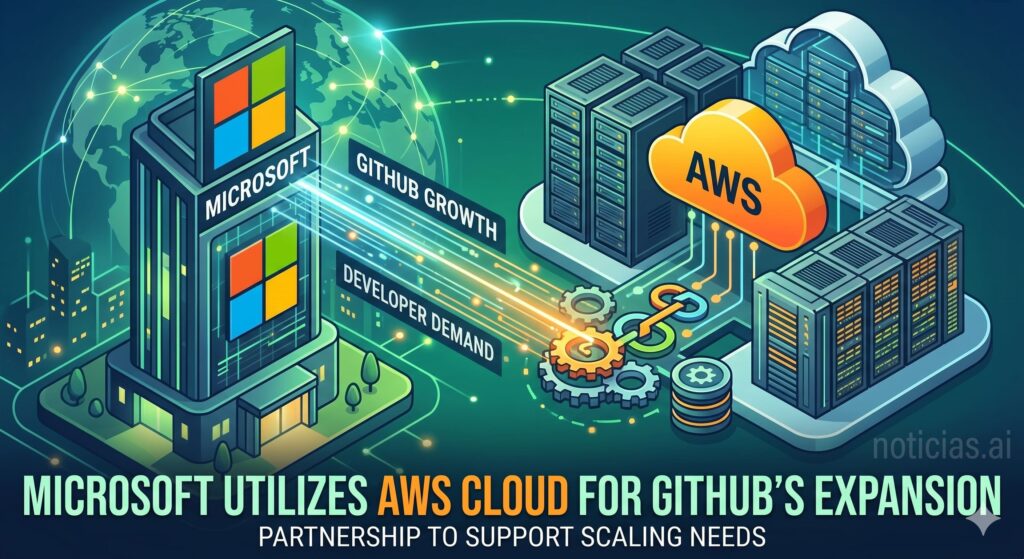
Media outlets like Noticias.AI have brought the issue to the forefront with reports on Microsoft and GitHub. According to the publication, Microsoft is turning to Amazon Web Services capacity to ease the pressure on GitHub caused by growth in AI-assisted development. Microsoft has not publicly confirmed AWS by name but has acknowledged a multicloud strategy for GitHub. This nuance is important; while it doesn’t change the core message— even a Microsoft-owned platform may require external capacity when AI usage outpaces available infrastructure.
The paradox is striking. GitHub is a key component of modern development, and Microsoft manages Azure, one of the world’s largest clouds. If this setup feels the pressure from activity generated around Copilot, engineering teams at any company should take a close look at their own CI/CD bills.
Cost no longer ends with the token
Over recent months, much of the debate around AI in development has focused on the cost of models—how much each million tokens costs, what each tool charges per user, which plan includes the most context, and which model is best for programming. While relevant, this is only part of the story.
An AI agent in coding doesn’t just respond in a chat. It can clone repositories, read files, modify branches, execute commands, run tests, open pull requests, request reviews, and repeat the cycle numerous times. Each step involves systems that predate AI but now bear more load and with less human intervention.
| AI-Generated Action | Visible Cost | Cost Usually Incurred Later |
|---|---|---|
| Suggest code | AI subscription or credits | Review, testing, and maintenance |
| Open a pull request | Agent credits | Runners, CI/CD, and storage |
| Automatically review code | AI credits | Minutes of Actions in some cases |
| Run tests | CI minutes | Retries, logs, artifacts |
| Refactor modules | Tokens and agent time | Functional and regression validation |
| Generate more changes | Apparent productivity | More pressure on pipelines |
GitHub explains this in its documentation: the Copilot cloud agent uses GitHub Actions minutes and AI credits. Review functions or third-party agents can also consume execution capacity beyond the model credits. This means AI activity is doubly counted: once for the model, and again for the infrastructure that turns its proposals into verifiable changes.
The challenge for many companies is that these two costs are not always viewed together. Development teams see productivity, finance sees increased cloud expenses, platform teams notice longer queues on runners, security observes more changes to review, and no one holds a complete picture of the cost per accepted change.
GitHub Actions becomes a critical expense line
Continuous integration has always incurred costs, but they were relatively predictable—teams opened pull requests, pipelines ran, tests passed or failed, and volume depended on human activity. With agents, this pattern changes. AI can multiply branches, commits, tests, and reviews without proportionally increasing the number of developers.
The incident with GitHub Actions in May 2026 clearly shows how critical this layer is. GitHub reported degraded performance in runners hosted in the East US region, with failures in jobs requesting standard and larger private network runners. During that window, approximately 8,500 Copilot Code Review requests exhausted time.
This isn’t a catastrophe or an indication of structural fragility. Platforms of this scale experience incidents. But it sends a clear message: code assistants are no longer just developer aids—they are part of GitHub’s operational flow. If the runners fail, parts of the AI experience also falter.
| Affected Layer | Why It Matters |
| GitHub Actions | Run builds, tests, and agent tasks |
| Copilot Code Review | Adds automatic review on pull requests |
| Copilot cloud agent | Operates in ephemeral environments based on Actions |
| Hosted Runners | Provide on-demand execution capacity |
| AI Credits | Measure model consumption | Logs and artifacts | Store results of each execution |
The takeaway for companies shouldn’t be “don’t use AI.” That would be a poor conclusion. The sensible one is that AI in development requires operational governance. It can’t be treated as a simple plugin to the editor.
More code doesn’t always mean less cost
A common mistake when evaluating AI tools is measuring only production speed. If a developer delivers a function faster with Copilot’s help, it seems like a direct savings. But software deployment ends not once the code is written, but after passing tests, reviews, deployment, monitoring, and maintenance.
AI can assist greatly in repetitive tasks, documentation, test generation, controlled migrations, and code analysis. But it can also increase the volume of changes entering the system. More changes require more validations; more validations mean more compute minutes; poorly designed automation leads to unnecessary executions.
| Traditional Metric | Emerging Relevant Metric |
| Lines of code generated | Changes accepted into production |
| Open pull requests | Merged pull requests without regressions |
| Development velocity | Total cost per useful change |
| Copilot usage | Impact on CI/CD and review processes |
| Hours saved manually | Increase in infrastructure costs |
| Active agents count | Quality and cost of their executions |
The phrase “AI reduces development costs” needs context. It can decrease human time in certain tasks, but it also shifts costs toward platforms, runners, models, and cloud resources. The expense doesn’t disappear; it simply moves elsewhere.
This idea is becoming increasingly important for CTOs, platform managers, and FinOps teams. Adopting development agents can’t be justified solely with productivity surveys or autocomplete metrics. It’s necessary to measure actual delivery costs.
Multicloud returns for a very simple reason: capacity
For years, multicloud was sold as an independence strategy. In practice, many companies ended up consolidating workloads on a single provider because operating multiple clouds is more costly and complex. The GitHub case reminds us there’s another much more direct reason to use multiple clouds: lack of sufficient capacity where and when it’s needed.
If Microsoft is adding external capacity to GitHub, it’s not driven by architectural romance. It’s to sustain a global service with millions of developers and rising AI demand. Users don’t care whether some load runs on Azure, AWS, or another provider. They want their workflows to start, Copilot to respond, and pull requests not to stall.
AI demand is straining GPUs, CPUs, storage, energy, networks, and data centers. Even major providers face build timelines, electrical constraints, and saturated regions. Capacity is becoming a strategic variable.
| Reason for Multicloud | Before | Now |
| Resilience | Avoid dependency on a single provider | Maintain services under extreme demand |
| Cost arbitrage | Price comparison | Access to available capacity |
| Regulatory compliance | Data location | Sovereignty and continuity |
| Performance | Proximity to users | Availability of specialized compute |
| Scale | Planned growth | Peaks driven by AI and agents |
AI is pushing companies toward a more pragmatic architecture—where capacity exists, load will be distributed accordingly, provided costs, security, and operation are manageable.
The new FinOps begins in the repository
Most FinOps programs started by focusing on cloud infrastructure: VMs, databases, Kubernetes, storage, traffic, and licenses. Now, it’s necessary to go a level deeper—look at the repository. Development activity has become a more dynamic source of costs.
A company adopting agents should know how many CI minutes each IA-generated pull request consumes, how many workflows fail, how many retries occur, which repositories concentrate expenses, and what percentage of generated changes actually reach production. Without this data, productivity can be an expensive illusion.
| Indicator | Question Answered |
| CI minutes per PR | What is the cost to validate each change? |
| Agent-generated PRs | What part of the process is no longer human-driven? |
| Workflow failure rate | Is AI producing useful changes or noise? |
| Automated retries | Are we paying multiple times for the same? | Repository cost | Where is the bill concentrated? |
| Merged versus generated changes | What is the net productivity? |
| AI credits per accepted change | Which model offers the best cost-value ratio? |
Pipelines also need to be rethought. Not all changes require running the full suite of tests. Not all agents should have permission to trigger any workflow. Not all repositories need the same policy. Automation should be smarter, especially because AI can generate more activity.
The unforeseen invoice
AI-assisted development is moving from experiment to infrastructure. This shifts the questions. It’s no longer enough to decide what tool the team uses. It’s necessary to determine how it’s governed, how much it can consume, what limits apply, what costs are involved, and how to measure its value.
GitHub serves as a warning because it consolidates all layers of the problem: code platform, CI/CD, assistants, agents, automatic review, and cloud infrastructure dependency. If its growth requires a more aggressive multicloud strategy, other companies should review their assumptions.
Artificial Intelligence does not eliminate platform engineering; it makes it even more critical. Teams that best leverage agents will not necessarily produce the most code but will know how to integrate that generation into a controlled, measurable, and efficient flow.
The next cloud bill will not only come from training models or running inference but also from all the pipelines these models enable.
Frequently Asked Questions
Why is AWS mentioned in relation to GitHub?
Business Insider reported that Microsoft is adding AWS capacity to GitHub due to the pressure caused by AI usage. Microsoft confirmed a multicloud strategy for GitHub but has not publicly named AWS.
What’s the connection between GitHub Copilot and GitHub Actions?
Copilot cloud agent works within environments based on GitHub Actions and consumes Actions minutes along with AI credits. Automatic reviews and third-party agents can also activate infrastructure consumption.
Does AI make software development cheaper?
It can reduce human time for certain tasks but also shifts costs toward models, CI/CD, runners, storage, logs, and validations. Expenses don’t vanish—they move elsewhere.
What should companies measuring code agents track?
They should monitor CI minutes per pull request, workflow failure rates, retries, per-repository costs, generated changes, and changes that actually reach production.
