
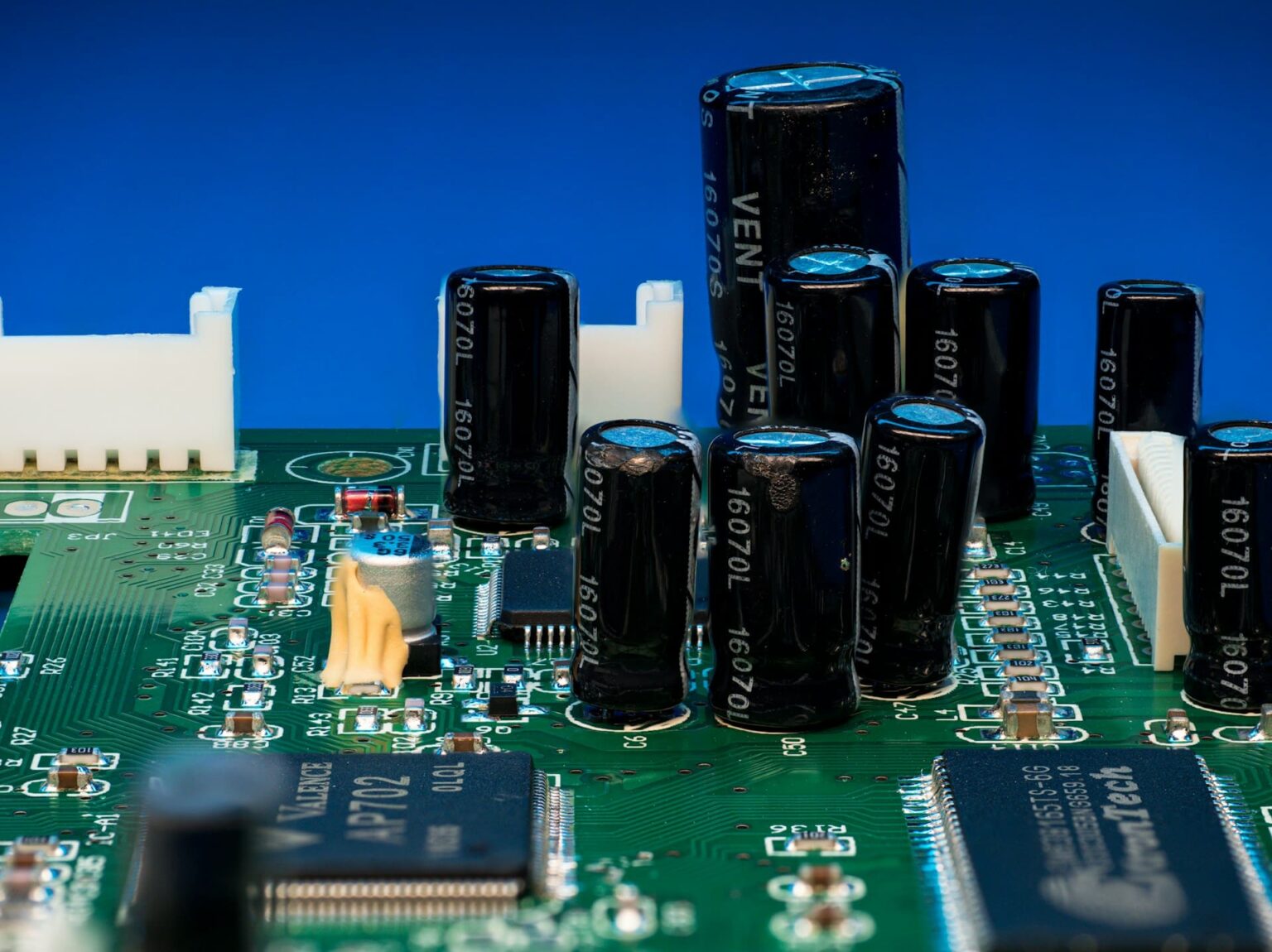
The rapid buildout of AI servers is now pushing pressure onto components far smaller than GPUs, present by the thousands in each system. High-performance multilayer ceramic capacitors (MLCCs) currently have lead times that, for certain products, reach about 30-40 weeks, while conventional models keep noticeably more stable availability. That gap signals a shift in demand for passive components tied to AI data centers.
The MLCC shortage in 20 seconds
- Conventional MLCCs generally have much shorter lead times than advanced models.
- Some high-capacity capacitors face 30-40 weeks of wait, depending on supplier and reference.
- An AI server can need several times more MLCCs than a conventional one.
- Murata, Samsung Electro-Mechanics, and Taiyo Yuden are prioritizing higher-value products.
- The pressure is already driving price increases and long-term supply contracts.
The situation again shows how AI infrastructure leans on a supply chain that goes well beyond NVIDIA, AMD, or HBM memory. An accelerator that draws hundreds or even more than 1,000 watts needs a complex power network to keep voltages stable as the load changes fast.
That’s where MLCCs come in.
These tiny components, little known outside the electronics industry, store small amounts of energy, filter electrical noise, and help stabilize the power delivered to processors, memories, and other circuits.
An AI server can hold thousands of them.
With AI, both the count and, above all, the required performance are rising.
From 14 weeks to nearly a year: not all MLCCs face the same problem
Talking about an “MLCC shortage” can lead to wrong conclusions. The tension isn’t the same across the whole market right now.
The differences come down to capacity, size, voltage rating, operating temperature, reliability, and application.
Distributor data gathered by Asian media in August show many conventional MLCCs with lead times of about 14-18 weeks. High-capacity and high-voltage models run around 15-20 weeks.
The jump shows up mainly in certain high-performance references.
Some Samsung Electro-Mechanics MLCCs have reached roughly 40 weeks, while some high-capacity Murata products hit around 30 weeks in July, up from about 24 weeks a month earlier.
These figures vary a lot by reference and distribution channel, so they can’t be applied to each manufacturer’s entire output.
Still, the broad picture lines up with other market indicators.
TrendForce reports that book-to-bill ratios, which compare new orders to shipped products, reached 1.30 for Murata, 1.31 for Samsung Electro-Mechanics, and 1.25 for Taiyo Yuden at the end of June, the highest since the pandemic. A value above one means orders are arriving faster than products ship.
| Type of MLCC | Observed lead times in 2026 | Situation |
|---|---|---|
| Conventional models | ~14-18 weeks | Relatively stable |
| High capacity / high voltage | ~15-20 weeks | Increased pressure |
| High-end for servers | More than 20 weeks | Tight supply |
| Some Murata references | Up to ~30-36 weeks | Limited availability |
| Some Samsung Electro-Mechanics references | Around ~40 weeks | Particularly tight cases |
Lead times are indicative and depend on reference, volume, manufacturer, contract, and distributor. They don’t mean all of a manufacturer’s MLCCs carry these waits.
Why an AI server needs so many capacitors
The explanation is electrical.
An AI GPU or ASIC can change its power draw extremely fast depending on the workload. The power network has to react to those swings and hold the voltage within very narrow margins.
MLCCs work as tiny energy reservoirs placed near the chips, part of the decoupling and filtering networks.
As consumption and compute density rise, the job gets harder.
Murata acknowledges the trend in its industrial planning. It expects demand for MLCCs in AI-equipped servers to roughly quintuple between 2023 and 2030, with particular need for compact, high-capacity components that can run at higher temperatures and voltages.
Some industry estimates suggest an AI server uses between five and thirteen times more MLCCs than certain conventional setups, though the exact figure depends heavily on the specific server and architecture being compared.
And it’s not just about quantity.
AI systems specifically need the hardest references to make: small, high-capacity, thermally resistant, and highly reliable components.
These products use more industrial capacity per unit than simple consumer-electronics ranges.
Production is shifting toward AI components
That difference has another consequence.
Manufacturers can’t expand capacity overnight, so they have to decide which products to make on the lines they already have.
MLCCs for AI servers also carry higher added value. The leading Japanese and South Korean manufacturers are gradually shifting more capacity to these ranges.
TrendForce expects manufacturing to be heavily booked with AI-related orders through the second half of 2026, alongside new platforms from NVIDIA, Google, and AMD. In July, the firm warned this could stretch lead times and drive further price increases.
It may also hit the rest of the market indirectly.
If factories devote more lines to advanced MLCCs, less capacity is left for conventional products, which could push orders toward Taiwanese and Chinese suppliers.
The bottleneck starts in high-end components and can cascade down.
Manufacturers are using recovered leverage to raise prices
Prices already reflect the shift.
Samsung Electro-Mechanics announced a 30% price increase for certain products under its Markup Business Code starting 08/01/2026, according to TrendForce. Taiyo Yuden has also asked for new adjustments, warning that even with them, hitting certain delivery deadlines could be hard.
This is a long way from periods of excess inventory, when manufacturers and distributors competed hard on price.
Now customers are after supply security.
In June and July, Samsung Electro-Mechanics closed two MLCC contracts with major international clients worth 453.99 billion and 295.12 billion won. Industry analysts in South Korea estimate that, converted to equivalent conventional-product capacity, these deals could represent about 10% of the company’s expected ceramic production in 2027.
Long-term agreements let manufacturers plan investments and give buyers more certainty over future availability.
They also shift bargaining power.
Building a factory in a few months isn’t the answer
Ramping up production of advanced MLCCs isn’t just a matter of installing more machinery.
Making smaller, higher-capacity components takes precise control over extremely thin ceramic layers, electrodes, materials, thermal processes, and yields.
Manufacturers are expanding capacity, but the investment takes time to turn into market-ready products.
Murata, for one, has planned capacity increases to meet expected growth in data center and AI applications. Its strategy includes ongoing expansion and new investment to prepare for future demand.
So it’s reasonable to expect some references to stay tight through the second half of 2026 and into 2027, even though not all MLCCs will face shortages in that period.
That split is exactly the point.
Another tiny component that can limit huge data centers
The AI industry keeps discovering components whose availability seemed secondary when volumes were lower.
First it was GPUs. Then HBM memory and advanced packaging. The pressure has also reached PCBs, specialized laminates, fiberglass, electrical systems, transformers, and cooling solutions.
MLCCs add another piece to the puzzle.
A single capacitor costs vastly less than a high-end GPU, but a server needs thousands. Swapping one reference for another isn’t simple; capacity, voltage, temperature, size, and electrical characteristics all have to match.
The shift can also work in the manufacturers’ favor. Combining fully used factories, higher-value products, less pressure to cut prices, and longer contracts can lift average prices and margins.
Maybe the clearest sign for 2026 is that the MLCC market is no longer moving as one.
Conventional components may stay available, but the models needed for AI infrastructure are seeing orders that stretch out over months.
As GPUs and ASICs grow more powerful, these small capacitors are becoming a bigger factor in planning some of the most expensive servers in the world.
Frequently Asked Questions
What is an MLCC?
An MLCC (Multilayer Ceramic Capacitor) is a multilayer ceramic capacitor. It’s used to store small amounts of energy, stabilize voltages, and filter electrical noise in virtually any electronic device.
Why do AI servers need more MLCCs?
AI GPUs and ASICs run at very high power with rapid load changes. They need power networks with many high-capacity capacitors close to the chips to keep the voltage stable and filter disturbances.
How long does it currently take to deliver an MLCC?
It depends entirely on the product. Many conventional references run about 14 to 20 weeks, while certain advanced ranges have reached 30-40 weeks in 2026.
Will supply issues persist into 2027?
Expanding capacity takes time, and AI infrastructure demand keeps growing. Sector analyses suggest some advanced ranges may stay tight into 2027, though the situation will vary across different MLCC types.
