
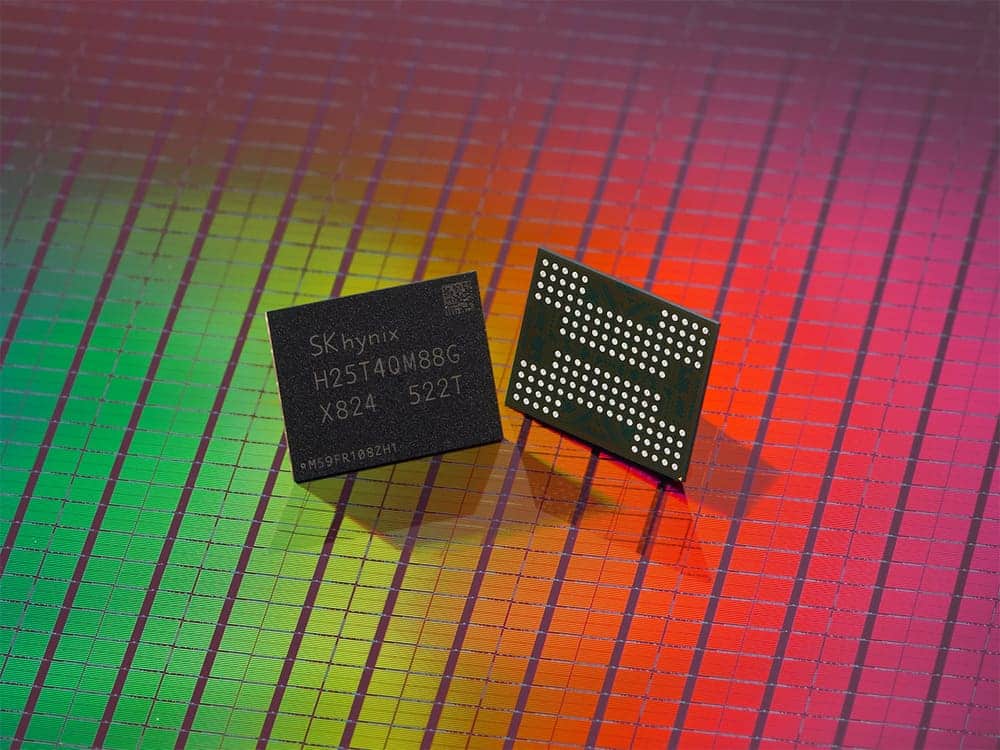
For years, when discussing memory shortages, the debate was split between DRAM and NAND. However, in 2026, the focus is shifting toward a less glamorous but critical component in any modern system: NOR flash, the type of memory that stores firmware, boot sequences, and essential code to ensure servers, accelerators, controllers, and network cards “come to life” reliably.
The pressure doesn’t stem from a single factor but from a familiar cocktail in the industry: , reallocation of manufacturing capacity toward more profitable products, and an industry operating on slim margins to absorb demand spikes. The result is a recurring pattern: when the “small” becomes essential, it stops being small.
From 3–5 chips per rack to over 30: how the bill is changing
The first warning sign is the increase in NOR content per system. Market reports from Asia cited in European media suggest that, in AI server racks, the number of NOR devices can jump from the roughly 3 to 5 typical units to more than 30 per rack in advanced configurations.
The most common case nowadays involves systems based on NVIDIA GB200 NVL72, where the “NOR flash content” per rack already exceeds $600 and could approach $900 in a couple of years if demand and prices stay consistent.
It’s not that NOR will replace HBM or compete in bandwidth with DRAM: it has become a silent multiplier of costs as the number of components and boards increases.
Why is NOR so hard to “remove” from design?
Unlike NAND, NOR stands out for its fast, deterministic random read, its suitability for execute-in-place (XIP), and its reliability in contexts where code storage is critical. This explains its long-standing presence in automotive, industrial, or telecom sectors, and now also in AI servers, where secure boot, firmware on multiple controllers, and system initialization are part of the platform’s “vital minimum.”
In other words: as a design becomes more complex — with more accelerators, NICs, controllers, and management layers — the need for separate, secure, and resilient firmware grows. NOR often becomes the natural place to house it.
The capacity battle: AI vs embedded, automotive, and industrial
The problem isn’t just data center demand. NOR is a smaller category than DRAM or NAND, and its production capacity doesn’t expand as easily or with the same economies of scale. Therefore, any additional “bite” from the AI sector can cause friction with segments already closely tied to this technology: automotive (including OTA updates), industrial, IoT, and embedded systems in general.
In fact, market rumors suggest price increases could occur in early 2026 by major NOR suppliers, with specific mentions of up to a 30% rise in certain products, according to regional financial news reports.
It’s important to read between the lines: even when a price hike isn’t officially confirmed, the mere possibility indicates tension in negotiations.
More “boot” chips per advanced memory system
Another less visible factor is the impact of advanced memories around accelerators. Asian media have pointed out that, in the technological transition between generations of high-performance memories, the number of NOR components associated with certain modules or subsystems can increase from 1–2 to 3–5 devices in scenarios tied to new architectures.
Without delving into commercial promises, the core idea remains: the more sophisticated the platform, the more “support microcomponents” appear — and NOR often falls among them.
3D NOR: the promise to break the deadlock (but not for tomorrow)
With demand climbing, the inevitable question returns: why not scale density and capacity like in other segments? This is where 3D NOR comes into play, an evolution that aims to stack cells for increased density and improved metrics while maintaining the reliability required for firmware and code uses. Macronix, for example, has positioned itself as a notable player in this area, showcasing advances in 3D NOR in recent industrial circuits.
Still, the industry’s cautious message is clear: large-scale transition to 3D NOR isn’t immediate. In the near term, the industry will continue relying on traditional NOR, making 2026 more about managing shortages than technological breakthroughs.
Implications for the market in 2026
The practical takeaway is straightforward: NOR flash joins the list of components where AI not only demands performance but also impacts supply chains. And that reorders priorities:
- Designs become more sensitive to the “bill of materials”: when multiplying boards, you multiply firmware and support memories.
- Buyers pay less attention to unit price and more to supply risk: if NOR is missing, the system won’t boot, even if HBM or GPU are available.
- Impact extends beyond AI sectors: automotive and industrial segments compete for the same capacity.
The paradox is that NOR isn’t the “muscle” of AI, but it’s one of its tendons. And when a tendon tightens, movement stalls.
Frequently Asked Questions
Why does NOR flash shortage affect AI servers if the key memory is HBM?
Because NOR typically stores firmware and boot code for multiple components (controllers, cards, subsystems). Without that layer, the system cannot reliably initialize even if HBM and GPUs are available.
What’s the difference between NOR flash and NAND flash in data centers?
NOR prioritizes fast, deterministic random reads and reliability for code/firmware (including execute-in-place). NAND is mainly used for mass storage due to cost/density but isn’t a typical substitute for critical firmware storage.
What signals indicate NOR market tension in 2026?
Increased number of NOR chips per rack in AI platforms, rising competition with automotive/industrial segments, and recurring rumors of price hikes or tougher commercial conditions.
Will 3D NOR solve the short-term problem?
It could help mid-term by increasing density and “useful” supply, but broad deployment isn’t immediate. In 2026, it’s more realistic to expect coexistence with traditional NOR, with tensions driven more by capacity and allocation issues.
via: eetimes