
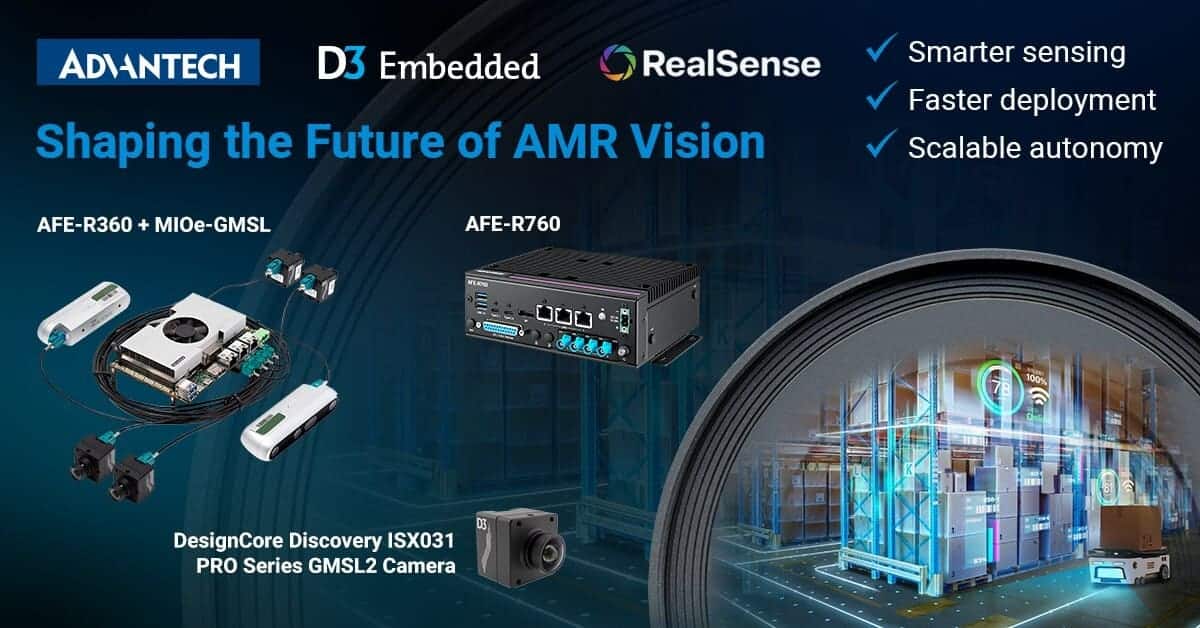
Advantech, one of the leading global players in embedded systems and Edge Computing infrastructure, has announced a strategic partnership with D3 Embedded to propel the next generation of autonomous mobile robots (AMRs) in industrial environments. The goal: deliver an integrated vision and computing package based on Intel Core Ultra and GMSL2 cameras that enables these robots to “see, understand, and react” in real-time within factories, warehouses, and retail settings.
The joint offering combines several key components: Advantech’s AFE-R360 and AFE-R760 platforms, Intel RealSense™ D457 depth sensors, and D3 Embedded’s DesignCore® Discovery PRO Series cameras, which are based on the Sony ISX031 sensor. All of these are packaged as a purpose-built embedded vision solution designed specifically to enhance perception, navigation, and safety of AMRs.
Smarter AMRs with Robust Vision
Autonomous Mobile Robots increasingly rely on computer vision to navigate without physical guides, detect obstacles, identify objects, and operate safely alongside humans. In this context, the partnership aims to strengthen two fundamental pillars: sensor quality and onboard computing power.
The D3 Embedded Discovery PRO cameras integrate the Sony ISX031 sensor and are IP67-rated, making them suitable for demanding industrial environments with dust, moisture, or temperature fluctuations. Additionally, they feature technologies like High Dynamic Range (HDR) and LED flicker mitigation (LFM), essential for managing extreme lighting conditions — from very dark zones to areas with intense or flickering lights, common in many production lines and automated warehouses.
Complementing these are Intel RealSense Depth D457 stereo depth cameras with GMSL2 interface, capable of high-speed stereoscopic vision. This combination of visible light cameras and depth sensors allows the robot to construct a 3D map of its surroundings, accurately measure distances, and run real-time object detection and tracking algorithms.
AFE-R360 and AFE-R760: The ‘Brain’ Powered by Intel Core Ultra
At the core of this solution are Advantech’s AFE-R360 (a 3.5″ SBC) and AFE-R760 (a chassis-based system) platforms, both built on Intel Core™ Ultra processors (Meteor Lake-H/U). These chips incorporate GPU capabilities and AI inference performance up to 32 TOPS, sufficient to run computer vision models and neural networks directly at the edge without relying on cloud connectivity.
The AFE-R360 supports up to 8 MIPI-CSI lanes for low-latency cameras, along with 3 LAN ports and 3 USB-C ports that can connect to depth sensors and LiDAR. With an Advantech-designed camera I/O module, it can manage up to 6 GMSL cameras simultaneously, providing the AMR with 360° panoramic vision. Its larger counterpart, the AFE-R760, adds chassis support and can accommodate up to 4 GMSL cameras, tailored for applications requiring a complete system form factor.
For even greater processing needs, both platforms can be extended with external MXM GPUs, such as Intel Arc or NVIDIA Quadro series, enabling advanced vision applications, complex 3D SLAM, or heavier AI models.
From Camera to Algorithm: A Developer-Focused Platform
This solution extends beyond hardware. Advantech integrates these capabilities into its Robotic Suite, a development environment that allows engineering teams to work with ROS (Robot Operating System) and create custom nodes for acquiring data from MIPI and GMSL cameras.
Developers can:
- Capture video streams and depth data directly from the cameras.
- Integrate perception algorithms (obstacle detection, object recognition, people tracking, etc.) within ROS.
- Test and fine-tune navigation and safety behaviors before deploying robots in production.
Meanwhile, D3 Embedded brings its expertise as a sensor integrator (cameras, radar), embedded electronics, and AI models for advanced perception. Their DesignCore platforms and design services enable customization for specific use cases across sectors like automotive, industrial robotics, healthcare, aerospace, and defense.
A Package Designed for Factories, Warehouses, and Retail
While the technology is universal, the initial focus is clearly set on three major environments:
- Manufacturing: AMRs transporting components, finished products, or tools between various plant zones, replacing traditional forklifts and reducing downtime.
- Logistics and Warehouses: Robots moving among shelves, picking zones, and loading docks, optimizing routes and minimizing errors in 24/7 operations.
- Retail and Big-Box Stores: AMRs performing restocking, inventory, cleaning, or internal delivery tasks where human interaction and safety are critical.
In all these cases, having a robust, ready-to-integrate vision platform significantly shortens the design cycle for new robot models and facilitates scaling deployments without reinventing the wheel for each project.
Edge AI for Real Autonomy
A key aspect of this announcement is the emphasis on edge AI. By focusing processing directly on the robot — leveraging Intel Core Ultra, optional GPUs, and the software stacks from Advantech and D3 Embedded — latency is reduced, and dependence on connectivity diminishes. This is crucial for ensuring AMRs respond swiftly to people, vehicles, unexpected obstacles, or route changes.
Furthermore, supporting ROS and dedicated development tools enables integrators and robot manufacturers to tailor AI models to their specific scenarios: from highly dynamic e-commerce warehouses to more predictable manufacturing plants, and even busy retail spaces requiring real-time perception and high system adaptability.
A Step Closer to Mass Adoption of Mobile Robots
Advantech’s core message is clear: “More robots in more scenarios.” The company enhances its range of integrated controllers for robotics and autonomous systems with a package that combines sensing, computing, and software resources. The offering is complemented by wireless communication modules, IMUs, LiDAR, motor controllers, and industrial panels, creating a solid foundation for AMR manufacturers aiming to avoid designing every component from scratch.
Meanwhile, D3 Embedded positions itself as a technology partner for those requiring advanced customizations in sensors, optics, electronics, and perception algorithms. Together, both companies aim to shorten the gap between concept and field deployment, a critical factor amid increasing pressure to automate logistics and industrial processes.
Frequently Asked Questions (FAQ)
What does the collaboration between Advantech and D3 Embedded bring to autonomous mobile robots?
The partnership offers an integrated vision and computing package for AMRs that combines the AFE-R360/AFE-R760 platforms based on Intel Core Ultra with high-quality GMSL2 cameras and Intel RealSense D457 depth sensors. This provides a ready-to-use solution that simplifies advanced vision robot development, reduces integration times, and enhances real-time environment perception.
Why are GMSL2 cameras and the Sony ISX031 sensor important in industrial applications?
D3 Embedded’s DesignCore Discovery PRO Series cameras incorporate the Sony ISX031 sensor and utilize GMSL2, a robust, high-speed interface designed for demanding environments. They offer IP67 protection, HDR, and LED flicker mitigation, ensuring consistent imagery in factories, warehouses, or stores with variable lighting, dust, or vibrations. Such cameras are crucial for reliable 24/7 AMR operation.
What role does Intel Core Ultra play in the AMR solution?
The AFE-R360 and AFE-R760 platforms, based on Intel Core Ultra (Meteor Lake-H/U) processors, combine CPU, GPU, and AI inference up to 32 TOPS. This enables real-time vision processing and navigation algorithms to run directly on the robot, reducing latency and increasing autonomy. They can also be expanded with external MXM GPUs (like Intel Arc or NVIDIA Quadro) for more demanding workloads.
Which industries are best suited for deploying this embedded vision platform for AMRs?
Primarily targeting manufacturing, logistics, and retail sectors, where autonomous mobile robots streamline internal material transport, picking, inventory, or support tasks. However, the combination of advanced vision, edge AI, and ROS support also makes it suitable for service robotics, healthcare, aerospace, or defense, especially where reliable perception and high adaptability are required.
Sources:
Official announcement from Advantech regarding its collaboration with D3 Embedded and the embedded vision platform for autonomous mobile robots.