
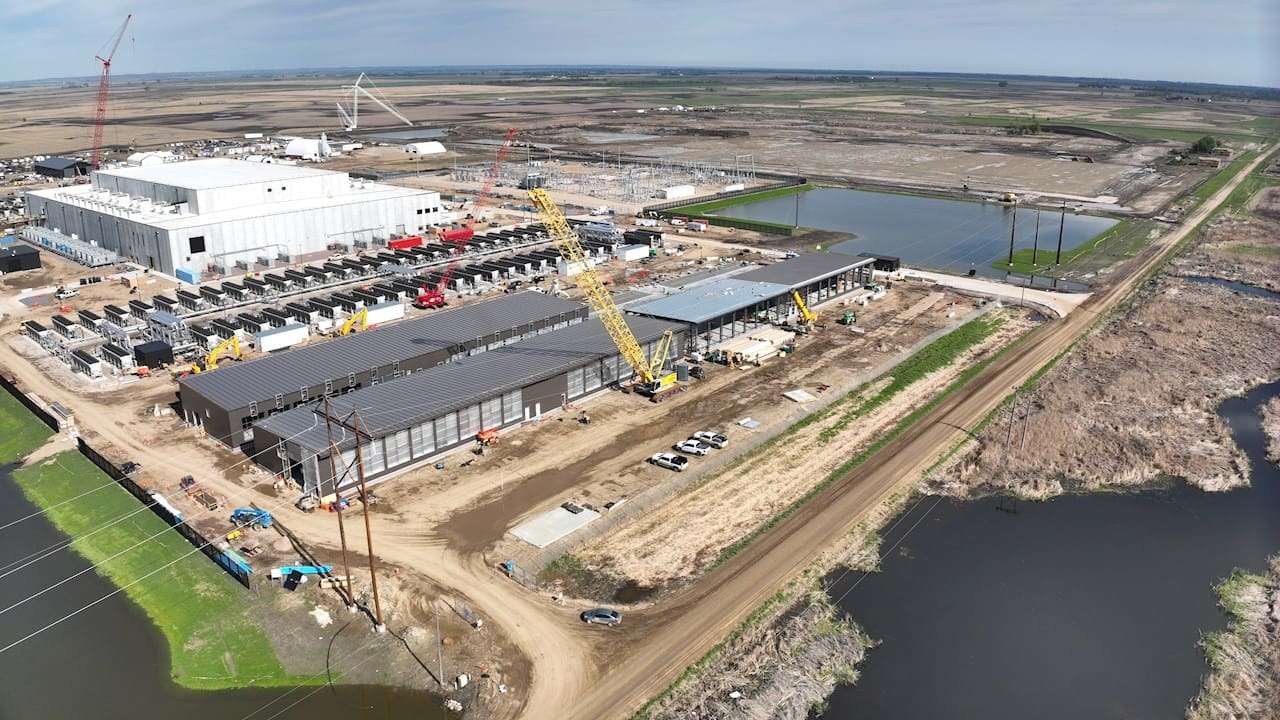
ABB has unveiled Infinitus, a portfolio of direct current (DC) solutions designed for data centers that need to power a new generation of AI chips with ever-higher power consumption. The offering spans everything from the grid connection or on-site generation down to the rack, with 800 VDC architectures aimed at reducing conversions, energy losses, and the space taken up by electrical infrastructure.
ABB’s Infinitus in 30 seconds
- ABB unveils a complete DC portfolio spanning from the power source to AI racks.
- The architecture is built around 800 VDC distribution for high-density data centers.
- The company estimates new AI chips could exceed 1 MW per rack.
- ABB calculates that a 5% efficiency gain in a 500 MW facility would free up 25 MW for computing loads.
- The first native DC installations using the full portfolio could be operating within two to three years.
The move responds to rising electricity demand tied to artificial intelligence. ABB cites forecasts from the International Energy Agency (IEA), according to which global electricity consumption from data centers could more than double by 2030. The company also estimates that between 25% and 40% of new capacity installed that year could use direct-current distribution.
The case for rethinking electrical architecture also comes from the accelerators themselves. ABB notes that next-generation chips could reach 1 MW per rack or more, compared with the roughly 200 kW it currently uses as a reference point. At those densities, how electricity is delivered to the equipment has a direct effect on losses, cooling, and available space.
From alternating current to the AI rack
A conventional data center’s electrical infrastructure relies on alternating current (AC) and several conversion stages before delivering the power that IT equipment needs.
ABB’s proposal is to bring direct current into a much larger part of that path. Its Infinitus portfolio is designed to work both in native DC data centers and in hybrid architectures that combine alternating and direct current.
One of the central elements is 800 VDC distribution. According to ABB, this approach allows for more compact infrastructure and eliminates some of the conversions that occur in conventional AC architectures. Fewer conversions also means fewer losses associated with those processes.
The company cites an analysis conducted with Boston Consulting Group (BCG) showing that DC distribution can deliver energy efficiency improvements of more than 5% and increase the space available for compute racks.
ABB uses a 500 MW data center as an example. With a 5% efficiency improvement, it calculates that 25 additional MW could become available for revenue-generating computing loads. The company further estimates that the annual energy savings from that 5% would be equivalent to Washington, D.C.’s electricity consumption for nearly a week.
These figures come from estimates cited by ABB and depend on a data center’s specific architecture, load, and operating conditions. They do not represent a guaranteed saving for any given facility.
The company has worked with DC technology for more than 25 years across various sectors and says it holds more than 700 patents related to renewables, power generation, storage, motors, and drives.
Five building blocks to get power to the accelerators
Infinitus isn’t a single piece of equipment but a portfolio built around five main building blocks that ABB presents as a complete architecture.
The first covers Medium Voltage Powertrains, responsible for providing stable power from the electrical grid or from generation systems installed on-site at the data center.
The second brings together DC Sources and Power Quality solutions, which convert alternating current into direct current before it reaches the area where the servers are located. ABB’s aim is to remove part of the conversion process from the rack area.
The third block is DC Power Distribution, responsible for safely distributing direct current and enabling higher power densities in less space.
The fourth covers DC Power Protection, meant to protect operators, AI servers, and other equipment from overcurrents in direct-current systems.
The fifth block focuses on Cooling Optimization. ABB proposes using DC-connected variable-speed drives and motors to reduce the energy consumed by cooling, both in technical areas and where the servers themselves are located.
At the center of this architecture sits the Infinitus solid-state transformer, which ABB presents as a technology aimed at shrinking infrastructure size and improving efficiency.
The company also highlights that it has a solid-state circuit breaker certified to IEC standards and a medium-voltage static UPS system already in production.
Electricity becomes another AI bottleneck
Rising power per rack is changing what data centers require. As a rack goes from consuming on the order of hundreds of kilowatts to approaching or exceeding a megawatt, the electrical infrastructure needs to handle higher currents and power densities.
That affects transformers, distribution systems, protection equipment, cooling, and the physical space taken up by everything needed to deliver power.
ABB believes a DC architecture can cut some of those losses and simplify certain electrical paths. The company isn’t necessarily proposing to replace all existing AC infrastructure, but rather offering an architecture that can also integrate with traditional systems.
That hybrid approach could matter during the transition, since many existing data centers were designed around AC distribution. Infinitus is built to adapt to different electrical architectures and combinations of power sources.
ABB says it works with each customer to tailor the solution to electricity demand, the facility’s physical layout, and the mix of energy sources.
ABB and NVIDIA are preparing gigawatt-scale data centers
The Infinitus launch also extends ABB’s collaboration with NVIDIA on 800 VDC electrical architectures for gigawatt-scale data centers, a partnership cloudnews.tech covered when it was first announced.
The two companies announced that collaboration in October 2025 with the goal of developing architectures capable of meeting the electrical needs of future AI facilities.
The approach gains relevance as data centers add more accelerators and increase compute density. A gigawatt-scale facility needs to coordinate a considerable amount of electrical infrastructure, along with generation, distribution, and cooling.
ABB expects to have several of Infinitus’s main components available over the next 12 months. The first installations using the full portfolio in a native DC architecture are expected, according to the company, within two to three years.
The launch, then, doesn’t mean data centers will immediately adopt a fully DC architecture. ABB is now introducing the components and architecture it intends to use in future high-density facilities.
The company also believes the same technology can be applied outside data centers. Among the sectors it identifies are industrial buildings, manufacturing, renewable energy, and marine operations — all areas with high electrical loads.
The central point is that AI’s expansion isn’t only increasing demand for accelerators, memory, and networking. It’s also forcing a rethink of how electricity reaches those machines. With Infinitus, ABB is betting that direct current will play a bigger role in that chain, especially as AI racks begin to routinely exceed today’s power densities.
Frequently Asked Questions
What is ABB’s Infinitus?
It’s a portfolio of direct-current solutions designed for AI data centers. It includes technologies covering everything from power supply to distribution, protection, and cooling for racks.
Why is ABB betting on 800 VDC?
ABB argues that 800 VDC distribution can reduce conversions and energy losses and take up less space than certain conventional AC architectures.
How much power could future AI racks need?
ABB says next-generation chips could require 1 MW per rack or more, compared with the roughly 200 kW it uses as a reference point for current racks.
When will the first DC data centers with Infinitus arrive?
ABB expects the first native DC installations using the full portfolio to be up and running within two to three years. The company plans to produce several of the main components over the next 12 months.
