
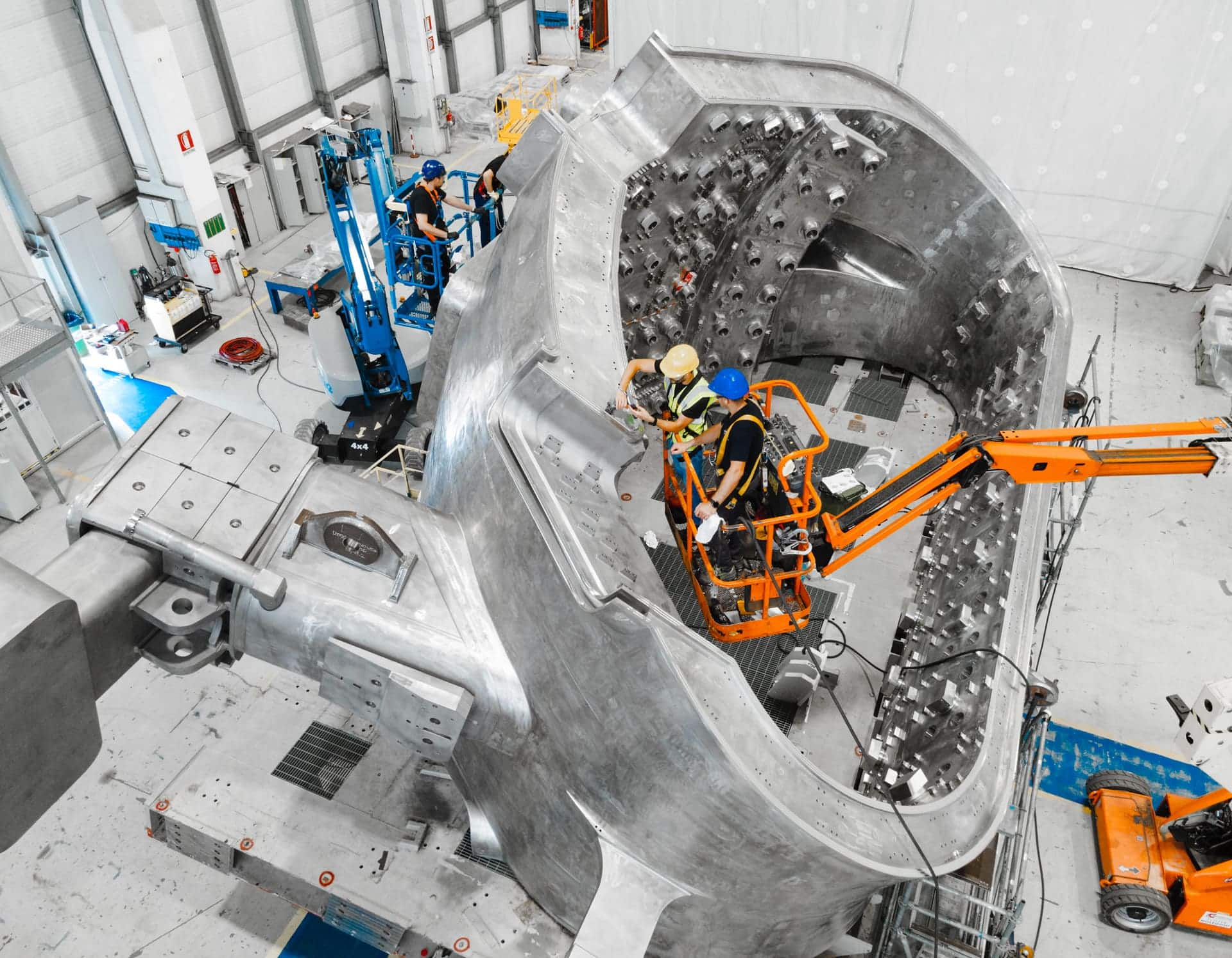
The race for fusion energy is often told through superconducting magnets, tokamak reactors, plasma at extreme temperatures, and massive public or private investments. But a less visible part of the challenge lies in software. Before building a physical machine, researchers need to simulate how the plasma will behave, how magnetic fields will respond, what stability can be achieved, and which designs have the best chance of success.
This is where VeloAlpha aims to position itself. Founded in April in Beijing by Xie Huasheng, a fusion theorist and plasma simulation expert, the startup is developing FusionAlpha, a simulator designed for fusion teams to test reactor designs on computers before engaging in costly physical experiments. As reported by South China Morning Post, the idea is based on an increasingly widespread sector concept: Artificial Intelligence (AI) won’t solve fusion on its own, but it can reduce costs and accelerate critical phases of design.
The “Impossible Triangle” of Fusion Simulation
Xie summarizes the problem with a clear expression: the “impossible triangle” of fusion simulation software. Existing tools tend to fall into one of three extremes. Some are highly precise but require enormous computational power. Others are fast but don’t always provide enough reliability to extrapolate results to new machines. And some are conceptually simpler, yet too approximate to guide the design of next-generation reactors.
Balancing accuracy, speed, and computational cost is one of fusion’s biggest bottlenecks. It’s not enough to have good physical equations; they must be converted into models that can be executed, compared with experimental data, and used to make engineering decisions. Each physical experiment at a fusion facility consumes time, money, and human resources. If some of this trial-and-error can be virtualized, the entire process moves forward faster.
VeloAlpha presents FusionAlpha as a tool to study designs before committing to costly testing. According to Xie, the performance of over a dozen physical design and analysis models has improved rapidly thanks to more refined mathematical structures and AI to boost research efficiency. The key isn’t replacing physics with a black box but combining physical models and AI techniques to speed up calculations, approximate scenarios, and reduce unproductive iterations.
| Fusion simulation challenge | Traditional approach | What AI can contribute |
|---|---|---|
| Highly accurate but slow models | High-fidelity physical simulations on supercomputers | Faster surrogate models to explore more scenarios |
| Fast but less reliable models | Useful approximations for initial estimations | Correction and calibration with experimental data |
| Cost of physical testing | Long cycles of design, construction, and testing | Early discard of unpromising configurations |
| Unstable plasma and hard-to-predict behavior | Specialized codes and manual analysis | Pattern detection, prediction, and assisted control |
| Reactor design | Reliance on accumulated experience and partial simulations | Integration of multiple variables into digital twins |
| Validation | Comparison with real machine data | Hybrid learning from simulation and experiments |
China Accelerates Through Software Innovation
VeloAlpha’s movement aligns with a broader phase of increased Chinese activity in fusion. The country hosts significant public facilities like the EAST tokamak and boasts a private ecosystem gaining international visibility. Energy Singularity, for example, has worked on the HH70 device, presented as a compact superconducting tokamak developed in China, and champions a strategy leveraging local supply chains to reduce costs compared to Western rivals.
The emergence of a startup focused on software adds another layer to this race. For years, fusion has been viewed as a challenge dominated by experimental physics and heavy engineering. That view remains true but is incomplete. The industry also needs better tools for simulation, control, data analysis, experiment planning, and design assistance.
This isn’t exclusively a Chinese phenomenon. Google DeepMind has worked on plasma control using reinforcement learning, and in 2025 announced a collaboration with Commonwealth Fusion Systems to apply AI to developing next-generation fusion. In the U.S., the Princeton Plasma Physics Laboratory has introduced initiatives combining AI and high-performance computing to accelerate simulations. In the UK, fusion research teams are exploring digital twins and machine learning to reduce design and operation time.
The difference is that China appears to be applying this logic with entrepreneurial agility. VeloAlpha doesn’t promise an immediate commercial fusion plant. Its more concrete goal is to sell or develop a simulation layer that helps reactor builders make better decisions before reaching the laboratory or factory.
Why AI Can Help but Can’t Overcome Physical Challenges
Nuclear fusion aims to replicate the Sun’s process: joining light nuclei to release energy. In magnetic confinement designs, this involves heating fuel to create plasma and maintaining its stability with magnetic fields. The challenge is immense because plasma is a complex, turbulent, and highly sensitive system to small variations.
AI can assist various parts of this problem. It can accelerate numerical models, predict instabilities, aid in plasma control, analyze experimental data, explore geometries, and develop surrogate models to test many configurations without running full simulations each time. It can also help build digital twins of fusion machines, where real and simulated behaviors feedback into each other.
However, it’s important to temper enthusiasm. AI doesn’t solve material, magnet, heat extraction, neutron damage, maintenance, plant economics, tritium handling, or grid integration issues on its own. It doesn’t replace physical testing either. A model can speed up learning, but a fusion plant must demonstrate net energy production, operational stability, industrial availability, and cost competitiveness.
Recent studies on AI and fusion emphasize this caution: machine learning tools have potential but must be integrated with robust physical models, responsible methodologies, and close collaboration between domain experts and AI specialists. In fusion, a fast but unreliable prediction can be more harmful than a slow, accurate simulation.
Fusion Enters a More Industrial Phase
This shift is driven by increased capital and attention to fusion. The Fusion Industry Association estimated that in 2025, private fusion companies raised $2.64 billion over the previous 12 months, totaling nearly $9.77 billion in funding across surveyed companies. Interest has been bolstered by demand for clean energy, pressure from data centers, and the search for reliable, emission-free electricity sources.
This capital doesn’t guarantee success but shifts the tools the sector needs. As projects move from academic research into industrial timelines, design, simulation, and validation software become more critical. Industries like aviation, automotive, and semiconductors have experienced similar shifts; no complex industry scales without powerful simulation layers.
VeloAlpha aims to occupy this space in fusion. If FusionAlpha successfully reduces design times, improves prediction accuracy, or enables smaller teams to explore advanced configurations, it could become a valuable part of the ecosystem. If it fails to prove reliability against real data, it will remain just another long-held promise in a sector accustomed to high expectations.
This news matters because it shifts part of the conversation. Fusion won’t progress solely by building larger machines or stronger magnets. It will also rely on software capable of deciding what’s worth building. In a technology where each experiment can cost millions, being able to discard unpromising options early can be as valuable as making the right choice later.
Frequently Asked Questions
What is VeloAlpha?
VeloAlpha is a Beijing-based startup founded by Xie Huasheng, an expert in fusion theory and plasma simulation. It is developing FusionAlpha, a simulator for fusion reactor design and analysis.
What problem does FusionAlpha aim to solve?
It seeks to reduce the cost and duration of design testing by using computer simulations that combine physical models with AI techniques to evaluate configurations before physical experiments.
Can AI make nuclear fusion feasible?
AI can accelerate key steps such as simulation, plasma control, and data analysis, but doesn’t solve fundamental material, engineering, or economic challenges like materials, heat extraction, fuel, continuous operation, and costs.
Why is China gaining visibility in fusion?
China combines large public facilities, industrial supply chains, and startups aiming to accelerate reactor development and related tools. Simulation software represents a new layer in that strategy.
via: SCMP. Image of a Microsoft fission reactor.
