
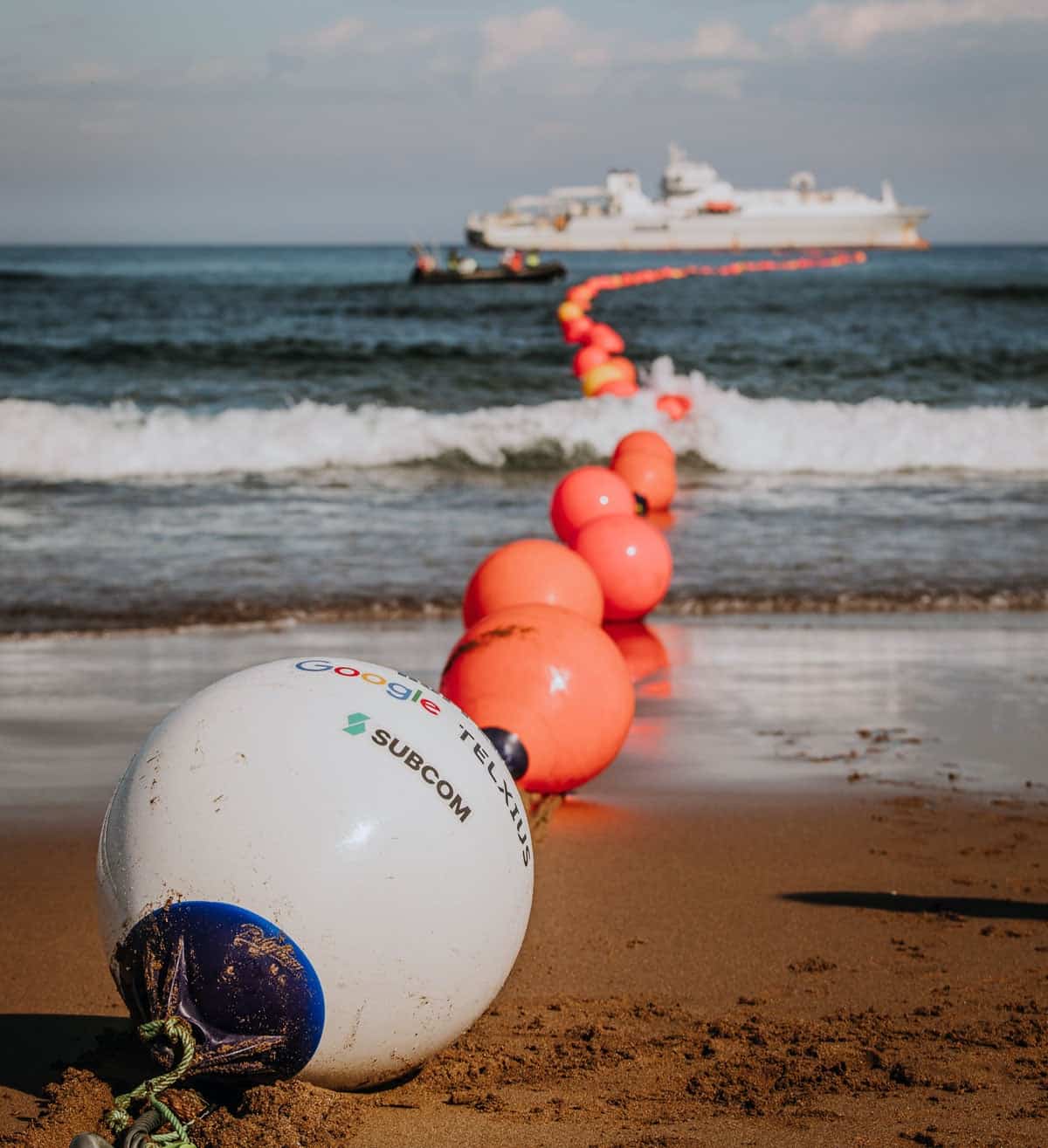
A roughly 500 million euro electrical infrastructure project between Ireland and Wales ended up altering part of its route due to an obstacle unlikely to appear in an engineering manual: Dobby’s fictional grave, the house elf from Harry Potter. Greenlink received hundreds of fan notifications when they discovered that the cable would land at Freshwater West, the Welsh beach used in filming Harry Potter and the Deathly Hallows for Dobby’s death and burial scene. The project rerouted to pass close, ironically, to real Bronze Age burial remains.
The key points of the Greenlink cable in 30 seconds
- Greenlink connects the electric grids of Ireland and Great Britain with 500 MW of bidirectional capacity.
- The route reaches Wales via Freshwater West, the filming location used in Harry Potter and the Deathly Hallows.
- Counters of fans protested upon learning that the planned route would affect the area of Dobby’s fictional grave.
- The responsible parties adjusted the route to avoid it.
- The cable ended up passing near real Bronze Age relics and urns.
This anecdote surfaced years after planning for Greenlink began, a project far more technologically impressive than its unexpected Harry Potter connection might suggest. It is a high-voltage direct current (HVDC) interconnector that allows electricity to be transmitted in both directions between Ireland and Great Britain.
The infrastructure is already completed, linking the Great Island substation in Wexford County, Ireland, with Pembroke in Pembrokeshire, Wales. Greenlink confirms the system has a nominal capacity of 500 MW and a total length of about 190 kilometers.
An electrical project that encountered Harry Potter
The story was explained by Simon Ludlam, project manager, on the Energy Revolution podcast and later reported by The Guardian.
During a BBC interview, Ludlam showed the location at Freshwater West where the cable would go underground. What seemed like a routine technical explanation had an unexpected consequence when the images aired on television.
The company began receiving hundreds of phone calls.
The reason related to a scene in Harry Potter and the Deathly Hallows. Freshwater West was used as the filming location for Shell Cottage and the site where Harry Potter buries Dobby after his death during the rescue mission.
Although there isn’t an actual grave built there for the film, fans have created an informal memorial over time. Many visitors leave stones with messages related to the character.
Ludlam admitted that initially he didn’t even know who Dobby was. When a colleague explained that the project would pass through his ‘grave,’ his first reaction was to point out that Dobby is a fictional character.
The numerous calls made it clear that the matter held a different significance for saga fans.
Greenlink ultimately sought an alternative route that avoided the area associated with Dobby.
The episode has an added peculiar twist. Ludlam mentioned that the new route passed quite close to authentic Bronze Age archaeological remains, including urns linked to human burials. The actual archaeology was managed through proper procedures; the cinematic grave was outside the new route.
500 MW beneath the Irish Sea
Beyond the anecdote, Greenlink is a significant energy infrastructure.
The project uses two HVDC submarine cables of ±320 kV, accompanied by fiber optics for control and monitoring. About 160 kilometers run beneath the Irish Sea, with an additional approximately 25 km of terrestrial cable in Ireland and 5 km in Wales.
Its operation is bidirectional.
When more electricity is available in Great Britain, Greenlink can transmit it to Ireland. When market and generation conditions favor the opposite, the flow reverses.
Electric interconnectors are becoming increasingly important as renewable generation grows. Wind and solar output vary with weather, so connecting markets enables energy transfer from surplus regions to those with higher demand.
Greenlink’s capacity is estimated to serve around 380,000 households, based on standard consumption and interconnector usage levels.
The infrastructure also has no overhead lines between stations.
The underground cables are buried, and on the maritime segment, they are either beneath the seabed or protected on the seabed if burial isn’t feasible.
The cable passes underneath the beach, not over it
Freshwater West posed an environmental challenge independent of Harry Potter.
The area has significant natural value. The National Trust implements initiatives to protect the beach and dunes, urging visitors to follow a “leave no trace” policy, avoiding littering or object leaving. The dunes are part of a Site of Special Scientific Interest (SSSI), a British designation for protected areas of scientific importance.
Dobby’s informal memorial directly conflicts with this conservation effort.
The site’s popularity has led visitors to leave stones, socks, and other Harry Potter-related objects. The cultural and tourism interest coexists with the need to preserve this sensitive coastal space.
For Greenlink installation, no large trench was dug across the beach.
Instead, horizontal directional drilling (HDD) was used to lay the cables beneath the dunes and Freshwater West, avoiding surface trenching. The company explains that this method allowed for the cable landing without disturbing the beach or disrupting visitor use.
From there, the cables are continued underground to the electric infrastructure in Pembroke.
The choice of Freshwater West involved more than engineering considerations. Greenlink states that during planning, studies were conducted on birdlife, ecology, geology, hydrology, noise, transport, landscape, and cultural heritage. Permissions for the land-based works in Wales were granted in 2020.
When a technical infrastructure meets a cultural site
Dobby’s story is striking because it highlights a variable difficult to account for in large infrastructure planning models.
Engineers can analyze geology, seabed, protected areas, archaeological heritage, landowners, roads, electrical networks, and nearly any physical factor along the route.
But predicting that a location used fleetingly in a film might later acquire cultural significance to generate hundreds of claims is much more complex.
Freshwater West is a prime example.
Legally and archaeologically, there is no actual Dobby’s grave there. But from the perspective of fans, the spot functions as a recognizable memorial and should be preserved.
For a project costing hundreds of millions, changing part of the route was viewed as more reasonable than managing ongoing conflicts with visitors and fans.
The case also highlights that submarine cable routes are not just about the shortest distance between two points.
Responsible planners must consider depth, seafloor geology, fishing, navigation, protected habitats, existing infrastructure, archaeological heritage, and landing site conditions. When on land, they also face roads, private properties, permits, and grid connections.
In Greenlink’s case, an additional factor appeared unexpectedly: Harry Potter.
From private investment to critical infrastructure
Greenlink reached financial close for construction in March 2022. The engineering, procurement, and construction (EPC) contract was awarded to a consortium of Siemens Energy and Sumitomo Electric.
Initial estimates valued the project at around 450 million euros, though later references suggest about 430 million pounds due to estimation timing, project evolution, and currency fluctuations.
Beyond this specific connection, the infrastructure reflects a broader trend.
Europe is expanding its electrical interconnections because higher renewable penetration requires faster energy transfer across regions. HVDC submarine cables allow linking separate systems across seas and transmitting large power volumes with relatively low losses.
While Greenlink’s 500 MW capacity is modest compared to some major interconnectors under development, it introduces a new link between Ireland and Great Britain and enables bidirectional energy flow as needed.
Freshwater West’s episode doesn’t change this technological function but adds a notable story: a billion-euro project was able to bypass environmental permits, marine floor, and archaeological remains, all while learning who Dobby is before completing its route.
Frequently Asked Questions
What is the Greenlink submarine cable?
Greenlink is a 500 MW HVDC interconnector between Ireland and Great Britain. It links Great Island in Wexford, Ireland, with Pembroke in Wales through underground and underwater cables.
Why was the route changed to avoid Dobby’s grave?
After the route was shown on television at Freshwater West, Greenlink received hundreds of calls from Harry Potter fans worried that the cable would affect the location used as Dobby’s grave in the movies. The project ultimately sought a new route to avoid the area.
Is there really a Dobby’s grave at Freshwater West?
No, there is no real grave. Freshwater West was used for filming, and fans later created an informal memorial by leaving stones and messages for the character.
Does the cable physically pass under the beach at Freshwater West?
The cable arrives there, but Greenlink used horizontal directional drilling (HDD) to install it beneath the beach and dunes, avoiding open surface trenches.
via: tomshardware
