
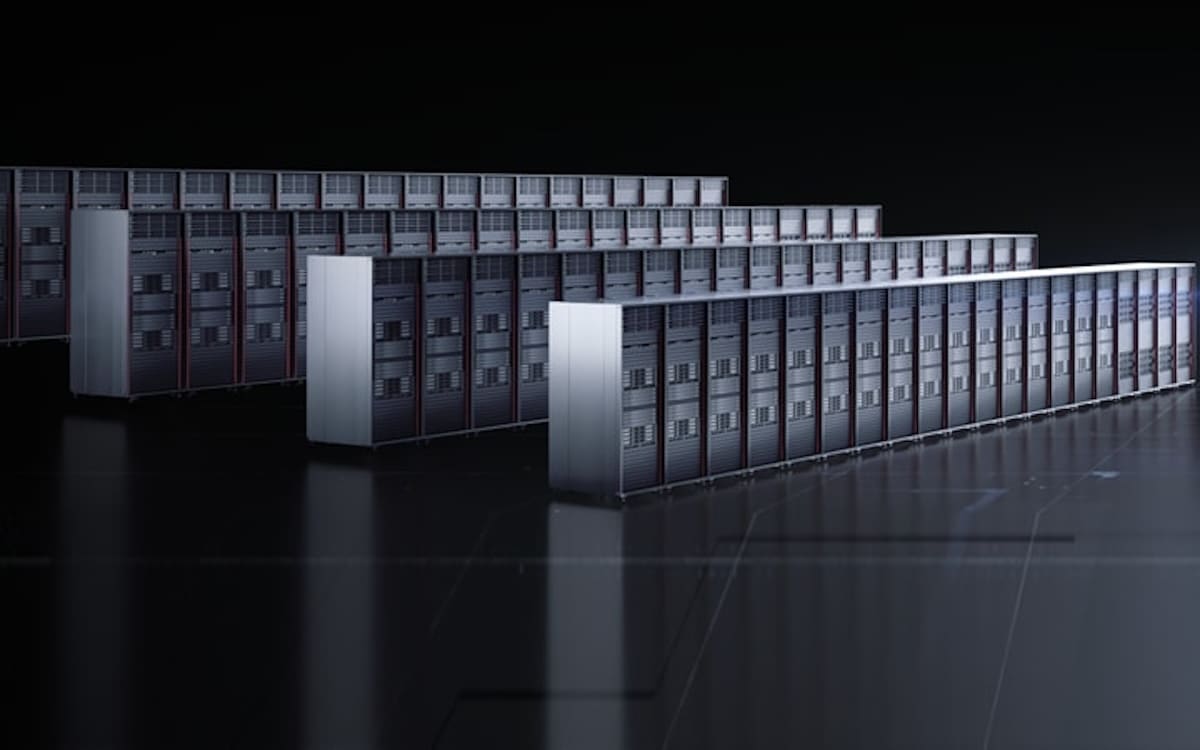
Huawei has unveiled part of its roadmap for artificial intelligence (AI) accelerators and introduced the Atlas 960E SuperPoD, a system with up to 4,096 neural processing units (NPUs) connected using NPO optical technology. The company expects the Ascend 960DT to arrive in the first quarter of 2027, followed by the 960PR in the third quarter, while the Ascend 970 and 980 are planned for 2028 and 2029, respectively.
Huawei’s new Ascend chips in 20 seconds
- The Ascend 960DT arrives in Q1 2027, three quarters ahead of Huawei’s earlier schedule.
- The 960PR is planned for Q3 2027 and raises FP4 performance to 8 PFLOPS.
- Huawei places the Ascend 970 in 2028 and the 980 in 2029, with more memory and bandwidth.
- The Atlas 960E SuperPoD packs up to 4,096 NPUs, 8 EFLOPS FP8, and 16 EFLOPS FP4.
- The system uses 5,500 Hi-ONE optical engines and UnifiedBus to connect the accelerators.
The announcement came on September 17 during Huawei Connect 2026, held in Shanghai. The company is pursuing a yearly cadence for its Ascend accelerators while simultaneously developing a systems architecture in which memory, storage, processing, and communications are all linked through UnifiedBus.
The strategy reflects a broader shift in scale for AI systems. Huawei is no longer focused solely on the performance of a single NPU, but also on how thousands of accelerators can work together as a coordinated system. The company has also introduced Peerium, a computing architecture designed to scale to up to one million processors through unified memory addressing and resource interconnection.
Ascend 960: more performance and memory for 2027
The Ascend 960DT will be the first chip in the new generation. Huawei says it will be available in the first quarter of 2027, three quarters ahead of the date in its previous roadmap. The 960PR arrives in the third quarter of that same year, also earlier than originally planned.
Figures released by Huawei put the 960DT at 2 PFLOPS of FP8 compute and 4 PFLOPS in FP4, along with 288 GB of HBM memory and 9.6 TB/s of memory bandwidth. Its interconnect bandwidth reaches 2.2 TB/s, according to the figures from the presentation.
The 960PR keeps the same 2 PFLOPS FP8 figure but raises FP4 performance to 8 PFLOPS. In exchange, it uses 192 GB of HBM with 2.4 TB/s of memory bandwidth. Interconnect bandwidth stays at 2.2 TB/s.
The update also includes new numeric formats. Huawei says it supports FP32, HF32, FP16, BF16, FP8, MXFP8, HiF8, MXFP4, and HiF4, a combination meant to cover different precision and performance needs across training and inference.
The new timeline moves up the roadmap Huawei presented in 2025, when the company placed the Ascend 960 in the fourth quarter of 2027 and the Ascend 970 in the fourth quarter of 2028.
Ascend 970 and 980 add more memory and bandwidth
For 2028, Huawei positions the Ascend 970 as the next generation. Preliminary figures point to 3.6 PFLOPS FP8 and 14 PFLOPS FP4, along with 288 GB of memory and 14.4 TB/s of memory bandwidth. Interconnect bandwidth would rise to 4.4 TB/s.
The Ascend 980 is planned for 2029. Huawei still considers these specs preliminary, so the figures could change before launch. The presentation points to 7.2 PFLOPS FP8 and 28 PFLOPS FP4, 384 GB of HBM with 38.4 TB/s of bandwidth, and 8 TB/s of interconnect.
Huawei itself has described this as a one-generation-per-year cycle and says it intends to increase not just compute, but also memory capacity, memory bandwidth, and interconnect. The 970 and 980 figures should therefore be read as a roadmap, not as final specs for products that are already available.
| Chip | Expected date | FP8 | FP4 | Memory | Memory bandwidth |
|---|---|---|---|---|---|
| Ascend 960DT | Q1 2027 | 2 PFLOPS | 4 PFLOPS | 288 GB | 9.6 TB/s |
| Ascend 960PR | Q3 2027 | 2 PFLOPS | 8 PFLOPS | 192 GB | 2.4 TB/s |
| Ascend 970 | 2028 | 3.6 PFLOPS | 14 PFLOPS | 288 GB | 14.4 TB/s |
| Ascend 980 | 2029, preliminary | 7.2 PFLOPS | 28 PFLOPS | 384 GB | 38.4 TB/s |
The Atlas 960E takes the bet to thousands of accelerators
Alongside the new chips, Huawei has introduced the Atlas 960E SuperPoD, a large-scale system that uses NPO technology — short for Near-Packaged Optics — to handle communication between accelerators.
The system can pack up to 4,096 NPUs, with 8 EFLOPS of FP8 performance and 16 EFLOPS in FP4. Huawei says it uses 5,500 Hi-ONE optical engines to replace an infrastructure that would otherwise require 48,000 800G optical modules. According to the company, this configuration cuts power consumption by more than 550 kW and reaches 99.8% system availability.
The centerpiece is Hi-ONE, an NPO optical engine that Huawei rates at 7.2 Tbit/s of transmission capacity per unit. The company claims it’s the first NPO product of its kind with volume production capability and an integrated light source. These are Huawei’s own claims, describing the features the company attributes to its solution.
UnifiedBus rounds out the architecture. Huawei uses it as the interconnection mechanism between NPUs, memory, storage, and other components. For inter-rack setups, the company cites 176 ports at 1.6 Tbit/s per port and 280 Tbit/s of aggregate optical interconnect, while its UBG networking gear is designed to scale toward systems with up to one million NPUs.
Huawei has also introduced the OceanStor M900 as a storage system for AI model context caching. The proposal extends the memory used for KV Cache into SSD storage and lays out a multi-tier architecture to retain and reuse large amounts of context.
The company says an M900 cluster can reach 64 PB of capacity and up to 40 TB/s of aggregate bandwidth. It also claims that direct access between NPUs and SSDs can cut latency from the millisecond range down to 60 microseconds. These are figures Huawei has stated for its architecture and should be read within the corresponding test and configuration conditions.
The next step is connecting multiple SuperPoDs. Huawei plans to use UnifiedBus or RoCE to build larger clusters, with an announced capacity of up to 512,000 accelerators and, through multi-path topologies, up to one million NPUs.
The company’s bet rests on three related pillars: a new generation of accelerators, an interconnect designed to keep thousands of processors working together, and a storage layer capable of meeting the growing context-memory needs of AI models.
Frequently asked questions
When will the Huawei Ascend 960 arrive?
Huawei expects the Ascend 960DT to be available in the first quarter of 2027 and the Ascend 960PR in the third quarter of 2027. The company moved up both dates from its previous roadmap.
What performance will the Ascend 970 offer?
Preliminary figures put the Ascend 970 at 3.6 PFLOPS FP8 and 14 PFLOPS FP4, with 288 GB of memory and 14.4 TB/s of memory bandwidth. Huawei expects it to arrive in 2028.
How much memory will the Ascend 980 have?
Huawei’s preliminary roadmap points to 384 GB of HBM and 38.4 TB/s of memory bandwidth for the Ascend 980, expected in 2029. Its specs could still change before launch.
What is the Atlas 960E SuperPoD?
It’s an AI system built on up to 4,096 Ascend 960 NPUs and NPO technology. Huawei cites 8 EFLOPS FP8, 16 EFLOPS FP4, and an interconnect system based on Hi-ONE and UnifiedBus.
