
The AI Atlas in Spain, published in August 2026, brings together in 33 pages the main public initiatives and indicators the Spanish government uses to describe the evolution of artificial intelligence (AI) in the country. The document places Spain 7th worldwide in Stanford’s Global AI Vibrancy Ranking and highlights progress in adoption, training, public procurement, open models, supercomputing, and semiconductors.
Spain’s AI Atlas in 20 seconds
- Spain ranks 7th in Stanford’s global AI activity ranking.
- 44.2% of the working-age population uses generative AI, according to the indicator cited by the Atlas.
- 21.1% of Spanish companies with 10 or more employees say they use AI.
- ALIA, the AI factories, supercomputing, and training programs are part of the public infrastructure described.
- The document identifies the next challenge as turning these capabilities into productivity, public services, and technological sovereignty.
The report works as a snapshot of the Spanish ecosystem and, at the same time, as an inventory of the public policies deployed around AI. The document itself splits that strategy into several layers: rights, training, the public sector, businesses, industry, and infrastructure. Underneath sits a cross-cutting idea, the so-called SpainStack, which the government uses to structure the country’s technology and digital sovereignty capabilities.
The Atlas was presented by the Ministry for Digital Transformation and the Civil Service and has been listed on the Transparency Portal since September 8. The Council of Ministers had already included its presentation among the matters discussed on August 25.
Spain gains ground in AI, but business adoption still has room to grow
One of the most striking figures in the document is the position it assigns Spain in international indicators. The Atlas cites 7th place globally in Stanford HAI’s Global AI Vibrancy Ranking, while placing the country 6th worldwide in generative AI adoption among the working-age population, at 44.2%. It also cites 4th place worldwide in demand for specialized AI talent, equivalent to 3.31% of the job postings analyzed.
These indicators don’t all come from a single measurement. The Atlas’s annex combines data from Stanford HAI, the Microsoft AI Economy Institute, Eurostat, Spain’s National Statistics Institute (INE), the European Commission, Dealroom, and other sources. The document itself warns that some figures aren’t directly comparable due to methodological differences. For instance, the share of companies with 10 or more employees using AI appears as 20.3% in Eurostat and 21.1% in the INE’s 2025 figures.
The business figure is especially useful for understanding the gap between technology availability and actual adoption. The Atlas notes that 21.1% of Spanish companies with 10 or more employees were using AI in 2025, up 8.7% from the previous measurement cited in the document. That figure puts the spotlight on businesses — especially small and medium-sized ones — as one of the areas where the next phase of adoption will need to translate into concrete use cases.
To that end, the report compiles programs such as Kit Digital, Kit Consulting, Acelera Pyme, RedIA, and the AI Value Chains program. According to the Atlas, Kit Digital and Kit Consulting have together provided more than 1 million grants worth nearly €4 billion. RedIA and RedIA Salud have mobilized €180 million for experimental development, prototyping, and validation of AI solutions.
From talent to homegrown models and supercomputing
The Atlas’s second major pillar is training. The document puts the investment from the National Digital Skills Plan at more than €3 billion and cites nearly 6 million free training courses. It also counts 83,437 courses currently underway.
On top of that comes a specific program for licensed professionals, with a €200 million budget and a goal of training up to 80,000 professionals. At the time captured by the report, 10,899 people had received training.
Specialized training is also expanding through vocational education and universities. The Atlas cites new specialization courses in AI and Big Data and notes that the university offering of degrees and master’s programs related to artificial intelligence and data science has kept growing.
Another program, Building the AI Generation, has, according to the document, 374 predoctoral, postdoctoral, and technical contracts, tied to a €120 million budget. The stated goal is to strengthen the pipeline of researchers and specialists in AI-related fields.
At the infrastructure layer sits one of the most distinctive elements of Spain’s strategy: ALIA, a family of open, public, state-run models trained in Spanish and with at least 20% of its data in co-official languages, according to the Atlas. The document cites use cases in government agencies and public bodies, plus projects tied to city councils and the Alhambra.
Computing infrastructure also gets significant space. Spain has, according to the report, two approved AI factories: those tied to the Barcelona Supercomputing Center-National Supercomputing Center (BSC-CNS) and the Galicia Supercomputing Center (CESGA). The Atlas also notes the reinforcement of the Spanish Supercomputing Network (RES) with more than €63 million and 14 nodes spread across the country.
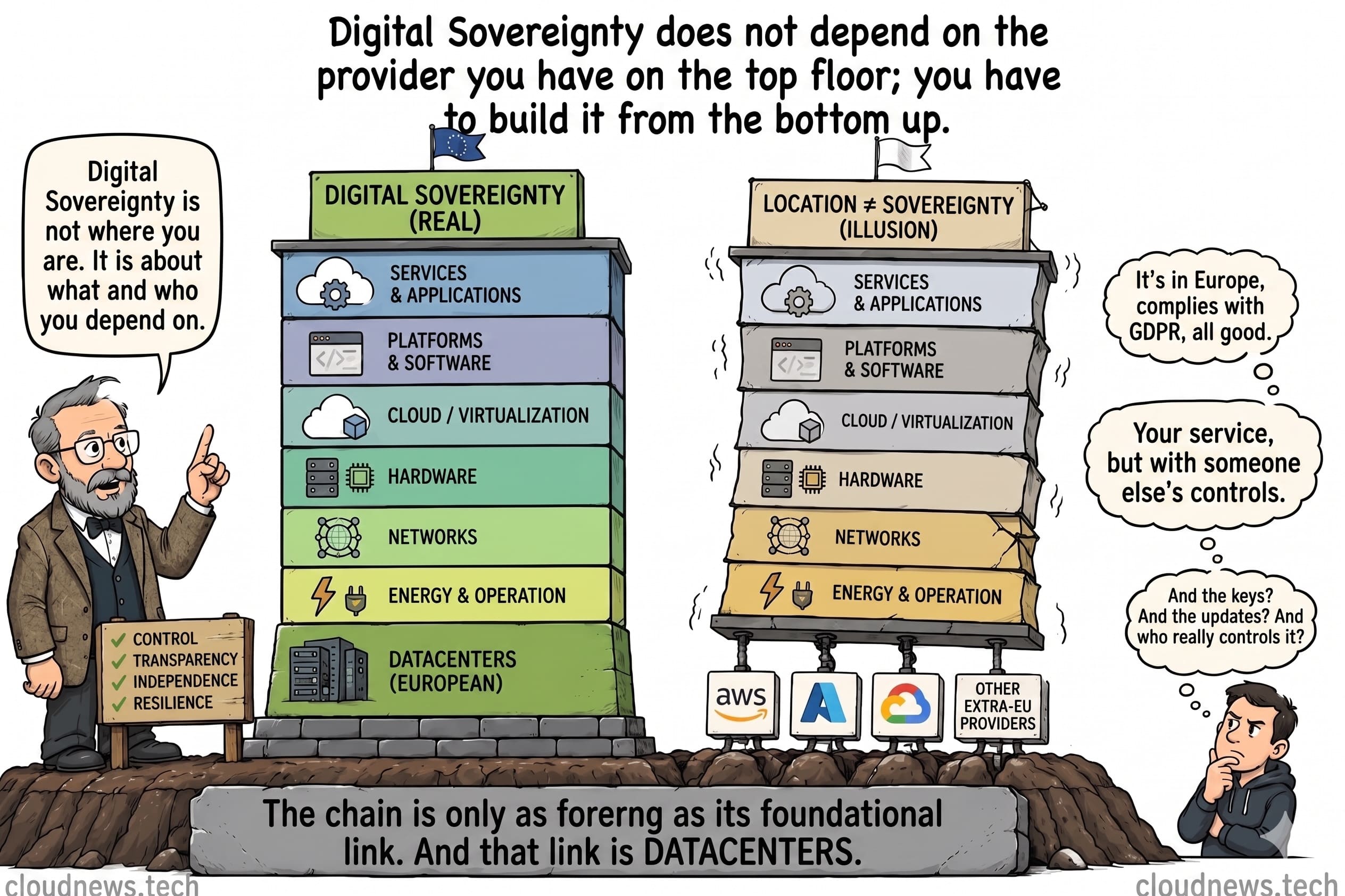
The document ties these capabilities to a broader technology strategy. The so-called SpainStack includes layers dedicated to materials and energy, chips, networks, the internet of things, cloud, software, and, at the top, data and artificial intelligence.
That framing explains why the Atlas devotes space to semiconductors, photonics, microelectronics, quantum computing, and data centers. Artificial intelligence needs models and software, but also compute capacity, networks, storage, chips, and access to data.
Government wants to use AI as a testing ground
The public sector makes up another of the document’s six major areas. Among the initiatives, GobTechLab stands out, cataloguing 19 use cases for experimenting with AI within the General State Administration.
The projects include intelligent assistants, document management, search and analysis of legal or scientific knowledge, and decision-support systems. The stated goal is to test solutions on concrete administrative problems before rolling them out to other bodies.
There’s also a Sovereign AI Platform for Government, conceived as shared infrastructure for using models under public control. The Atlas ties it to the protection of sensitive data, auditability, traceability, and the ability to share compute, data, and model capabilities between agencies.
The regulatory dimension also takes up significant space. Spain created the Spanish Agency for the Supervision of Artificial Intelligence (AESIA) and launched an AI regulatory sandbox that the document identifies as the first in the European Union. This environment included 12 AI systems from 12 companies and produced 16 best-practice guides, according to the Atlas.
The government has also pushed forward an Organic Law bill for the good use and governance of AI. Since it’s a piece of draft legislation, its provisions need to be kept separate from measures already in force. The document cites among its goals organizing national governance, identifying competent authorities, and establishing certain authorization and sanction regimes.
Public-sector activity isn’t limited to regulation. The Atlas counts 187 public contracts related to AI between 2013 and 2024, putting Spain in 3rd place worldwide on that indicator. It also notes that Spain ranks 1st worldwide in mentions of AI within legislative procedures between 2016 and 2024, according to Stanford HAI.
The big remaining bet is on scale
The industrial section shows just how far Spain’s strategy is trying to reach beyond models and applications. The Atlas cites investments from the Spanish Society for Technological Transformation (SETT), the Chip PERTE, the Next Tech fund, and projects related to microelectronics, photonics, and new materials.
At the European level, Spain also participates in the European Tech Champions Initiative (ETCI) with a €700 million contribution, according to the document. The Atlas puts the resources this initiative has mobilized for European scale-ups at more than €10 billion.
Infrastructure plans for the coming years also include a Spanish bid for a European AI gigafactory. The Atlas talks about a possible public-private investment of more than €4 billion. This is a bid and an investment forecast, not infrastructure that’s already operational.
The same caveat applies to the rest of the initiatives still under development. The document mixes capabilities already operating with programs in execution, projects under development, and future goals, so the August 2026 snapshot isn’t the same as an inventory of fully completed infrastructure.
Spain’s AI Atlas leaves a fairly concrete technological picture. The country has built a network of training programs, business funding, open models, supercomputing, regulation, and infrastructure that the government presents as a comprehensive strategy. The indicators used show meaningful AI adoption and a strong international position on several metrics, though they also reflect that a significant share of the business sector still isn’t using these technologies.
The report itself identifies the next challenge: turning accumulated capabilities into economic growth, better public services, and greater national and European digital sovereignty. That transition will depend less on the existence of individual programs and more on their ability to translate into business projects, research, operational infrastructure, and effective uses of AI.
Frequently asked questions
What is Spain’s AI Atlas?
It’s a report from the Ministry for Digital Transformation and the Civil Service that compiles indicators and initiatives related to artificial intelligence in Spain. Its August 2026 edition covers rights, training, the public sector, businesses, industry, and infrastructure.
What position does Spain hold in AI, according to the Atlas?
The document cites Spain’s 7th place worldwide in Stanford’s Global AI Vibrancy Ranking. It also includes other international indicators on adoption, talent, public procurement, and infrastructure.
How many Spanish companies use AI?
The Atlas cites 21.1% of Spanish companies with 10 or more employees using AI in 2025, according to the INE. Eurostat puts that same indicator at 20.3%, a difference the report attributes to sampling methodology.
What is ALIA?
ALIA is a family of open, public, state-run models, trained mainly in Spanish and including co-official languages. The Atlas presents it as one of the public AI infrastructures developed as part of Spain’s strategy.
