
Red.es has published the resolution for RedCyTI, the program through which it will fund 52 smart economy projects submitted by city councils, provincial councils, island councils, and single-province autonomous communities. The public body will contribute more than €94 million, drawn from its own funds and the European Regional Development Fund (ERDF), and total investment will exceed €126 million once the beneficiary administrations’ own contribution is added.
RedCyTI’s resolution in 20 seconds
- Red.es selects 52 smart economy projects spread across 14 autonomous communities.
- The agency contributes more than €94 million between its own funds and ERDF money.
- With local administrations’ share, total investment tops €126 million.
- Each project has a budget of between €1.5 million and €6 million.
- Andalusia accounts for 15 initiatives and the Canary Islands for seven.
The aid will cover between 40% and 85% of each initiative’s eligible budget, a percentage that depends on the region where it’s carried out. Red.es explains that, in choosing the projects, it took into account the applicants’ digital maturity, the potential impact on their local economy, and their long-term sustainability.
Urban labs, digital twins, and data spaces
The program focuses on the economic side of smart cities and territories, what Red.es calls Smart Economy. According to the agency, the funds will go toward creating or improving technology infrastructure, innovation spaces, and digital solutions to boost economic activity, support entrepreneurship, and generate employment.
Planned actions include experimentation environments or sandboxes for smart mobility technologies, such as connected and autonomous vehicles or drones, along with urban innovation labs and infrastructure for testing solutions in agriculture, fishing, livestock farming, and energy. Red.es also expects these spaces to serve as meeting points between administrations, companies, and technology centers.
The project names offer clues about where much of the money will go. Several are presented as data platforms or spaces, such as the Toledo Municipal Data Space, the Data Hub Tenerife, the Santiago Smart Economy Data Hub, and the Jaén Dual Data Hub. Others incorporate digital twins — virtual replicas of a territory or its activity — such as the Digital Twin of the Logistics-Industrial Territory of the Principality of Asturias, the Sevilla SmartEconomy Twin, and the LPA Smart Economy Twin & Data Space in Las Palmas de Gran Canaria.
Artificial intelligence shows up explicitly in VALENT.IA, from Valencia City Council, and in SantomeraIA, which the Murcian municipality frames as a municipal AI hub and economic digital twin. There are also proposals tied to specific sectors: Agriculture 4.0 in Lebrija, digital transformation of banana farming in Gáldar, an agroindustry demonstration center at the Badajoz Provincial Council, Construction 4.0 at the Barcelona Provincial Council, Smart Water Alcoi in Alcoy, and the Digital Footwear Factory Lab from the Government of La Rioja.
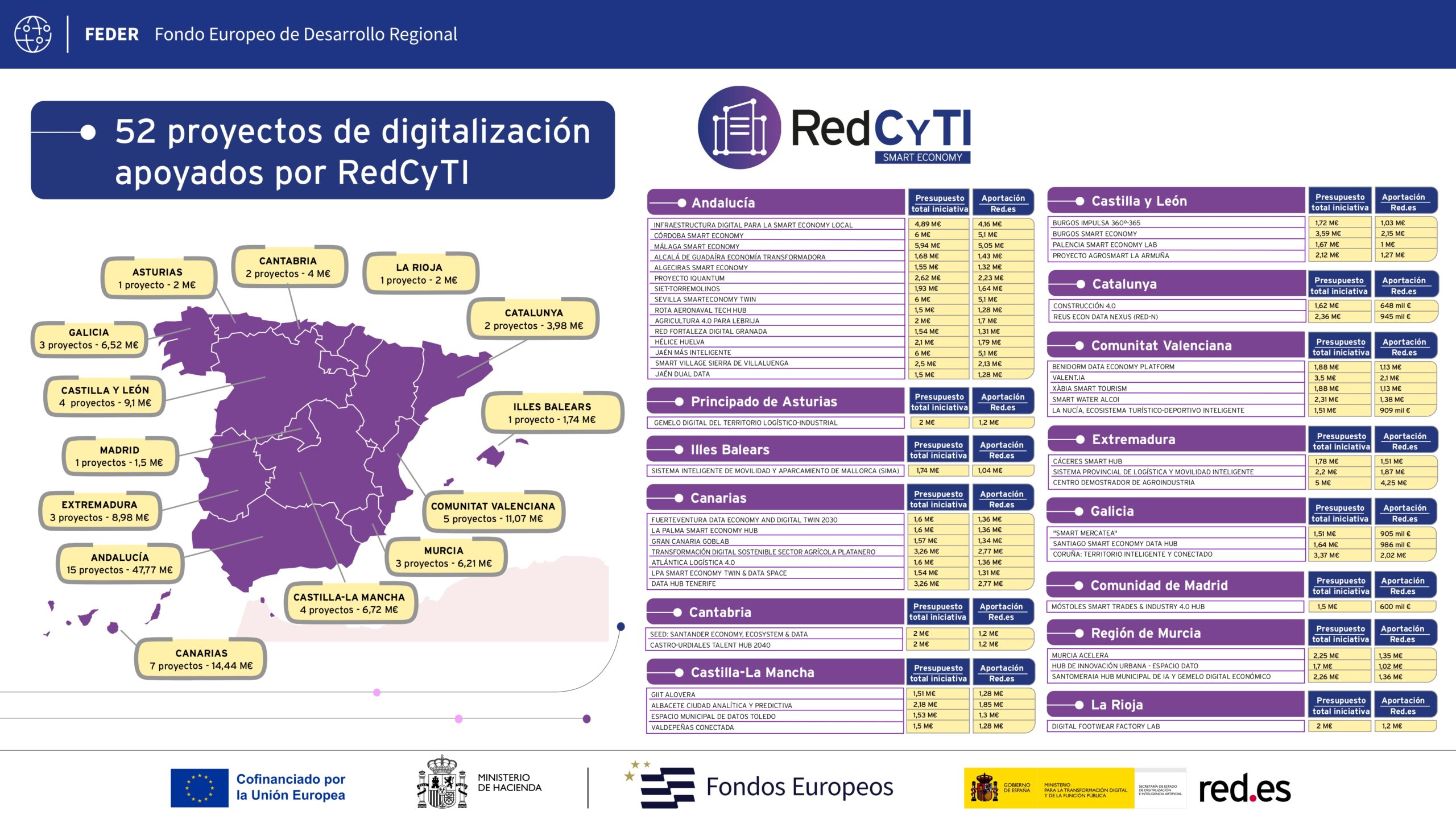
Andalusia and the Canary Islands account for 22 of the 52 projects
By region, Andalusia has 15 projects, almost three in ten. It’s followed by the Canary Islands with seven and the Valencian Community with five. Castilla-La Mancha and Castilla y León each have four; Extremadura, Galicia, and the Region of Murcia have three each; Cantabria and Catalonia have two; and Asturias, the Balearic Islands, Madrid, and La Rioja have one each.
Most of the selected entities are city councils, but the list also includes nine provincial councils (Córdoba, Granada, Huelva, Jaén, Burgos, Barcelona, Cáceres, Badajoz, and A Coruña), four Canary Island councils, the Mallorca Island Council, and the governments of the Principality of Asturias and La Rioja. Alongside capitals like Seville, Málaga, Valencia, or Murcia, the list also includes small municipalities such as Villaluenga del Rosario, La Vellés, and Alovera.
Here is the full list of selected projects published by Red.es:
| Autonomous community | Beneficiary entity | Project |
|---|---|---|
| Andalusia | Córdoba City Council | Digital Infrastructure for the Local Smart Economy |
| Andalusia | Córdoba Provincial Council | Córdoba Smart Economy |
| Andalusia | Málaga City Council | Málaga Smart Economy |
| Andalusia | Alcalá de Guadaíra City Council | Alcalá de Guadaíra Transformative Economy |
| Andalusia | Algeciras City Council | Algeciras Smart Economy |
| Andalusia | Granada City Council | iQuantum Project |
| Andalusia | Torremolinos City Council | SIET-Torremolinos |
| Andalusia | Seville City Council | Sevilla SmartEconomy Twin |
| Andalusia | Rota City Council | Rota Aeronaval Tech Hub |
| Andalusia | Lebrija City Council | Agriculture 4.0 for Lebrija |
| Andalusia | Granada Provincial Council | Granada Digital Fortress Network |
| Andalusia | Huelva Provincial Council | Hélice Huelva |
| Andalusia | Jaén Provincial Council | Jaén Más Inteligente |
| Andalusia | Villaluenga del Rosario City Council | Smart Village Sierra de Villaluenga |
| Andalusia | Jaén City Council | Jaén Dual Data Hub |
| Asturias | Principality of Asturias | Digital Twin of the Logistics-Industrial Territory |
| Balearic Islands | Mallorca Island Council | Smart Mobility and Parking System of Mallorca (SIMA) |
| Canary Islands | Fuerteventura Island Council | Fuerteventura Data Economy and Digital Twin 2030 |
| Canary Islands | La Palma Island Council | La Palma Smart Economy Hub |
| Canary Islands | Gran Canaria Island Council | Gran Canaria GobLab |
| Canary Islands | Gáldar City Council | Sustainable Digital Transformation of the Banana Farming Sector |
| Canary Islands | Santa Cruz de Tenerife City Council | Atlántica Logística 4.0 |
| Canary Islands | Las Palmas de Gran Canaria City Council | LPA Smart Economy Twin & Data Space |
| Canary Islands | Tenerife Island Council | Data Hub Tenerife |
| Cantabria | Santander City Council | SEED: Santander Economy, Ecosystem & Data |
| Cantabria | Castro-Urdiales City Council | Castro-Urdiales Talent Hub 2040 |
| Castilla-La Mancha | Alovera City Council | GIIT Alovera |
| Castilla-La Mancha | Albacete City Council | Albacete Analytical and Predictive City |
| Castilla-La Mancha | Toledo City Council | Toledo Municipal Data Space |
| Castilla-La Mancha | Valdepeñas City Council | Valdepeñas Conectada |
| Castilla y León | Burgos Provincial Council | Burgos Impulsa 360º-365 |
| Castilla y León | Burgos City Council | Burgos Smart Economy |
| Castilla y León | Palencia City Council | Palencia Smart Economy Lab |
| Castilla y León | La Vellés City Council | AgroSmart La Armuña Project |
| Catalonia | Barcelona Provincial Council | Construction 4.0 |
| Catalonia | Reus City Council | Reus Econ Data Nexus (RED-N) |
| Valencian Community | Benidorm City Council | Benidorm Data Economy Platform |
| Valencian Community | Valencia City Council | VALENT.IA |
| Valencian Community | Jávea City Council | Xàbia Smart Tourism |
| Valencian Community | Alcoy City Council | Smart Water Alcoi |
| Valencian Community | La Nucía City Council | La Nucía, Smart Sports-Tourism Ecosystem |
| Extremadura | Cáceres City Council | Cáceres Smart Hub |
| Extremadura | Cáceres Provincial Council | Provincial Smart Logistics and Mobility System |
| Extremadura | Badajoz Provincial Council | Agroindustry Demonstration Center |
| Galicia | Ponteareas City Council | Smart Mercatea |
| Galicia | Santiago de Compostela City Council | Santiago Smart Economy Data Hub |
| Galicia | A Coruña Provincial Council | Coruña: Smart, Connected Territory |
| Community of Madrid | Móstoles City Council | Móstoles Smart Trades & Industry 4.0 Hub |
| Region of Murcia | Murcia City Council | Murcia Acelera |
| Region of Murcia | Cartagena City Council | Urban Innovation Hub – Data Space |
| Region of Murcia | Santomera City Council | SantomeraIA: Municipal AI Hub and Economic Digital Twin |
| La Rioja | Government of La Rioja | Digital Footwear Factory Lab |
A funding line with more than a decade of history
RedCyTI joins the calls the Spanish government has launched since approving the National Smart Cities Plan in 2015. According to Red.es, the five previous calls allocated more than €200 million, co-financed with ERDF funds, to 59 initiatives: 25 for cities, 24 for tourist destinations, seven for buildings, and three for islands. The agency also works with the Spanish Network of Smart Cities (RECI) and the Spanish Federation of Municipalities and Provinces (FEMP).
Cloudnews.tech already reported in September 2025 on the 2025 RedCyTI call, announced at the time with €87 million and the same per-project budget range, from €1.5 to €6 million. Red.es’s announcement of the resolution doesn’t detail how it arrived at the more than €94 million it will now contribute, nor the execution timelines for the initiatives.
The agency, which reports to the Ministry for Digital Transformation and the Civil Service, also manages other technology funding lines. In late August, RedIA and RedIA Salud were resolved, with €180 million for 372 artificial intelligence projects. In RedCyTI’s case, the beneficiaries are public administrations, which will have to carry out the projects and contribute the portion of the budget not covered by the grant.
Frequently asked questions
What is RedCyTI?
It’s a funding program managed by Red.es to strengthen the smart economy of cities and territories through technology infrastructure, innovation spaces, and digital solutions.
How much money will RedCyTI mobilize?
Red.es will contribute more than €94 million from its own funds and ERDF money. With the beneficiary administrations’ contribution, total investment will exceed €126 million.
What percentage of each project does Red.es fund?
Between 40% and 85% of the eligible budget, depending on the region where the initiative is carried out. Each project has a total budget of between €1.5 and €6 million.
Which autonomous community has the most selected projects?
Andalusia, with 15 of the 52 projects. It’s followed by the Canary Islands with seven and the Valencian Community with five.
Sources:
