
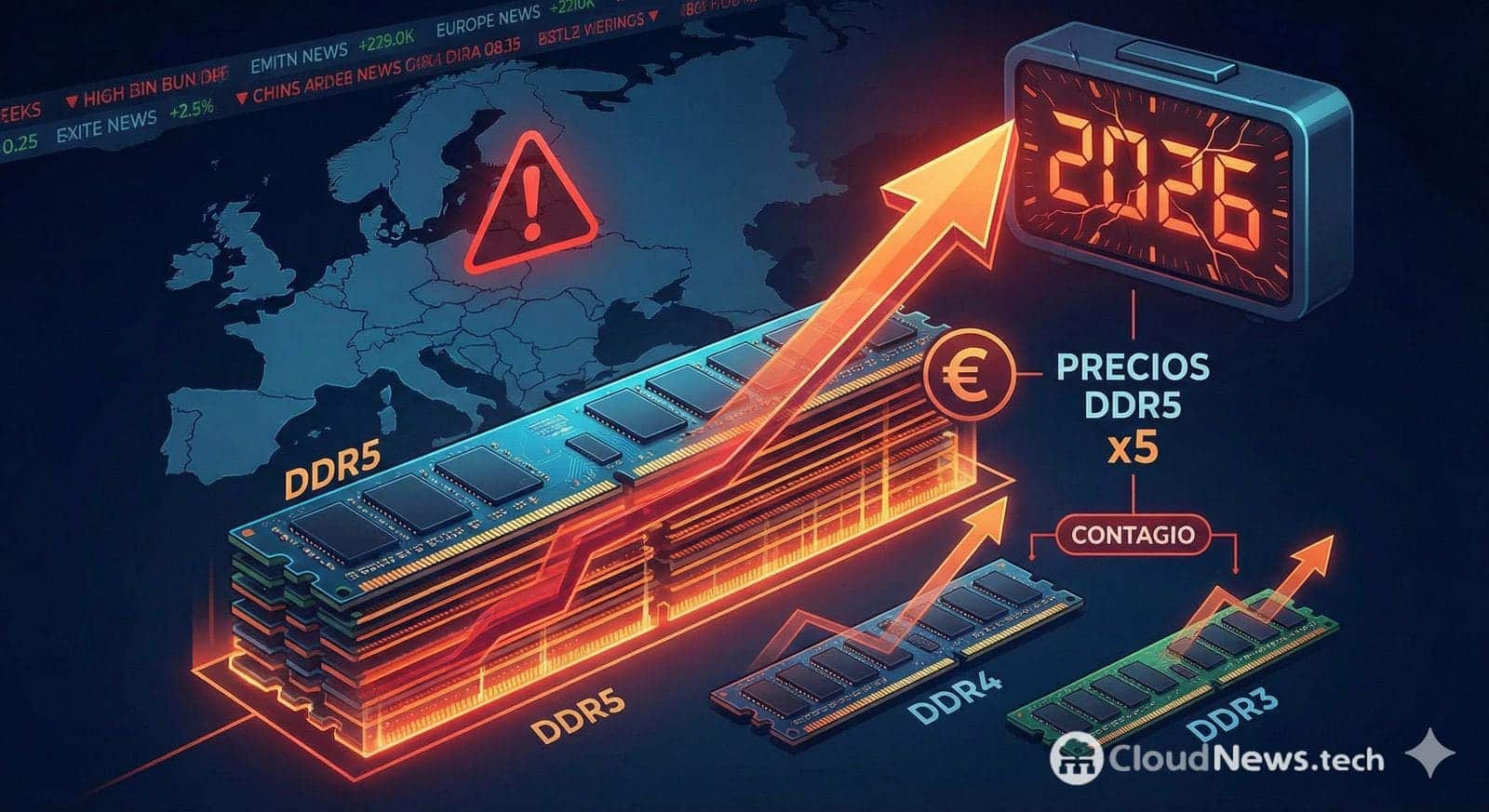
Retail DDR5 memory prices in Germany hit a new high in September 2026. The index compiled by 3DCenter from prices gathered on Geizhals reached 544% of the July 2025 level, up from 486% in August. In other words, the sample tracked now costs an average of 5.44 times its reference price from fourteen months earlier, though part of September’s jump is driven by a sharp increase in specific configurations.
DDR5 pricing in 30 seconds
- 3DCenter’s German index rose from 486% in August to 544% in September 2026.
- The monthly increase runs around 12%, while the cumulative increase versus July 2025 stands at 444%.
- A 2x16GB DDR5-6400 CL30 kit got 103% more expensive in a single month, pulling the average up considerably.
- 2x32GB DDR5-6400 kits rose 33%.
- The data reflects the German retail market and shouldn’t be extrapolated directly to every country.
The chart also shows that this price surge didn’t start now. The sharpest rise happened in the closing months of 2025: the index went from 120% in October to 178% in November and 346% in December. It hit 441% in January 2026.
A period of relative stabilization followed. The indicator dropped to 408% in March and stayed around 400% through June, before resuming its upward trend: 445% in July, 486% in August, and 544% in September.
This trajectory shows just how much the cost of building or upgrading a PC with large amounts of DDR5 memory has changed.
From 100 to 544: What the Index Actually Means
The 544% figure can be confusing.
It doesn’t mean prices have risen by 544%. The index uses July 2025 as its base of 100. Reaching 544 means the current price represents 544% of the starting price.
The cumulative increase from the starting point is therefore 444%.
| Month | DDR5 Index | Monthly Change |
|---|---|---|
| July 2025 | 100% | Base |
| August | 102% | +2% |
| September | 103% | +2% |
| October | 120% | +16% |
| November | 178% | +49% |
| December | 346% | +94% |
| January 2026 | 441% | +28% |
| February | 439% | ≈0% |
| March | 408% | -7% |
| April | 409% | ≈0% |
| May | 415% | +2% |
| June | 419% | +1% |
| July | 445% | +6% |
| August | 486% | +9% |
| September | 544% | +12% |
The monthly percentages 3DCenter publishes are rounded, so they don’t always match exactly what you’d get by dividing two consecutive index values.
Nor does the indicator track the price of a single module.
3DCenter uses various DDR5 configurations available on the German market and references retail prices sourced through Geizhals. The chart notes that the index is built from an average of 20 memory types.
This makes it possible to track a market trend, but it doesn’t mean every DDR5 kit has multiplied its price by exactly 5.44.
A DDR5-6400 Kit Jumps 103% in September
That’s precisely where part of the explanation for last month’s jump lies.
According to data compiled by 3DCenter, a 2x16GB DDR5-6400 CL30 configuration saw its price rise 103% during September.
Practically doubling the price of one of the configurations in the sample has a noticeable effect on the average.
It wasn’t the only increase.
2x32GB DDR5-6400 kits posted a 33% rise, while some 32GB and 24GB configurations increased by as much as 18%. 16GB kits also saw increases, though generally more moderate ones.
That’s why it’s worth separating two conclusions.
The first is fairly clear from the data: DDR5 keeps getting more expensive in the German market analyzed here.
The second calls for more caution: the index rising from 486 to 544 in September doesn’t mean every module on sale in August is now 12% pricier. The sample’s composition and extreme moves like that 103% jump in the DDR5-6400 configuration skew the result.
The Steepest Rise Actually Happened in Late 2025
Although the new high grabs attention, September isn’t actually the most violent moment of this price crisis.
Between October 2025 and January 2026, the index went from 120 to 441.
December stood out in particular, with the indicator posting a monthly increase of close to 94%.
The full sequence shows three fairly distinct phases.
Prices stayed practically stable through the summer of 2025. The big jump happened between October and January. A temporary stabilization followed at around four times the reference price, and since June, increases have accelerated again.
August rose roughly 9%, and September adds another 12%.
The result is that a buyer who put off purchasing a configuration included in this sample since July 2025 is now facing a completely different market.
This hits computers that need 64, 96, 128GB or more of RAM especially hard, because the cost of memory starts eating up a much larger share of the total budget.
It also hurts workstations, small servers, virtualization setups, and certain systems used to run AI models locally, where having plenty of memory can matter more than in a conventional home PC.
AI’s Pressure Reaches Conventional Memory Too
Rising memory prices can’t be explained just by looking at German retailers.
The industry has spent months under heavy demand tied to data centers and artificial intelligence. Major manufacturers have an incentive to direct investment and capacity toward higher-margin products linked to servers and accelerators, a dynamic analysts expect to keep memory prices elevated well into 2028.
HBM (High Bandwidth Memory), used alongside GPUs and other AI accelerators, occupies an especially important position.
That doesn’t mean a line making DDR5 today can automatically switch to making HBM tomorrow. The processes, packaging, and requirements are different. Still, conventional DRAM and HBM share manufacturers, investment, wafers, and certain capacity-allocation decisions, so the AI market’s extraordinary growth can indirectly affect the supply of other products.
This is also happening alongside the tensions seen in SSD and NAND.
IDC noted recently that rising NAND and DRAM prices are pushing up the cost of enterprise storage systems, and it doesn’t expect meaningful relief from component pressures before 2028. That forecast focuses on enterprise storage and isn’t a specific prediction about DDR5 retail prices, but it reflects broader pressure on the memory market.
DDR4 Stabilizes, But Hasn’t Returned to Its Old Prices Either
DDR4 is behaving differently.
3DCenter’s data shows more stabilization in recent months, without the sharp increases DDR5 keeps posting.
That doesn’t mean DDR4 is cheap compared with its earlier price levels.
A 16GB DDR4-2133-or-higher configuration shows up in the September index with a cumulative increase close to 296% versus July 2025, according to data published by 3DCenter.
The difference lies in the recent price direction: DDR4 seems to have stabilized, while DDR5 is accelerating again.
For anyone who already has a DDR4-compatible platform, this trend can extend the economic lifespan of some equipment. For building current systems based on platforms that use DDR5 exclusively, the option to choose disappears.
The cost of RAM then becomes an important variable when configuring a computer.
Germany Is a Good Reference, But It Doesn’t Automatically Represent Spain
There’s another caveat necessary when interpreting this data.
The index is built from retail prices in the German market. Geizhals aggregates offers from different retailers, and 3DCenter uses that information to track the evolution of specific configurations.
It’s a useful source for spotting trends because it keeps a comparable methodology over time, but it isn’t a global DDR5 index.
Spain, France, the United States, or any other market may show different prices due to inventory, taxes, distribution, promotions, and model availability.
Nor should the retail price of a kit be confused with the contract price of the DRAM chips that computer manufacturers pay.
Between the two lie modules, PCBs, distribution, inventory, commercial margins, and other costs.
What the German indicator does make quite clear is the scale of the change hitting end buyers: the set of DDR5 configurations analyzed by 3DCenter has gone from an index of 100 in July 2025 to 544 in September 2026.
And after several months of relative calm around 400%, the curve is pointing upward again.
September’s figure is still shaped by extreme moves in some configurations, so the coming months will need to be watched to see whether 544 marks another stable plateau or whether part of the rise gets corrected.
For now, building a PC with lots of DDR5 is substantially more expensive than a year ago, and the increase no longer affects only especially fast or high-capacity configurations.
