
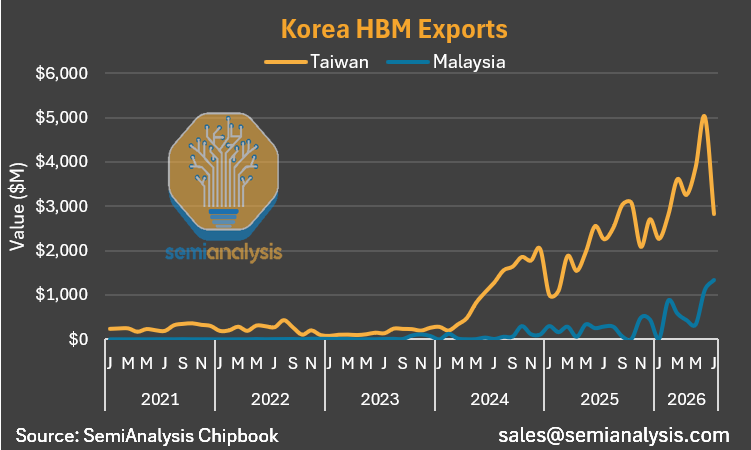
South Korea is closing in on a milestone that seemed distant not long ago: reaching $1 trillion in annual exports. But behind that growth lies a deepening reliance on semiconductors. Between January and August 2026, overseas chip sales reached $280.028 billion, up 171.7% year-on-year, and accounted for 73.8% of the country’s entire export growth.
South Korea’s exports in 20 seconds
- Cumulative exports reached $709.4 billion as of September 5, 2026.
- Semiconductors added up to $280.028 billion between January and August, up 171.7%.
- Chips generated 73.8% of the export increase.
- Autos, auto parts, steel, and machinery all declined.
- AI-driven demand is deepening South Korea’s reliance on its memory and semiconductor industry.
The contrast between sectors is stark. According to K-STAT data compiled by BusinessKorea, total exports rose 52.8% between January and August. Excluding semiconductors, growth drops to 17.9%. At the same time, auto exports fell 3.5%, auto parts exports fell 5.6%, steel products fell 0.2%, and general machinery fell 1.2%.
The AI boom is benefiting an economy home to two of the world’s leading memory makers, Samsung Electronics and SK hynix, while also making an unusually large share of its trade growth dependent on the tech investment cycle continuing.
Semiconductors explain nearly three-quarters of the growth
South Korea had exported $709.4 billion as of 1:00 p.m. on September 5, according to data from the Korea Customs Service and the Korea International Trade Association (KITA).
That figure carries a notable detail: it already exceeds the $709.3 billion recorded for all of last year. The country needed just 248 days in 2026 to reach that volume, 117 fewer days than in 2025.
The January-to-August breakdown shows more clearly where the growth is coming from.
| Sector | Year-on-year change, Jan-Aug 2026 |
|---|---|
| Semiconductors | +171.7% |
| Computers | +302.4% |
| Petrochemicals | +6.6% |
| Steel | -0.2% |
| General machinery | -1.2% |
| Automobiles | -3.5% |
| Auto parts | -5.6% |
Semiconductor exports reached $280.028 billion, while South Korea’s total exports between January and August came to $693.318 billion.
That means chips accounted for around 40.4% of all the country’s exports over those eight months.
Even more striking is their share of the growth: semiconductors contributed 73.8% of the total increase versus the same period last year.
The 302.4% jump in the computers category also stands out. But the figure needs context. A significant part of that increase comes from enterprise SSDs, NAND-based storage devices that are also benefiting from the buildout of AI infrastructure.
So a share of the growth counted outside the category strictly labeled “semiconductors” remains closely tied to the chip industry.
The situation reflects South Korea’s position in the global memory market. Samsung Electronics and SK hynix are central suppliers of DRAM and high-bandwidth memory (HBM), the latter especially sought after by the accelerators used in AI data centers.
The growth of AI servers and clusters has driven up demand for these components and pushed up both volumes and prices for certain types of memory.
Autos, steel, and machinery aren’t keeping pace
The other side of the numbers shows up when looking at some of the sectors that have traditionally underpinned South Korean exports.
Overseas auto sales fell 3.5%, while auto parts exports dropped 5.6%.
BusinessKorea notes that parts exports have also shown weakness for several years running. In 2022 they reached $23.238 billion and have been on a downward trend ever since.
Recent data from Hyundai Motor shows part of that pressure. The automaker sold 254,241 vehicles outside Korea in August, falling below 300,000 in monthly global sales for the first time in four years and seven months, according to figures compiled by the South Korean outlet.
During the second quarter, its global sales came to 991,885 units, down 6.9% year-on-year.
Kia told a different story: it posted record sales over the same period, though its operating profit fell 4.9% from a year earlier.
Among the factors cited by the industry are a shift in the European market toward smaller electric vehicles, which lowers average export prices, the growing presence of Chinese automakers, and a drop in certain used-vehicle exports to markets such as the Middle East and Russia.
The pressure doesn’t stop with autos.
Steel products posted a 0.2% decline, and general machinery fell 1.2%. Petrochemicals managed to grow 6.6%, but well below the 52.8% posted by exports as a whole.
South Korea’s petrochemical industry is also facing oversupply from China and losing competitiveness in lower-value-added products.
The result is an export economy growing at two different speeds.
On one side are semiconductors, memory, enterprise SSDs, and other products tied to the expansion of digital infrastructure. On the other, several traditional industrial sectors remain stalled or in decline.
The $1 trillion mark could be hiding a vulnerability
If the current pace holds, South Korea could become the fourth country to reach $1 trillion in annual exports, according to forecasts cited by BusinessKorea.
The figure would be a milestone for an economy of roughly 52 million people and would confirm the international weight its industry has achieved.
But the aggregate volume can mask the sector concentration behind it.
Kang Sung-jin, an economics professor at Korea University, considers the overall increase a macroeconomic achievement, but warns of a possible “optical illusion” created by the semiconductor market. His recommendation is that public policy shouldn’t assume the current favorable chip cycle will continue indefinitely.
The warning has precedent.
Semiconductors are a cyclical industry. Periods of shortages and high prices can encourage new investment and capacity increases that later end up producing oversupply and falling prices.
The difference this cycle is artificial intelligence.
Data center construction and accelerator manufacturing are driving huge demand for HBM and advanced DRAM. The growth of AI storage infrastructure is also driving up consumption of enterprise NAND.
As long as that investment continues, South Korea holds a favorable position thanks to Samsung Electronics and SK hynix.
But the trade data itself shows the scale of the risk if the cycle were to weaken. With roughly four out of every ten dollars exported between January and August coming directly from semiconductors, a major correction in memory would have effects far larger than in a conventional export sector.
The situation also explains why Seoul is putting resources into expanding its chipmaking infrastructure and strengthening its supply chain. The semiconductor industry no longer represents just one of the country’s leading tech sectors: in 2026, it’s carrying much of the growth of its entire foreign trade.
The possible $1 trillion record therefore tells two stories at once. South Korea is living through one of the strongest export periods in its history, driven by global demand for AI infrastructure. At the same time, autos, steel, machinery, and other sectors aren’t keeping that pace, increasing the economy’s exposure to any shift in the global chip market.
Frequently asked questions
How much did South Korea export in 2026?
As of September 5, 2026, cumulative exports had reached $709.4 billion, already surpassing the total recorded for all of last year, according to data cited by BusinessKorea.
How much do semiconductors account for in South Korea’s exports?
Between January and August, semiconductors totaled $280.028 billion out of $693.318 billion in overall exports. That works out to roughly 40.4% of the total.
Why are South Korea’s chip exports growing so fast?
One of the main drivers is AI-related demand, especially for advanced DRAM and HBM used in accelerators and data center servers.
Which South Korean sectors are losing export ground?
Between January and August, automobiles (-3.5%), auto parts (-5.6%), steel products (-0.2%), and general machinery (-1.2%) all declined.
via: businesskorea.co.kr