
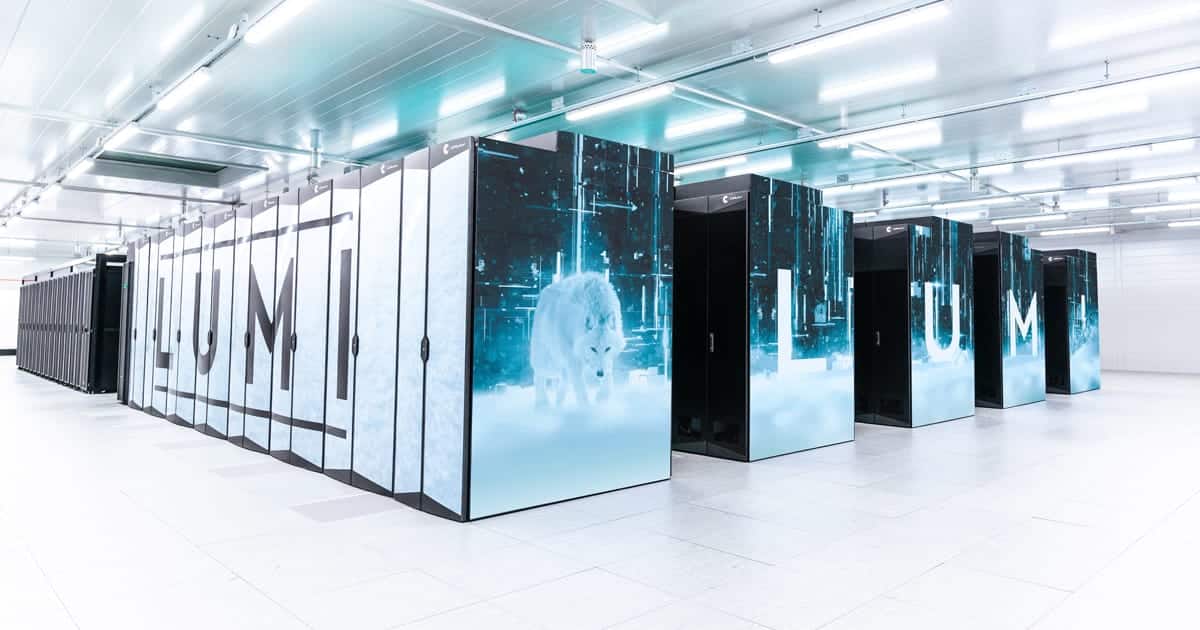
Europe is expanding its supercomputing capacity with LUMI-AI, a new system that will combine AMD Instinct MI430X accelerators with sixth-generation AMD EPYC processors carrying up to 256 cores. The EuroHPC Joint Undertaking (EuroHPC JU) has contracted Bull to build the supercomputer in Kajaani, Finland, with a budget of €387.8 million and deployment planned for the second half of 2027.
LUMI-AI in 30 seconds
- LUMI-AI will use AMD Instinct MI430X GPUs and sixth-generation AMD EPYC CPUs with 256 cores.
- The system aims to deliver ten times the AI capacity of the current LUMI and nearly double its HPC capacity.
- Installation is planned for the second half of 2027 in Kajaani, Finland.
- The contract is worth €387.8 million, covering acquisition, installation, and maintenance.
- It will be the core computing infrastructure of the European LUMI AI Factory.
The project goes beyond simply swapping one supercomputer for a more powerful one. LUMI-AI is designed to combine artificial intelligence and high-performance computing (HPC) within a single infrastructure, with access for researchers, universities, startups, and European companies.
According to information published by AMD, the system will be owned by EuroHPC JU and hosted by the six-country consortium behind the LUMI AI Factory: Finland, the Czech Republic, Denmark, Estonia, Norway, and Poland.
The choice of AMD also extends a technology relationship already present in the current LUMI system, which uses EPYC processors and Instinct accelerators.
Ten times more AI capacity than the current LUMI
The main difference with LUMI-AI will be how much weight artificial intelligence carries in the design.
The new supercomputer is expected to deliver ten times the AI capacity of LUMI, while its HPC capacity will be close to double what’s currently available. These are estimates for a system that still has to be built and installed.
AMD’s announcement doesn’t disclose the total number of MI430X GPUs LUMI-AI will have, nor does it give a final FLOPS performance figure for the machine as a whole.
It does confirm two of its main components.
The first is AMD Instinct MI430X, a generation of accelerators built to handle both AI and HPC workloads. The second is sixth-generation AMD EPYC processors configured with up to 256 cores.
This combination reflects how the design of large supercomputers is changing.
For years, the main benchmark for these machines was high-precision scientific computing performance. The expansion of AI now requires systems capable of also handling training, inference, and the numerical formats used by large models.
LUMI-AI will have to serve both worlds.
Its potential workloads include large-scale scientific simulations, model training, inference, and AI-related business projects.
The system will also use a multi-tenant architecture, so different organizations and communities can share the infrastructure while keeping their own environments separate.
It will also offer additional compute and storage resources and access via application programming interfaces (APIs), aimed at making it easier to use from modern development tools.
There’s another particularly interesting connection: LUMI-AI will integrate with LUMI-IQ, the quantum computing platform tied to the environment.
That will make it possible to develop projects where conventional supercomputing, GPU acceleration, artificial intelligence, and quantum resources can all be part of a broader scientific infrastructure.
€387.8 million to strengthen Europe’s computing capacity
The LUMI-AI contract is worth €387.8 million.
The figure covers the system’s acquisition, delivery, installation, and maintenance. Funding will be split evenly between EuroHPC JU and the LUMI AI Factory consortium.
That works out to roughly €193.9 million for each of the two parties, according to the announced breakdown.
Bull will be responsible for delivering the system.
The timeline puts deployment in the second half of 2027 at CSC’s new data center, located in the Renforsin Ranta business park in Kajaani.
The infrastructure will serve as the computing core of the LUMI AI Factory.
These AI Factories are part of Europe’s strategy to widen access to AI compute capacity, especially for researchers, startups, and companies that would struggle to deploy infrastructure at this scale on their own.
The question of available capacity is becoming increasingly important.
Developing advanced models requires GPUs, storage, high-speed networking, and large amounts of energy. Concentrating these resources among a small number of private providers can limit the options available to universities, research centers, and smaller companies.
EuroHPC-funded infrastructure is meant to provide a European alternative for certain projects.
LUMI-AI will also have an international dimension within Europe. Although it will be physically located in Finland, the consortium hosting it brings together six countries, and the stated goal is to serve wider scientific and business communities.
The project can therefore be read as shared European infrastructure, not simply a new Finnish supercomputer.
Renewable energy and data center heat recovery
Computing power is only part of a modern supercomputer’s design.
Facilities that concentrate thousands of processors and accelerators need large amounts of electricity and generate an equally significant amount of heat.
LUMI-AI is expected to run entirely on renewable energy, according to information provided by AMD.
The system will use liquid cooling, and part of the heat it generates will be recovered and fed into Kajaani’s district heating network.
This approach is already familiar in facilities located in the Nordic countries, where outdoor temperatures and district heating networks can create favorable conditions for reusing thermal energy that other data centers simply vent outside.
The consortium aims for LUMI-AI to rank among the world’s most energy- and environmentally efficient supercomputers. That position, however, will need to be verified once the machine is operational and its actual power consumption and performance can be measured.
Efficiency will be especially relevant given the growing energy consumption tied to artificial intelligence.
Multiplying compute capacity without a proportional improvement in performance per watt can turn power availability into the main constraint on scaling these facilities.
AMD points precisely to efficiency and infrastructure openness among the reasons behind its participation in LUMI-AI.
For the company, the contract is also an important reference for Instinct MI430X.
NVIDIA currently dominates much of the AI accelerator market, but EuroHPC’s large systems give AMD a significant space to deploy its architectures at scale, especially in environments where AI and scientific computing converge.
LUMI-AI also shows that Europe’s AI strategy increasingly depends on physical infrastructure.
Models and applications can be built with software, but data centers, networks, storage, power, and accelerators are still needed behind them.
Europe is trying to grow that capacity through shared projects like the LUMI AI Factory.
The full picture won’t be clear until 2027. For now, there’s a €387.8 million contract, an AMD-centered architecture, and an ambitious goal: multiplying the current LUMI’s AI capacity tenfold without giving up the HPC scientific workloads the project was originally built for.
Frequently Asked Questions
What is LUMI-AI?
LUMI-AI will be a new European supercomputer installed in Kajaani, Finland, built for artificial intelligence and high-performance computing workloads. It will be the main computing infrastructure of the LUMI AI Factory.
What processors will LUMI-AI use?
The system will be equipped with AMD Instinct MI430X GPUs and sixth-generation AMD EPYC processors with up to 256 cores.
How much will the LUMI-AI supercomputer cost?
The contract is valued at €387.8 million and covers acquisition, delivery, installation, and maintenance. EuroHPC JU and the LUMI AI Factory consortium will fund the project equally.
When will LUMI-AI be available?
Deployment is scheduled for the second half of 2027 at CSC’s new data center in Kajaani, Finland.
Source: newsroom.amd