
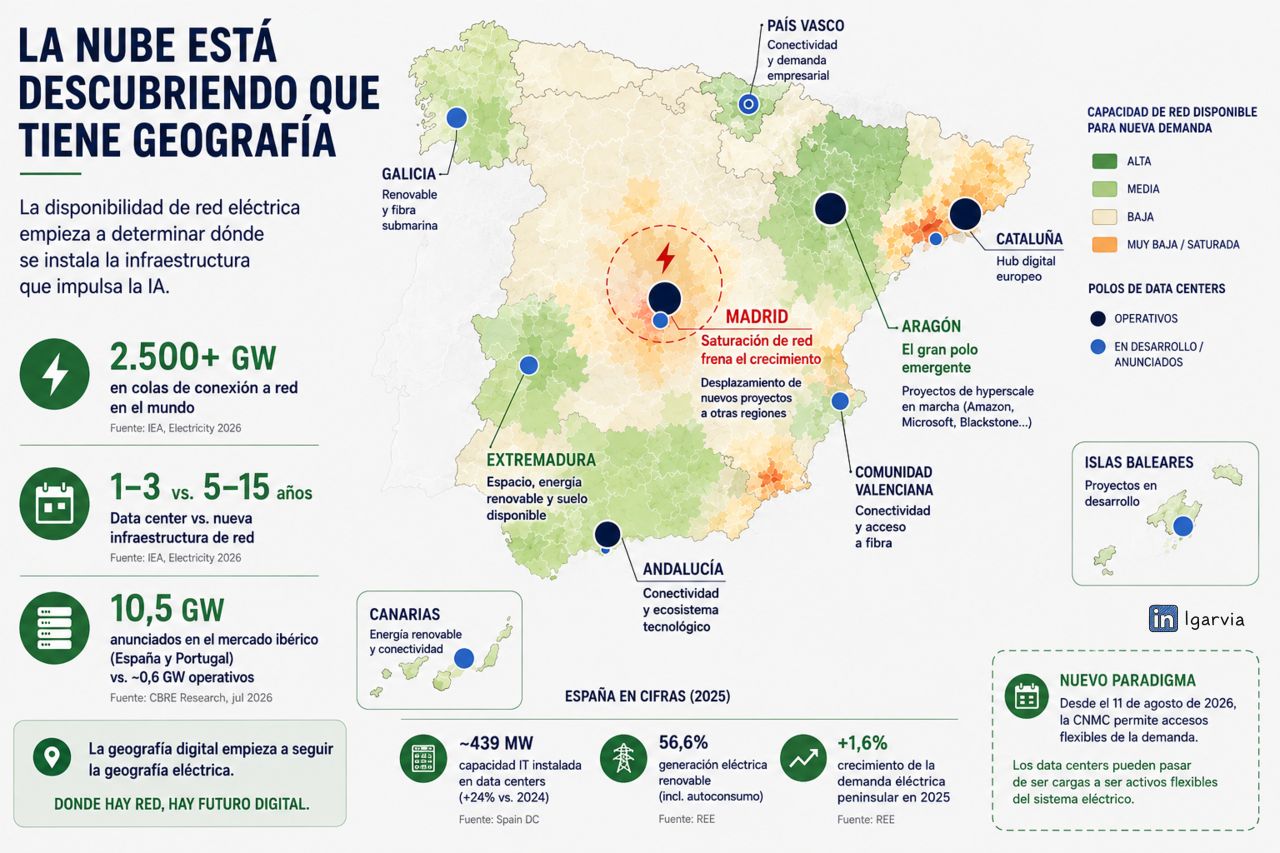
Spain has an unusual opportunity to become one of Europe’s major locations for data centers and artificial intelligence. That’s exactly why it’s surprising that the government is now proposing energy conditions that, while aiming for a reasonable goal, could end up discouraging new investment. The draft rule, currently open for public comment, requires new data centers of at least 1 MW to back 80% of their consumption, hour by hour, with new renewable generation, on top of strict efficiency, water, and digital-sovereignty criteria. It isn’t law yet: the proposal is open for public consultation until September 4.
The new data center rules in 20 seconds
- The draft applies to new data centers with 1 MW or more of grid access capacity.
- At least 80% of each hour’s consumption must be matched by new renewable generation.
- That energy can be backed through self-consumption or term contracts such as PPAs.
- Spain has already granted more than 12 GW of grid access and connection rights to data centers.
- The measure could favor efficient projects, but it could also raise costs and complexity compared with other European countries.
This shouldn’t be reduced to the usual sustainability-versus-growth debate. The real question is how to design regulation that delivers both, without turning one of Spain’s competitive advantages, its abundant renewable energy, into a new barrier to entry.
The government itself acknowledges the scale of what’s happening. Spain’s AI Strategy envisions roughly 2.5 GW of compute power by 2030, which could require between 3.5 and 4 GW of electricity. Yet since 2021, Spain has already granted more than 12 GW of grid access and connection rights to data centers.
Not all of those projects will end up getting built. But the figure shows Spain is facing a real industrial opportunity.
The 80% renewable target isn’t the hard part — the “hour by hour” is
At first glance, requiring a data center to run mostly on renewables seems especially reasonable in Spain.
The country has abundant solar and wind resources and has spent years growing its renewable output. If a sector is about to add gigawatts of new electricity demand, it seems logical to ask that part of that demand come with new generation capacity attached.
In fact, the reasoning from Spain’s Ministry for Ecological Transition and the Demographic Challenge (MITECO) has a clear basis: data centers run at fairly constant consumption around the clock, and their arrival represents mostly new demand, not fossil fuel being swapped for electricity.
If that demand grows much faster than renewable generation and the system’s firm capacity, certain hours could require more gas-fired generation and push up electricity system costs. That’s precisely one of the risks the Ministry cites to justify the regulation.
Up to that point, the goal is hard to argue with.
The trickiest part shows up when hourly correlation comes into play.
The draft states that, as long as renewables don’t exceed 90% of the electricity mix, at least 80% of consumption must be covered by renewable generation produced during that same hour. On top of that, it has to be additional generation: every new megawatt consumed must be matched by a new renewable megawatt installed within the 18 months before the data center comes online.
That changes things considerably.
A data center runs 24 hours a day. A solar plant, obviously, doesn’t. Covering a certain amount of renewable electricity on an annual basis through a Power Purchase Agreement (PPA) is relatively straightforward. Making generation and consumption match up every single hour of the year requires designing far more sophisticated combinations of solar, wind, storage, contracts, and grid supply.
And that sophistication costs money.
The upside: Spain can make sure the boom leaves behind more than just data centers
There’s a favorable reading worth keeping in mind.
If Spain is about to receive dozens of power-hungry projects, tying them to new generation could make that tech investment also finance energy infrastructure.
A hypothetical 100 MW data center couldn’t simply buy certificates showing that enough renewable electricity was produced somewhere over the course of the year. It would have to contribute much more directly to new generation and demonstrate that hourly match.
That can generate long-term contracts for renewable developers, encourage storage, and speed up new energy investment.
It also avoids another problematic scenario: data centers simply competing for already-available electricity against homes, industry, and other electrification efforts.
The government believes Spain can afford to be selective because connection demand far exceeds what was originally planned for. That argument has some logic. If more than 12 GW has already been granted and the 2030 compute target implies between 3.5 and 4 GW of electricity, there’s no obvious need to accept every project under any condition.
The regulation also isn’t just about electricity.
Until the future European labeling scheme kicks in, the draft sets a maximum PUE of 1.15 and a maximum WUE of 0.1 for these facilities. PUE (Power Usage Effectiveness) measures the ratio between a data center’s total energy use and the energy consumed directly by its IT equipment; WUE (Water Usage Effectiveness) measures how efficiently it uses water. Starting in August 2027, these facilities would need to meet category A under the planned European system.
Spain would essentially be saying: capacity is limited, so incoming projects need to be among the most efficient.
The theory is appealing.
The risk shows up if Spain ends up being far more demanding than its competitors before it has the infrastructure needed to meet those same demands itself.
The danger of regulating an industry that can pick another country instead
A data center doesn’t have to be built in Spain.
France, Portugal, Italy, Germany, and the Nordic countries also want to attract digital infrastructure. Major operators decide where to invest by comparing electricity, connectivity, land availability, taxation, permitting, regulatory stability, water, talent, and, above all, available grid capacity and how long it takes to get it.
Spain holds several strong cards: renewable energy, available land, international connections, submarine cables, an appealing geographic position, and a growing tech sector.
But it also has limitations.
The grid needs enormous investment to simultaneously absorb new generation, storage, electrified industry, and gigawatts of data centers. In February, Red Eléctrica noted that the transmission grid alone had 11.8 GW of capacity granted to new demand that wasn’t yet in service, on top of 7.1 GW already connected.
That helps explain why the government wants to bring order to grid access.
But ordering shouldn’t turn into blocking.
An international operator can accept paying somewhat more for clean electricity. It might even take on extra investment in storage or renewables in exchange for 10 or 15 years of predictability.
What it’s unlikely to accept is a mix of complex requirements, regulatory uncertainty, and the risk of later losing grid access altogether.
And the draft does spell out serious consequences. Non-compliance can trigger escalating surcharges on grid fees and tolls and ultimately lead to the loss of access and connection rights.
This is where Spain needs to be especially careful.
AI is turning electricity into industrial policy
The debate is also arriving at the worst possible moment to think about this purely in electrical terms.
Data centers have stopped being simple buildings full of servers. They’re infrastructure for cloud, artificial intelligence, digital public services, research, telecommunications, banking, industry, and virtually any data-intensive economic activity.
Countries that concentrate compute capacity will hold an advantage that increasingly resembles what factories, ports, or telecom networks provided during earlier industrial eras.
That’s why a megawatt going to a data center shouldn’t be analyzed as just one more megawatt of consumption.
What happens inside matters too.
A 200 MW building that mainly serves other markets from Spain doesn’t contribute the same thing to the country as infrastructure that draws in engineering teams, cloud services, AI companies, universities, technology suppliers, and compute capacity available to Spanish businesses.
That distinction may matter more than setting energy criteria alone.
Spain could use its capacity auctions precisely to prioritize projects that combine energy efficiency with investment, tech jobs, digital sovereignty, compute capacity, and services for the Spanish and European economy.
In fact, the draft already introduces another element pointing that way: it requires the operator to be established in the European Union and requires certain data, metadata, and operational records to stay within EU territory.
Energy regulation is thus becoming industrial and digital-sovereignty policy as well.
The real risk is Spain arriving late after arriving early
Spain now has something it spent years chasing: international interest in investing billions in technology infrastructure. It’s a dynamic playing out across Europe more broadly, as May’s data already confirmed for the continent’s shifting data center map.
The mistake would be assuming that interest is guaranteed to stick around.
The more than 12 GW of granted rights doesn’t mean Spain will end up with 12 GW of data centers, either. There’s a huge distance between announcing a campus, requesting grid capacity, getting permits, financing it, sourcing equipment, and actually putting servers into production.
It’s already becoming clear that some permits aren’t turning into real consumption. In July, 16 demand facilities gave up more than 1 GW of previously granted capacity on the transmission grid.
That leaves two possible mistakes.
One is allowing disorderly expansion that reserves grid capacity for years, strains the network, and socializes costs while some projects never actually materialize.
The other is responding by piling on so many conditions that the most attractive investments end up moving to other markets instead — the kind of tension already visible in how Spain’s own transitional permitting rules have been separating real data center projects from paper ones.
Spain needs to find the space between those two extremes.
Requiring renewable additionality seems defensible. Encouraging long-term PPAs does too. Demanding extremely efficient data centers makes sense in a country where energy, water, and grid capacity are limited resources.
The 80% hourly correlation requirement, though, deserves especially careful technical and economic analysis before becoming a binding obligation.
It can accelerate storage, renewables, and new forms of electricity contracting. But it can also significantly raise the cost of every new megawatt of Spanish digital infrastructure compared with equivalent facilities in other countries.
And there’s an even bigger question at stake.
Europe has spent years asking how to reduce its technological dependence on the United States and Asia. It wants to develop its own artificial intelligence, sovereign cloud, and greater compute capacity. At the same time, it needs to meet its climate targets.
Spain has exceptional conditions to combine both goals.
The regulation will have gotten it right if it manages to make every new gigawatt of compute help finance the next gigawatt of clean energy.
It will backfire if the end result is renewable energy getting built in Spain while the servers, the tech investment, and the AI capacity end up installed across the border instead.
That’s the balance that should be debated during the public consultation. The question isn’t choosing between data centers or renewables. It’s making sure Spain can have both without turning one of its biggest energy advantages into a regulatory disadvantage.
Frequently Asked Questions
Is Spain already requiring data centers to run on 80% renewables?
Not yet. The government has presented a draft royal decree, open for public comment until September 4, 2026. The text can still change before final approval.
Which data centers would the new regulation affect?
The main obligations apply to facilities with grid access capacity of 1 MW or more. Data centers above 500 kW would also face reporting obligations on efficiency and sustainability.
What does it mean for the 80% renewable target to be verified hour by hour?
It means annual consumption couldn’t simply be offset by contracting an equivalent amount of renewable electricity. During every hour of operation, at least 80% of consumption would need to be backed by renewable generation produced in that same hour and meet the established additionality requirements.
Could this regulation slow down new data centers in Spain?
It could raise costs and complexity for some projects, especially because of the hourly correlation requirement, though it could also encourage new renewable generation, storage, and more efficient data centers. The final effect will depend on the finished text and how it compares with the conditions offered by other European countries.
