
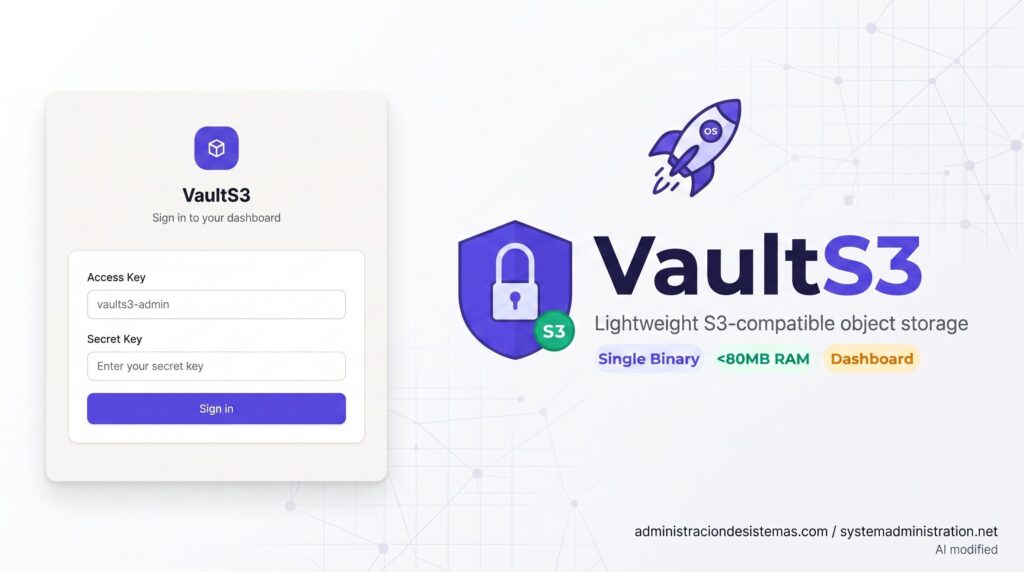
VaultS3 presents itself as a new alternative for deploying Amazon S3-compatible object storage within private infrastructure, with an unusual proposition: a single binary, no mandatory external services, and an idle memory footprint estimated by its developer at around 17 MiB. The project enters a market where offerings range from managed services like Amazon S3 to established open-source platforms such as Ceph, Garage, or SeaweedFS.
VaultS3 key features in 20 seconds
- VaultS3 implements over 80 S3 API operations and operates as a single binary.
- Its developer measures approximately 17 MiB of RAM at rest, although usage increases under load.
- Includes encryption, IAM, OIDC, versioning, Object Lock, Prometheus metrics, and erasure coding.
- Competes with alternatives like Ceph, Garage, SeaweedFS, and managed services such as Amazon S3.
- The distributed mode of VaultS3 still has components considered beta.
S3 compatibility has become a common element in many storage architectures. Backup applications, analytics platforms, data repositories, Kubernetes, and numerous enterprise tools can leverage this interface regardless of whether the backend is Amazon Web Services (AWS) or an in-house installed platform.
VaultS3 aims to fill that second niche while avoiding some of the complexity associated with certain distributed solutions. The project is mainly developed in Go and distributed under the AGPL-3.0 license.
From 17 MiB at rest to approximately 185 MiB during operation
The most striking figure is its memory consumption. According to tests published by the project itself, VaultS3 uses around 17 MiB of RAM when idle.
This does not mean it can handle any storage load using that amount.
For example, during a test writing 64 MiB objects with 16 concurrent operations, memory usage can approach 185 MiB. The actual memory required will depend on factors such as the number of connections, object sizes, and workload.
Additionally, the available comparisons are mainly from the project itself and do not constitute an independent benchmark. The 17 MiB figure should be seen as a reference to the lightweight nature of the base process, not as a fixed requirement for production deployments.
VaultS3 consolidates many functions into a single executable. It does not require an external database to run and uses BoltDB to store metadata. It also provides Docker images, packages for various Linux distributions, and options for Kubernetes.
It features an integrated web interface, AWS Signature Version 4 authentication, IAM, OIDC and LDAP integration, AES-256-GCM encryption, bucket policies, Prometheus metrics, and various data protection mechanisms.
VaultS3 vs Ceph, Garage, and SeaweedFS
S3-compatible storage has enough alternatives that memory consumption alone may not determine the best choice.
A rough comparison can help place each option:
| Solution | Model | S3 API | Complexity | Main Focus |
|---|---|---|---|---|
| VaultS3 | Open source, AGPL-3.0 | Yes | Low in single-node setups | Labs, edge, home labs, and lightweight private storage |
| Ceph | Open source | Yes, via RGW | High | Enterprise clusters and distributed storage |
| Garage | Open source | Yes | Medium-low | Lightweight distributed storage |
| SeaweedFS | Open source | Yes | Medium | Distributed object/file storage |
| MinIO AIStor | Commercial, with evaluation/free tier options depending on mode | Yes | Medium | Enterprise S3 storage |
| Amazon S3 | Managed cloud service | Natively | Low for the user | Large-scale cloud object storage |
The table does not aim to declare a winner, as architectures differ significantly.
Ceph, for example, operates in a different category. It can provide object, block, and file storage over the same distributed cluster. Its RADOS Gateway (RGW) implements a broad portion of the Amazon S3 API and offers features like versioning, lifecycle policies, encryption, IAM, and multisite configurations.
This capability comes with operational costs. Deploying Ceph involves multiple components and usually several OSD servers or devices to build a redundant platform. The official documentation indicates that at least three OSDs are typically needed for redundancy and high availability.
VaultS3 seeks essentially the opposite: starting with a small server and simple configuration.
Garage is also an interesting comparison because it was designed with a philosophy of lightweight distributed storage, capable of running even on heterogeneous hardware and connections. VaultS3 differentiates itself by incorporating additional management and data protection features within the same project.
SeaweedFS, on the other hand, has a broader scope than just an S3 server. Its distributed architecture can use different components to manage volumes, metadata, and data access, increasing deployment flexibility but also complexity.
MinIO’s position has evolved over the years
MinIO has long been one of the most well-known solutions for deploying S3-compatible storage outside AWS.
However, its licensing and commercial stance have changed.
The current MinIO documentation states that the distributed software is under its own license, and without an active Enterprise agreement, the license limits the software to a single instance for internal evaluation, not for productive use. The company markets its platform now under the AIStor brand.
Therefore, directly comparing the current MinIO AIStor with an AGPL project like VaultS3, simply under the label “open source S3,” can be misleading.
VaultS3 aims to recapture some of the experience that made early self-managed S3 platforms attractive: download a program, run it, and quickly have an endpoint compatible with S3 clients.
Amazon S3 serves a different purpose
The other end of the comparison is Amazon Web Services S3.
AWS manages the physical infrastructure, redundancy, hardware replacement, and much of the platform’s availability. In a self-managed solution like VaultS3, these responsibilities fall on the operator of the servers.
This significantly changes the economic equation.
Hosting a private S3 server can be advantageous when there is a large volume of local data, when certain workloads need to stay within the organization’s infrastructure, or when transfer costs to and from cloud services are significant.
However, software alone does not automatically transform a server into a service comparable to Amazon S3.
Final durability depends on disk configurations, backups, replication, server setup, and data center architecture.
Erasure coding and replication expand options
VaultS3 does not limit itself to storing a single copy of each object on disk. The project implements Reed-Solomon erasure coding, versioning, Object Lock, scheduled backups, and processes for recovering damaged fragments.
It also features clustering through Raft consensus, consistent hashing, and active-active replication.
This introduces one of its main current limitations.
The project differentiates between stable functions and those still in development. Deployments with a single node, including erasure coding across multiple disks, are the most mature scenario. Some clustering and distributed replication features remain in beta.
For a home lab, this difference may be minor. For a business storing terabytes of backups or critical data, it’s a different story altogether.
A storage system should not be judged solely by its idle memory footprint. Data durability, fault recovery, consistency, behavior during network partitions, version updates, monitoring, and the ability to rebuild large volumes after disk or server failures are equally important.
A particularly attractive option for labs and edge deployments
VaultS3 currently has a clear positioning. Its low resource consumption and ease of setup make it appealing for home labs, development environments, small servers, edge devices, or applications needing a local S3 endpoint.
It can also be used to test S3-compatible applications without relying on external services continually.
For larger enterprise deployments, Ceph offers a mature distributed architecture and a broader set of features, including the ability to use IAM policies, OpenID Connect, LDAP, encryption, and multisite configurations on Ceph’s storage backend.
Managed services like Amazon S3 address part of the problem by outsourcing infrastructure operations to the provider, but this comes with their own consumption and cost models.
VaultS3 seeks a middle ground. Its real test will come as deployments grow and it’s possible to observe how its distributed functions perform under sustained workloads, updates, and hardware failures.
In the meantime, that 17 MiB of RAM at rest highlights something more interesting: there’s still room to build S3-compatible storage solutions without starting from a complex cluster.
Frequently Asked Questions
Is VaultS3 compatible with Amazon S3?
It implements over 80 S3 API operations and works with compatible tools and SDKs, but that does not mean it replicates all Amazon S3 features.
Can VaultS3 replace Ceph?
It depends on the scenario. VaultS3 aims for simplicity and low resource use, whereas Ceph is designed to build large-scale distributed storage clusters for objects, blocks, and files.
Does VaultS3 really use only 17 MiB of RAM?
That is the measurement taken by the developer with the server idle. Under load, consumption increases; one published test shows around 185 MiB when writing 64 MiB objects with 16 concurrency.
Is VaultS3 ready for production?
Its single-node setup is the most mature. Some distributed features, including clustering and active-active replication, are still in beta and should be thoroughly tested before storing critical data.
