
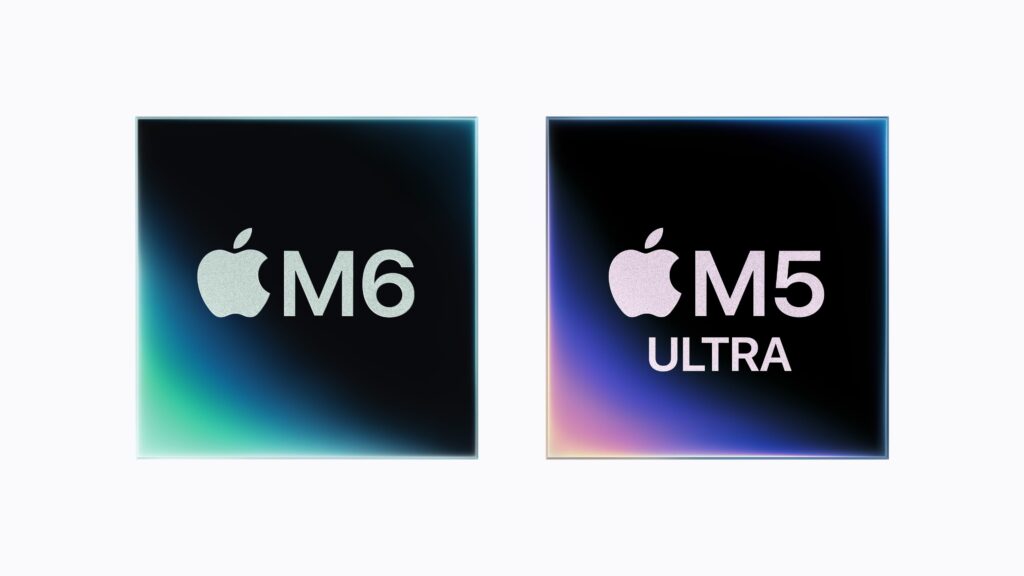
Apple has upgraded its computer chip platform with two major moves: the M6 becomes its first processor built with 2-nanometer technology, and the M5 Ultra boosts the Mac Studio to 512 GB of unified memory and 1.2 TB/s bandwidth. Beyond the traditional increase in CPU and GPU performance, the new generation clearly emphasizes the company’s technical focus: executing increasingly larger artificial intelligence workloads directly on the Mac.
The key points of the Apple M6 and M5 Ultra in 20 seconds
- The M6 debuts 2 nm in Apple chips and increases CPU and GPU up to 12 cores.
- Its memory bandwidth reaches 170 GB/s.
- The M5 Ultra offers up to 36 CPU cores, 80 GPU cores, and 512 GB of unified memory.
- Its 1.2 TB/s bandwidth directly supports large locally executed AI models.
Apple initially places the M6 in the new Mac mini, while reserving the M5 Ultra for the Mac Studio. These products target different segments but share a significant evolution: AI now directly influences silicon design, memory architecture, and bandwidth considerations.
This shift is especially evident with the M5 Ultra. Unlike the focus on TOPS and FLOPS that dominates much of the accelerator market, Apple continues leveraging a proprietary feature of its SoCs: a large amount of unified memory accessible by both CPU and GPU without physically separating system RAM from VRAM.
With 512 GB available in a single memory architecture, the new Mac Studio enters a rare territory for a desktop workstation.
M6: Apple Launches 2 Nanometers with a 12-Core CPU
The M6 marks the arrival of 2 nm technology in the Apple Silicon family. The company claims this new process boosts performance and density while maintaining energy efficiency as a primary design goal.
The CPU features 12 cores compared to the 10 in the M5, with a different organization: two super-cores, four performance cores, and six efficiency cores.
Based on internal testing, multithreaded performance is up to 1.2 times that of the M5 and up to 2.4 times that of the M1. Apple also asserts it has the market’s highest single-thread performance core, a claim based on tests conducted in August 2026, which will need independent benchmarks to verify.
The GPU also scales up to 12 cores, each with a Neural Accelerator designed to speed up AI-related operations.
Apple estimates a nearly 30% increase in maximum AI processing capacity with this GPU compared to the M5, and over eight times more than the M1.
This evolution reflects how current processors are advancing. While conventional CPU and GPU remain vital, an increasing portion of silicon is dedicated to matrix operations and other workloads used in machine learning and generative AI.
Adding to this is a dual 16-core Neural Engine, capable of operating simultaneously on two tasks.
Memory Becomes as Important as Processing Power
The M6 boosts memory bandwidth to 170 GB/s, roughly 10% above the M5 and 2.5 times the original bandwidth of the M1, according to Apple.
Maximum configuration remains at 32 GB of unified memory.
For a Mac mini, this is a significant amount, and it clearly sets the scope of local AI the system can handle. Small to medium models, especially quantized ones, can operate comfortably within this range. Larger language models require much more memory.
This is where the M5 Ultra comes into play.
Running an AI model isn’t just about having enough computational capacity; the weights must stay in memory and be continuously moved to the units performing operations.
That’s why memory bandwidth is becoming one of the most critical specifications for inference hardware.
An extremely fast processor can be underutilized if it doesn’t receive data at sufficient speed.
Apple has used unified memory for years to reduce data movement between CPU, GPU, and other accelerators. The M5 Ultra takes this concept much further.
M5 Ultra: Four Matrices and 4.4 TB/s of Internal Communication
The new M5 Ultra employs an evolution of UltraFusion to create what Apple describes as the first quadruple architecture used in an M-series SoC.
It combines two M5 Max chips with double matrices via an interconnection exceeding 4.4 TB/s.
This system can be managed by the OS and applications as a single processor, streamlining development and avoiding complexity and potential bottlenecks associated with explicitly programming multiple chips.
The result is a CPU with up to 36 cores, comprised of 12 super-cores and 24 performance cores.
Apple claims up to 25% more single-thread performance and 30% more multithreaded performance compared to the M3 Ultra.
The GPU scales up to 80 cores, each with a Neural Accelerator. Apple’s estimates suggest AI processing capacity can multiply by 4.5 times over the M3 Ultra and over six times the M1 Ultra.
It also features a 32-core Neural Engine.
These numbers represent a substantial leap, but for certain AI workloads, the most significant metric lies outside CPU, GPU, and Neural Engine—namely, memory bandwidth and capacity.
512 GB and 1.2 TB/s: The M5 Ultra’s Special Weapon for AI
The M5 Ultra supports up to 512 GB of unified memory with a maximum bandwidth of 1.2 TB/s.
Apple increased bandwidth by 50% over the M3 Ultra.
To understand its significance, consider how loading a large language model (LLM) works. A 70-billion-parameter model quantized to 4 bits requires roughly 35 GB just to store its weights, excluding cache, context, and other resources.
As models scale to hundreds of billions of parameters, memory capacity becomes a primary obstacle.
The 512 GB of the Mac Studio allow models that simply cannot fit into standard professional GPU memory.
This doesn’t necessarily mean the M5 Ultra is faster than specialized accelerators; memory capacity and compute performance are different variables.
Data center GPUs often offer greater computational capacity and specialized tools for certain models, but Apple’s approach is different: providing enormous shared memory accessible directly by the GPU inside a workstation.
For AI developers, researchers, and users working with local models, this difference can be more crucial than peak FLOPS figures.
Apple claims the system can run models with hundreds of billions of parameters entirely on the device. The actual size depends on factors like precision, quantization, context length, and memory demands during inference.
The Mac Studio Nears a Large LLM Workstation
Combining the M5 Ultra with 512 GB opens a compelling category bridging traditional professional desktops and dedicated AI servers.
This setup can be advantageous for LLM experimentation, private inference, application development, multimedia generation, scientific analysis, and tasks where keeping data local provides a benefit.
Apple explicitly mentions applications like LM Studio Bionic and MATLAB.
It’s also enhancing the software ecosystem surrounding the hardware. Core ML, Metal, Core AI, and tools integrated into Xcode facilitate load balancing across CPU, GPU, Neural Engine, and system accelerators.
This will be critical. Hardware capable of running large models is of little use if frameworks, runtimes, and models don’t utilize it efficiently.
This is also where Apple faces a market still dominated by CUDA-based infrastructure for AI. The Mac architecture is attractive for some local uses, but NVIDIA’s ecosystem retains a strong presence in enterprise training, inference, and data centers.
Apple is building a different alternative, focusing on AI integrated into the device and workstations with large shared memory pools.
The M6 brings this approach to a relatively compact Mac mini. The M5 Ultra elevates it to a machine capable of hosting models whose size years ago would have required multiple-GPU servers.
Independent benchmarks will be needed to determine the actual token processing speed of the M5 Ultra and its behavior across various models and quantizations. Still, the 512 GB of memory and 1.2 TB/s bandwidth already make its architecture an unusual technical proposition in the workstation market.
FAQs
Is the Apple M6 built with 2-nanometer technology?
Yes. Apple presents the M6 as its first chip manufactured using 2 nm process.
How much memory can a Mac Studio with M5 Ultra have?
The new M5 Ultra supports configurations up to 512 GB of unified memory, with a maximum bandwidth of 1.2 TB/s.
Can the M5 Ultra run large language models?
Apple states it can run models with hundreds of billions of parameters locally. Actual capacity depends on factors like quantization, precision, context length, and memory needs during inference.
What’s the main difference between M6 and M5 Ultra?
The M6 is initially aimed at the Mac mini, offering up to 12 CPU and GPU cores and supporting up to 32 GB of memory. The M5 Ultra is designed for the Mac Studio, scaling up to 36 CPU cores, 80 GPU cores, and 512 GB of unified memory.
