
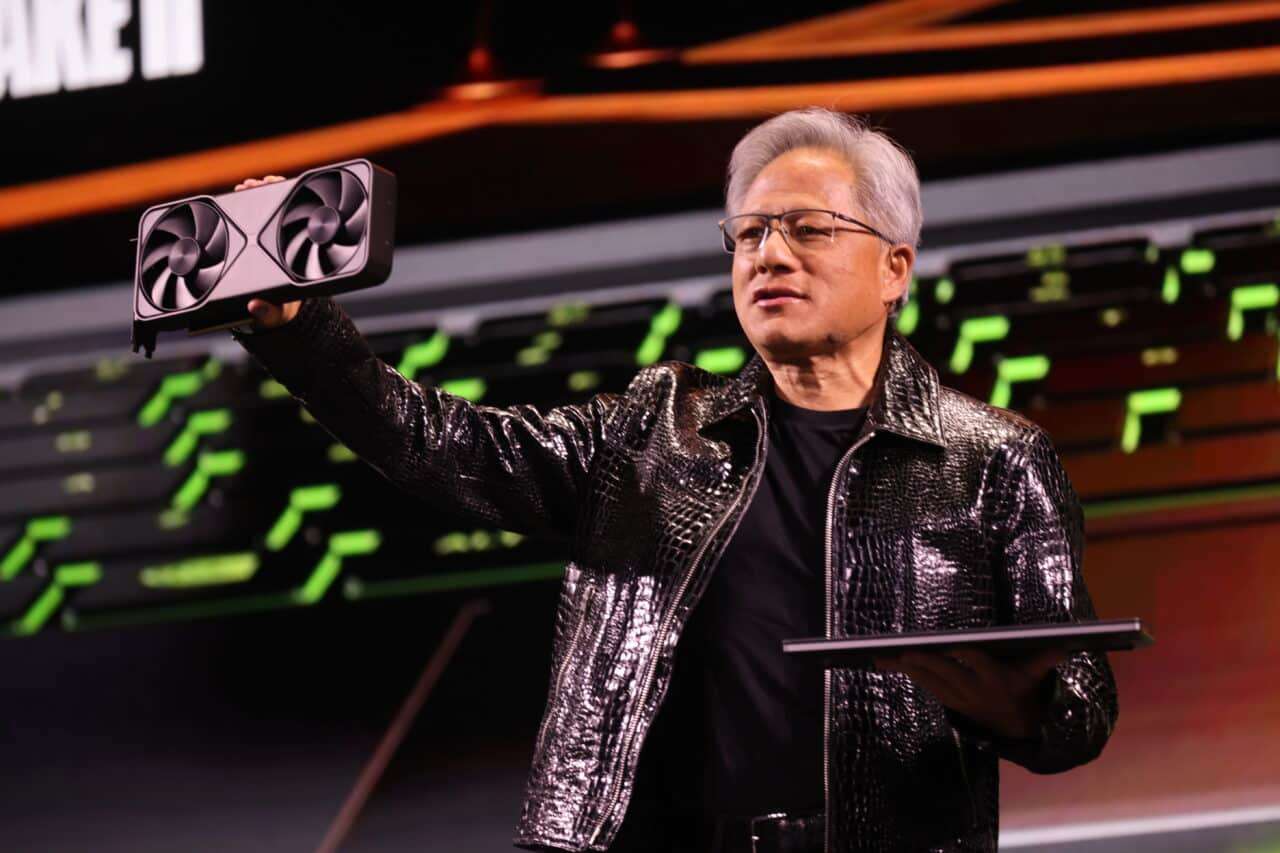
NVIDIA is making one of its biggest bets outside hardware: a deal linked to Poolside for around $7 billion that includes $6 billion for a non-exclusive license of its technology, the planned addition of over a hundred employees, and an extra $1 billion investment in the company. This move could accelerate the development of the open models Nemotron and confirms Jensen Huang’s desire to expand NVIDIA’s position far beyond selling GPUs for artificial intelligence.
The key points of NVIDIA and Poolside in 20 seconds
- NVIDIA would pay $6 billion to license Poolside’s technology and add a $1 billion investment.
- More than 100 startup employees could join NVIDIA.
- The goal is to strengthen Nemotron and better compete in open-weight model markets.
- Poolside would continue operating as an independent company.
- Presenting this deal as a hedge against a drop in demand for GPUs is, for now, an interpretation and not a confirmed fact.
The operation was announced by Poolside to its investors and later reported by various sources. The licensing deal does not involve acquiring the company: Poolside would retain its founders and part of its structure, while NVIDIA would mainly acquire talent related to its Laguna models and gain access to the so-called Model Factory, the infrastructure used by the startup to train and develop its systems.
The figure is high even by current AI standards, but makes more sense when considering what NVIDIA is building around Nemotron and especially how quickly Chinese open-weight models are gaining ground.
Poolside adds more than engineers to NVIDIA
Poolside specializes in AI applied to software development and training models capable of handling prolonged programming tasks.
In May, it introduced Laguna M.1 and Laguna XS.2, two Mixture-of-Experts models designed specifically for long-duration agentic programming. Laguna M.1 has 225.8 billion total parameters, with 23.4 billion active per token, while XS.2 has 33.4 billion and activates roughly 3 billion with each token.
More important than the parameter counts is the system Poolside has built around them.
The company talks about a Model Factory, a set of tools, data, training infrastructure, and processes aimed at creating and improving models through real software development tasks.
That knowledge aligns directly with the direction NVIDIA is taking with Nemotron.
In August, NVIDIA introduced Nemotron 3.5 Lightning, a 30-billion-parameters Mixture-of-Experts model designed for specific tasks within multi-agent systems and loads that need to stay active for extended periods. NVIDIA also accompanies it with tools like NeMo Switchyard to route requests between different models.
Therefore, NVIDIA’s interest in Poolside does not seem limited to buying a finished model. They would be obtaining technology, training processes, and specialized talent to continue developing their own family of models.
NVIDIA also aims to compete at the model layer
During much of AI’s rise, NVIDIA held a particularly comfortable position.
OpenAI, Anthropic, Meta, xAI, Microsoft, Google, and almost any lab needing large amounts of accelerated capacity could end up purchasing or renting NVIDIA GPUs.
In that scenario, the company provided the tools that others competed with.
Nemotron begins to change that relationship.
NVIDIA offers models that developers can adapt and run on different infrastructures, but naturally they are highly optimized for its own hardware and software. The manufacturer can thus participate simultaneously in multiple layers:
GPU → networks → complete systems → CUDA software → libraries → inference → models.
The move into Poolside specifically reinforces the last layer.
It also reflects a geopolitical evolution in the market. Chinese labs have gained prominence with open-weight models like DeepSeek and Kimi, which enable companies and developers to deploy systems without relying necessarily on closed APIs.
The US retains some of the most capable proprietary models, but a significant part of the competition in open-weight AI is coming from China.
NVIDIA has strong incentives to prevent this layer of the market from being dominated primarily by models designed and optimized around other technological ecosystems.
Is NVIDIA trying to become its own GPU buyer?
A particularly striking interpretation of the deal suggests that NVIDIA is preparing some form of insurance against a future demand drop.
The logic is simple.
If NVIDIA manages to build extremely competitive Nemotron models and large AI services around them, it could internally use an increasing amount of its own accelerators. In an oversupply scenario, this internal demand would serve as a semi-alternative destination for its computing capacity.
The idea isn’t impossible, but the available data do not confirm that this is the purpose of the Poolside deal.
NVIDIA has not announced plans to become a ‘last-resort’ buyer of its own GPUs nor is it accumulating capacity to absorb a future market crash.
In fact, recent moves point in the opposite direction: the company continues to speak of very high infrastructure demand.
On August 10, NVIDIA announced deals with Apollo, BlackRock, Blackstone, Brookfield, Goldman Sachs, and KKR aimed at creating platforms capable of mobilizing more than $500 billion in third-party capital for AI infrastructure. Jensen Huang claims AI computing is becoming a new class of infrastructure asset.
A week later, NVIDIA also announced an agreement with SB Energy related to Ohio’s PORTS-Pike campus. The company will provide credit support to initially secure 4.25 GW of land, energy, and buildings, with an option for another 3.75 GW; OpenAI is listed as a prospective customer for the 8 GW of IT. NVIDIA also disclosed a $1.5 billion investment in SB Energy.
These are huge commitments that hardly fit with a company publicly expecting an imminent demand collapse.
The most prudent explanation is another: NVIDIA is trying to gain more control over the AI value chain.
The $7 billion can also be seen as a defense of CUDA
There’s another, less obvious reason why NVIDIA might want highly competitive models of its own.
Every popular model influences technological decisions around it.
Companies choose inference engines, quantization formats, libraries, hardware, cloud platforms, and orchestration systems based on the workloads they need to run.
If Nemotron gains adoption, NVIDIA can ensure its models are optimized from day one for CUDA, TensorRT, Blackwell, Rubin, and their future platforms.
Instead of waiting for another lab to publish a model and then optimizing it later, NVIDIA can co-design the model and infrastructure.
This vertical integration is one of the advantages exploited by companies like Apple for years in other tech markets: hardware and software evolve together.
NVIDIA now has enough resources to apply a similar approach to AI.
A growingly peculiar relationship with OpenAI and Anthropic
The move also creates a peculiar situation.
OpenAI and Anthropic are major consumers of accelerated infrastructure, and they are part of the market that has made NVIDIA one of the world’s most valuable companies.
But if Nemotron continues to expand its capabilities, NVIDIA also begins to compete with them in certain use cases.
The difference is that, for now, it is not attempting to replicate exactly the same models.
OpenAI and Anthropic focus much of their business on accessible models via products and APIs. NVIDIA is betting more explicitly on open-weight models that other companies can deploy and customize.
That approach might even increase GPU demand.
A high-quality open model isn’t only run in its creator’s data centers. It can be deployed across hundreds of cloud providers, companies, universities, and governments that need computing capacity.
From that perspective, developing Nemotron could be less about hedge against falling GPU sales and more about creating new reasons to buy them.
Poolside also needed much more access to computing
The relationship between both companies highlights the importance that infrastructure access has reached.
According to information shared with investors, Poolside had previously tried to raise billions and even proposed an infrastructure based on around 40,000 GPU GB300. The startup struggled to finance such capacity at the needed speed.
For NVIDIA, the situation is exactly the opposite.
It has the hardware and enormous financial resources, but building top-tier models requires researchers, data, training methodologies, and expertise.
This operation combines both needs.
Poolside gains capital and maintains independence. NVIDIA gains over a hundred professionals and licenses technology that could save years of internal development.
Sam Altman isn’t saying the AI boom is over
It’s also important to distinguish this deal from another ongoing debate around Sam Altman’s forecasts.
OpenAI’s CEO has acknowledged that the economic transformation driven by AI will not necessarily happen instantly. OpenAI compares AI rollout to technologies like electricity, whose effects were deep but took years to spread throughout the economy.
This is very different from claiming that Altman believes AI demand will now collapse.
OpenAI’s published data in August show increasing adoption. ChatGPT surpasses 1 billion users, and the company notes that firms are moving from just using AI for responses to employing it for complete tasks and processes via agents.
Recently, Altman also argued that developing the most advanced models might require a more controlled pace to ensure safety systems and society adapt to new capabilities. This mainly addresses safety and governance concerns, not a belief that the economic need for computing is disappearing.
This distinction is significant because it prevents turning two separate stories into a single narrative of a bubble about to burst.
NVIDIA is becoming more than just NVIDIA
The $7 billion linked to Poolside is probably more strategically significant than financially.
For a company the size and cash flow of NVIDIA, this doesn’t radically alter its finances. But it could change how the company perceives what kind of business it wants to be in five years.
Jensen Huang started by building GPUs.
Later, NVIDIA created CUDA and made a significant portion of accelerated computing dependent on its software platform.
Subsequently, it added networks, complete systems like DGX and GB200 NVL72, cloud services, inference engines, and agent-building tools.
Now, it is investing billions in its own models that will utilize all that infrastructure.
This scenario is much more interesting than simply framing the deal as a hedge against a potential sales decline.
NVIDIA could end up manufacturing the accelerator, designing the system, providing the network, funding the data center, developing the inference software, and offering the model that runs all of it.
Such level of integration also raises risks. The company must avoid competing too directly with its biggest clients, justify larger investments, and ensure Nemotron’s adoption is sufficient to challenge open models that change almost weekly.
Poolside provides the technology and talent to make that happen.
What this deal has yet to prove is that NVIDIA expects to be short of buyers for its GPUs. Right now, all signs point to the contrary: it’s using the extraordinary profits from hardware to try and occupy more layers of the AI business before others do.
Frequently Asked Questions
How much will NVIDIA invest in Poolside?
Available information estimates the total commitment around $7 billion: $6 billion for a non-exclusive technology license and another $1 billion through an investment in Poolside at a pre-money valuation of $12 billion.
Has NVIDIA purchased Poolside?
No. The deal announced to investors is not a takeover. Poolside will continue to operate independently, and its founders will remain. Over 100 employees mainly related to its models could join NVIDIA.
What does NVIDIA want to do with Poolside’s technology?
One main goal is to accelerate the development of Nemotron, NVIDIA’s open-weight model family, leveraging Poolside’s training technology and expertise.
Is NVIDIA buying its own GPUs because it fears demand might collapse?
There is no sufficient evidence to support that. Its investments in models and infrastructure can be seen as diversification, but NVIDIA continues to push aggressively for capacity expansion and publicly states that AI computing demand is still increasing.
