

The rising cost of memory is starting to make comparisons almost unimaginable just three years ago. A user has shown that they bought a Samsung 870 EVO SATA 4TB for $169.99 in October 2023, while a comparable model recently appeared on Amazon for $1,099.90. This specific price doesn’t represent the entire market, but the underlying phenomenon is real: SSDs have become significantly more expensive during 2026 as NAND manufacturers prioritize the growing demand for server storage and artificial intelligence.
The key points of the SSD price surge in 30 seconds
- A Samsung 870 EVO 4TB bought for $169.99 in 2023 was listed at $1,099.90 in 2026 on the same Amazon listing.
- In Spain, the same model can be found around 1,000 euros, although there are significantly cheaper SATA 4TB SSDs available.
- NAND remains under pressure from data center and AI demands.
- Manufacturers are allocating more capacity to enterprise SSDs, where margins are higher.
- TrendForce forecasts that contractual NAND prices will increase another 10-15% in Q3 2026.
The comparison of the Samsung 870 EVO went viral because it visually highlights something that market statistics present in a far less dramatic way.
In October 2023, it was possible to find deals on 4TB SSDs for less than $200. Three years later, capacities that seemed destined to become increasingly affordable products have taken a turn in the opposite direction.
And it’s especially curious that this occurs with a SATA SSD, a mature technology limited by an interface that has been familiar to PC users for many years.
A 2021 SSD that can now cost much more than when it was new
Samsung introduced the 870 EVO family in early 2021. The 4TB model uses V-NAND memory and reaches official sequential speeds of up to 560 MB/s read and 530 MB/s write.
These figures are far from current PCIe 4.0 and 5.0 NVMe SSDs, but they are sufficient for many applications.
Additionally, SATA still has an advantage: millions of computers can use 2.5-inch drives even if they don’t have enough M.2 slots.
This made large-capacity SATA SSDs an attractive option for expanding storage for years.
The current price situation has broken part of that logic.
| Samsung 870 EVO 4 TB | Observed Price |
|---|---|
| Purchase shown by user, 10/11/2023 | $169.99 |
| Amazon listing in 2026 | $1,099.90 |
| Recent lowest price recorded by Idealo Spain | from 991.17 euros |
| Samsung USA | $1,759.99, out of stock |
Samsung also continues to list the 4TB model with its original specifications.
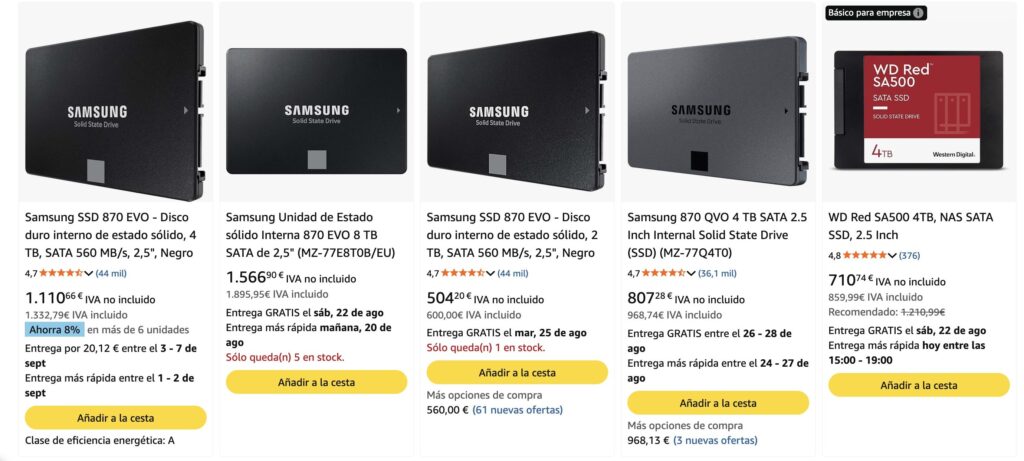
However, these figures require an important caveat.
That a specific listing shows $1,099 or $1,759 does not mean all 4TB SATA SSDs cost that much.
Prices for older products can become heavily distorted when normal stock disappears and external sellers, imported units, or references with limited availability remain. It’s possible to find 4TB SATA SSDs from other brands well below those prices.
Therefore, it would be incorrect to conclude that SSD prices have universally multiplied sixfold.
What’s important is that even current alternatives are considerably more expensive than those highly aggressive deals from 2023.
The explanation lies in NAND, not in the SATA interface
A SATA SSD and an NVMe can have very different performance, but both require NAND Flash memory to store data.
And that’s where the real issue appears.
The infrastructure for artificial intelligence is rapidly increasing demand for enterprise storage. Large data centers need enormous amounts of NAND to feed SSDs with capacities that can far exceed those available in consumer products.
TrendForce expects contractual NAND Flash prices to increase between 10% and 15% quarterly during Q3 2026.
The consulting firm identifies AI inference and large deployments of data centers as the main reasons for maintaining high demand.
There’s also a key data point that helps grasp the scale of these changes.
According to Counterpoint Research, enterprise SSDs absorbed approximately 48% of global NAND bits shipped in Q2 2026, compared to 26% a year earlier.
Almost half of the production, measured by capacity, is ending up in enterprise storage.
Manufacturers prefer to sell server storage
The issue for consumers isn’t just that more buyers are competing for the same memory.
It’s also about what type of memory manufacturers are choosing to produce.
Samsung, SK hynix, Micron, Kioxia/SanDisk, and other producers have limited capacity. If enterprise demand rises and offers better margins, there’s a strong incentive to dedicate more resources to those products.
TrendForce confirms that suppliers are allocating more capacity toward enterprise SSDs while keeping NAND wafer supply limited in the open market.
This helps explain a paradox in 2026.
The demand for personal computers and other consumer devices is not particularly strong. Normally, weak demand would push storage prices down.
But the industry’s focus has shifted.
Data centers are absorbing enough capacity to keep the supply chain tight even when consumer buying declines.
AI is also changing how much storage a server needs
There’s another important difference compared to previous memory cycles.
An AI-centered server doesn’t just need GPUs and HBM memory.
It also generates and moves huge datasets. Training requires storing datasets, checkpoints, and results, while large-scale inference introduces new storage and cache needs.
The NAND market is responding to that demand.
TrendForce currently describes a clear polarization: strong cloud and enterprise demand versus a consumer market weakened by high prices.
This makes domestic SSDs an indirect victim of AI’s rise.
Not because manufacturers are literally using a Samsung 870 EVO inside an AI server, but because enterprise products and consumer SSDs end up competing for manufacturing capacity and raw materials within the same NAND industry.
The Samsung 870 EVO case also involves its age
The remarkable price increase of the 870 EVO can’t be explained solely by the memory crisis.
It’s a product launched over five years ago.
When a model ages and its availability diminishes, prices can behave seemingly irrationally. Sellers holding units may set prices well above the reasonable value of the product.
In fact, paying around 1,000 euros for a 4TB 870 EVO is hard to justify if there are modern SATA or NVMe alternatives that are cheaper.
This example is better viewed as a snapshot of the market rather than a buying guide.
Samsung USA currently shows the 4TB model at $1,759.99, but it’s out of stock for delivery or pickup. This illustrates why listed prices and actual market prices don’t always align.
When might SSD prices drop again?
Forecasts here are not entirely uniform.
TrendForce believes NAND supply could outpace demand more rapidly in 2027 thanks to migration to more advanced processes and increased bits per wafer.
Their current forecast suggests that supply constraints could start easing during the second half of 2027.
This doesn’t necessarily mean prices will return to 2023 levels.
The market has evolved. Manufacturers are channeling more resources into enterprise products, and AI infrastructure is becoming one of the main structural consumers of storage.
Some specialized segments face even more extreme situations. For example, TrendForce predicts that contractual prices for SLC NAND memory could increase between 120% and 170% in H2 2026 due to scarcity and industrial, networking, data center, and edge AI demand.
The old Samsung 870 EVO symbolizes a much larger transformation.
For years, the outlook seemed inevitable: each NAND generation would offer more terabytes for less money. Memory manufacturing has always been cyclical, but AI has introduced a buyer willing to absorb huge capacities and pay higher margins.
For someone who bought that 4TB SSD for $169.99 in 2023, the results are especially striking: three years later, upgrading a computer with the same capacity can be considerably more expensive, even though the technology remains exactly the same.
Frequently Asked Questions
Does a Samsung 870 EVO 4TB really now cost six times what it did in 2023?
A comparison shared by a user shows a purchase at $169.99 in 2023 and a listing at $1,099.90 later. However, these are specific prices and do not mean the entire SSD market has multiplied sixfold.
Why are SSD prices rising?
NAND supply remains tight while demand from data centers and AI continues to grow. Manufacturers are also prioritizing enterprise SSDs and higher-margin products.
Is it worth paying 1,000 euros for a Samsung 870 EVO 4TB?
The high price of this model is also influenced by its availability. There are alternative 4TB SATA and NVMe SSDs, so it’s wise to compare before paying a premium for a particular model.
Will SSD prices fall in 2027?
TrendForce expects that the growth in NAND supply could gradually alleviate shortages during 2027, especially in its second half. The actual trend will also depend on how much demand for AI storage continues to grow.
via: Reddit
