
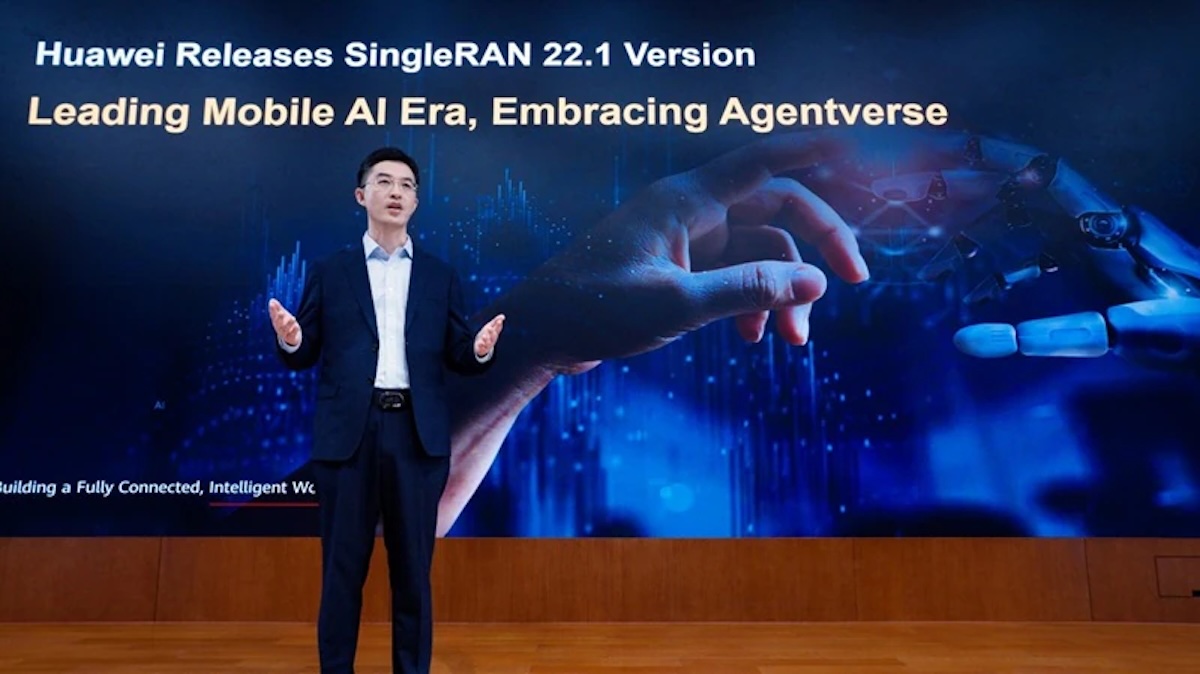
Huawei has launched SingleRAN 22.1, a new commercial version of its radio access network (RAN) software aimed at adapting operators’ infrastructure to the growth of AI-powered mobile services. The update introduces six technologies focused on increasing uplink capacity, better spectrum reuse, improved speeds, reduced energy consumption, and applying AI to network management itself.
The key points of Huawei SingleRAN 22.1 in 20 seconds
- SingleRAN 22.1 integrates six technologies designed for networks supporting more AI services.
- Huawei claims that GigaUplink has over 30% improved uplink performance in validation tests on real networks.
- GigaBand enables spectrum sharing between 4G and 5G.
- RANSpirit uses a foundational model for telecommunications and a digital twin of the RAN.
- Huawei states that the version is already in commercial use by 35 operators across 23 countries.
Behind this announcement lies an intriguing question for the future of telecommunications. So far, much of the conversation around infrastructure for AI has revolved around GPUs, data centers, and electrical capacity. Huawei anticipates that the expansion of multimodal assistants and agents running from phones and other devices will also increase demands on mobile networks.
In particular, uplink traffic will be crucial. An application that continuously sends images, videos, audio, or sensor data to AI systems generates a different pattern compared to traditional networks designed around content consumption.
GigaUplink aims to ready 5G for sending much more data
One of the main innovations of SingleRAN 22.1 is GigaUplink, a combination of hardware and software technologies designed to boost uplink capacity.
Huawei uses FDD 8T8R and Massive MIMO along with intelligent multi-layer convergent reception and uplink CoMP improvements to reduce interference.
According to validation tests on commercial networks shared by the manufacturer, this combination achieved a more than 30% increase in uplink performance and generally delivered upload speeds of 20 Mbps in the evaluated scenarios.
These results are provided by Huawei and do not guarantee that any operator will automatically attain such improvements. Final performance depends on spectrum, radio deployment, devices, traffic, configuration, and network conditions.
The importance of uplink could grow if forecasts about the evolution of mobile AI come true.
A phone that merely receives a text response requires relatively little bandwidth. But multimodal applications differ. An assistant capable of interpreting in real time what a camera captures, listening to audio, or continuously analyzing environmental data can send significantly larger amounts of information to inference systems.
And smartphones are just one part of the picture. Vehicles, cameras, robots, industrial devices, and various connected equipment could also become data sources for AI models.
Huawei aims to better utilize existing spectrum between 4G and 5G
SingleRAN 22.1 also introduces GigaBand, which seeks to jointly utilize FDD spectrum allocated for both 4G and 5G networks.
The technology pools spectrum resources and applies planning across time, frequency, space, and power domains to enable 5G to reuse capacity already employed by 4G.
Huawei reports that testing has resulted in a 1.2x better 5G experience without compromising 4G service.
This approach is valuable because the transition between mobile generations is gradual. Operators need to increase 5G capacity while continuing to serve millions of devices on 4G.
Dynamic spectrum sharing can help increase capacity without waiting for new frequency bands to be allocated.
Another innovation, iBeam 3.0, shifts precise beam management from the control plane to the user plane by using channel condition data and real-time planning.
Huawei claims that validations on real networks achieved over 15% improvements in download speeds compared to previous iBeam versions.
AI also begins to manage the mobile network itself
Perhaps the most AI-related feature is RANSpirit.
Huawei combines a telecommunications-focused foundational model with a digital twin of the radio access network.
The goal is for the infrastructure to interpret intentions and use that data to dynamically manage resources among users and services.
This approach aims toward networks with greater autonomy. Instead of relying solely on manual configurations and operations, certain processes can leverage AI to analyze infrastructure status and decide on resource allocation.
Huawei talks about moving from manual operations and maintenance toward autonomy within the RAN domain.
This does not mean that SingleRAN 22.1 transforms mobile networks into fully autonomous systems. Huawei presents RANSpirit as a technology to automate specific decisions related to resources, user experience, operation, and energy efficiency.
Another feature, IDEA, allows setting different speed levels based on users and services. It also employs dynamic slicing to estimate required resources and reserve blocks accordingly.
Differentiating services could become increasingly important if operators begin supporting AI applications with vastly different requirements. A text chatbot, a standard video call, and a multimodal agent processing video in real time all have different latency, uplink, and capacity needs.
AI increases traffic, but networks must also reduce their energy use
The update also introduces 0 Bit 0 Watt 0 Loss, a technology designed to lower the energy consumption of infrastructure during periods of low traffic.
The system extends periods during which resources can stay inactive and allows quick reactivation when demand rises again.
Huawei reports that real-world validations achieved over 10% reductions in energy use.
Energy efficiency has become a critical issue in telecommunications. Adding capacity, antennas, and processing can increase network capabilities but also raise operational costs.
Implementing algorithms that adapt resources dynamically aims to balance these factors.
From connecting smartphones to connecting AI agents
Huawei uses an especially ambitious term to describe its vision: a world with trillions of interconnected agents.
This is a business forecast, not current reality, and it’s still impossible to predict the scale autonomous agents connected via mobile networks will reach.
However, the technological direction suggests where infrastructure vendors are beginning to look.
AI doesn’t just need massive data centers for training models. If agents are embedded across phones, vehicles, robots, cameras, and industrial devices, then the network connecting these devices with inference capabilities will need to evolve.
SingleRAN 22.1 aims to prepare that layer with increased uplink capacity, better spectrum utilization, intelligent resource management, and infrastructure automation.
Huawei states that the version is already meeting general availability criteria and is being used commercially by 35 operators in 23 countries. The company does not specify which operators or the specific scope of each deployment in this announcement.
The so-called Mobile AI is still in early stages but introduces a concept likely to gain importance: the infrastructure needed to scale AI doesn’t end at the data center. It also includes the networks that transport data between millions of devices and the systems that process that data.
Frequently Asked Questions
What is Huawei SingleRAN 22.1?
It is a new version of Huawei’s SingleRAN software for mobile networks. It incorporates technologies to improve capacity, spectrum efficiency, energy use, and automation through AI.
How does GigaUplink improve performance?
Huawei claims validation on real networks has achieved over a 30% increase in uplink performance and general upload speeds of 20 Mbps in tested scenarios.
How does RANSpirit use artificial intelligence?
RANSpirit combines a telecommunications-specific foundational model with a digital twin of the RAN to automate tasks related to resource management and allocation.
Is SingleRAN 22.1 already in commercial use?
Yes. Huawei states that the version has achieved general availability and is being used by 35 operators across 23 countries, though the full list of operators is not disclosed.
via: Huawei
