
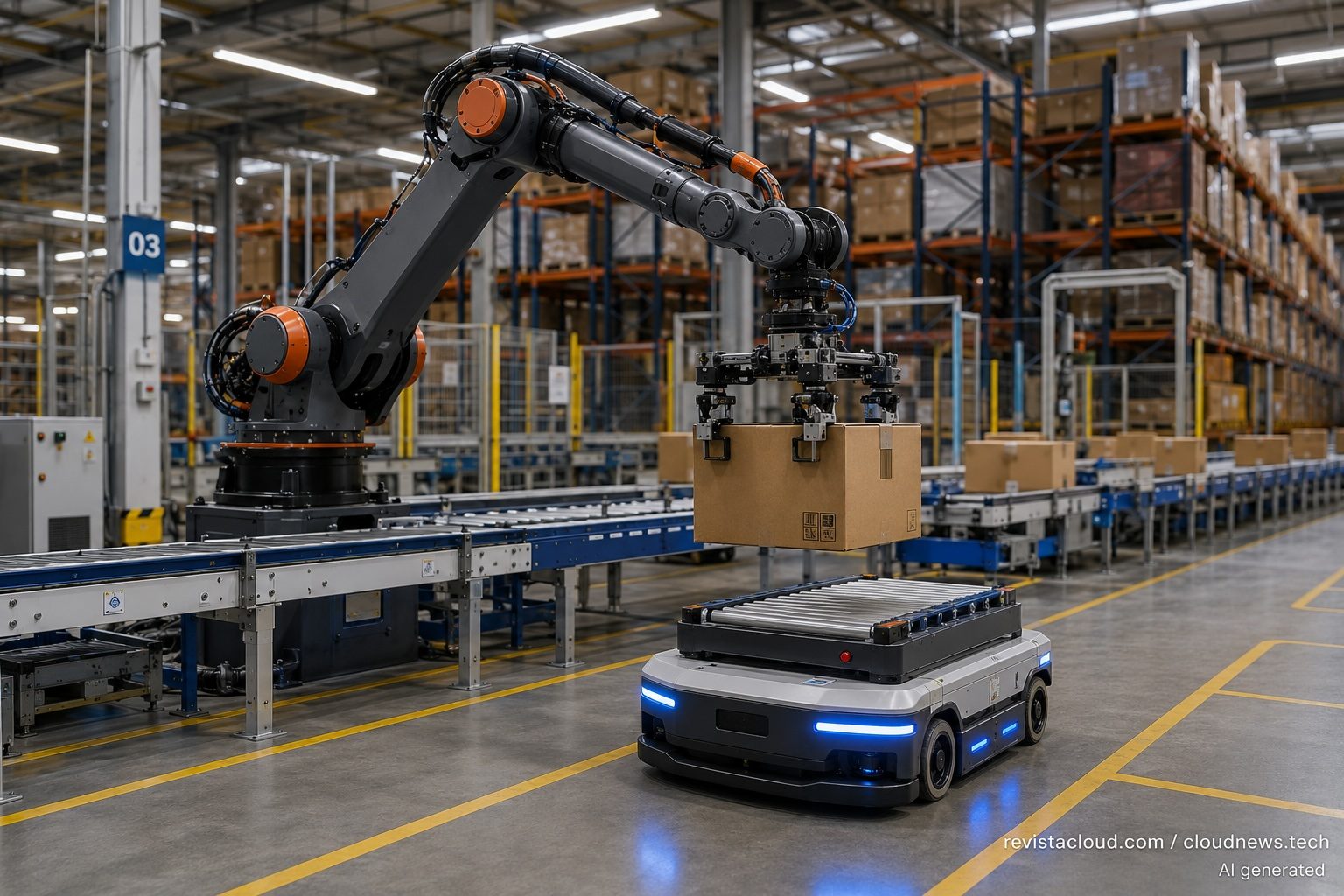
Robotics is shifting from pilot projects to mid-term corporate plans, but organizations don’t seem to be progressing at the same pace in their internal preparation. A study commissioned by Intel reveals that six out of ten managers expect their organizations to operate fleets of robots within the next five years, while only 40% currently have a formal strategy in place to manage both workers and robots jointly.
Key points on enterprise robot adoption in 30 seconds
- 60% of surveyed managers expect to operate fleets of robots within five years.
- Only 40% currently have a formal strategy for a workforce made up of humans and robots.
- 67% believe their organization will be ready to manage it by 2030.
- Safety concerns are delaying robotics projects for 55% of respondents.
- Most demanding applications will require local AI and responses under 100 milliseconds.
The data come from The Robotics Readiness Gap, a study commissioned by Intel and conducted in partnership with Man Bites Dog and Coleman Parkes Research. The survey included 800 business and IT leaders, robotics specialists, and representatives from public administrations and healthcare organizations across the United States, United Kingdom, Germany, Japan, China, and South Korea. The organizations represented generate over $500 million in annual revenue.
The report also reflects a shift in market size. According to the International Federation of Robotics (IFR), in 2024, 542,000 industrial robots were installed worldwide, more than double the number ten years ago. The global installed base is roughly 4.66 million units.
The problem is no longer installing a robot, but managing hundreds
The difference between deploying a few robots and making them a routine part of operations is identified as one of the main challenges by Intel.
67% of participants trust that their organization will be prepared to manage a mixed workforce of humans and robots by 2030. However, currently only four out of ten have a formal strategy for doing so.
Additionally, 74% believe that workforce planning and robotics strategy will be closely linked by 2030.
This issue extends beyond just acquiring machines. An organization incorporating robots at scale will need to decide who supervises them, how they integrate with applications, what happens when they fail, what tasks remain manual, and what training employees require.
It also changes the type of technological infrastructure needed.
Advanced robots incorporate cameras, sensors, and AI systems capable of perceiving their environment and making decisions. This generates a vast amount of data that cannot always be sent to a remote data center for processing.
The study highlights the importance of latency: more than three-quarters of managers consider critical robotics applications need decision times under 100 milliseconds, with nearly a quarter setting the limit below 10 milliseconds.
This requirement favors on-device or edge processing infrastructure, rather than relying solely on distant cloud services.
Currently, 42% of organizations report they have a defined and funded strategy for AI at the device or edge level. Another 39% are developing one.
Security and skill shortages hinder deployment
Technological readiness is not the only obstacle.
Forty percent of managers cite the lack of skilled professionals as a barrier to expanding robotics deployments.
At the same time, two-thirds believe that introducing robots will require human workers to develop greater professional skills, rather than reduce them.
This is a notable point because automation is often associated directly with job displacement. Instead, Intel’s study asks about the skills needed to operate organizations where humans and autonomous machines work together within the same processes.
Programming, maintenance, system integration, supervision, cybersecurity, and data analysis all become part of that equation.
Physical security also emerges as a major contradiction.
31% of participants see security as the area where robotics has added the greatest value. Robots can perform dangerous tasks or operate in environments where human presence poses risks.
But 55% also acknowledge that security concerns have delayed robot deployments.
68% believe clearer international safety standards would help accelerate adoption.
This challenge becomes even more apparent when robots leave industrial spaces isolated from people. Autonomous mobile robots, cobots, and future general-purpose machines may share work zones with employees, customers, or patients.
AI is starting to move beyond screens
Intel uses the concept Physical AI to describe the combination of artificial intelligence and physical systems capable of perceiving their environment, reasoning, and acting upon it.
It is one of the trends that is bridging two markets which previously evolved separately: AI and robotics.
Vision models allow for recognizing objects and people; other systems can interpret instructions, plan actions, or adapt movements. By incorporating these capabilities into a physical machine, AI ceases to be limited to producing text, images, or responses on a screen.
However, the report offers an interesting nuance regarding the growing interest in humanoid robots.
For 77% of respondents, robot performance matters more than appearance. Moreover, 65% believe the current shape of robots is mainly constrained by technological limitations, not necessarily the real needs of each task.
This means the expansion of industrial robotics doesn’t necessarily have to result in factories and warehouses filled with humanoid-looking machines.
A robot specifically designed for transporting goods, inspecting facilities, or handling certain parts can be more practical with wheels, specialized arms, or entirely different designs away from human form.
Global figures support this broader view of automation. The latest consolidated data from IFR shows that Asia accounted for 74% of new industrial robot installations in 2024, compared to 16% in Europe and 9% in the Americas. China alone represented 54% of global installations.
Spain installed approximately 5,100 industrial robots during 2024, ranking third in Europe after Germany and Italy. The automotive industry remained a primary demand driver.
Intel’s study does not guarantee that the forecasts from its participants will come true. They are expectations from leaders of large organizations, not an exact projection of the number of robots that will be operational in five years.
It does, however, show where challenges begin to emerge as robotics scales up. Buying a machine is just part of the project. Integrating it with people, applications, networks, and AI systems—maintaining very low response times safely—can be significantly more complex than the robot itself.
Frequently Asked Questions
How many companies expect to use robot fleets in five years?
60% of respondents in the Intel-commissioned study expect their organization to operate a fleet of robots over the next five years.
Are companies prepared to work with robots?
Only 40% of surveyed organizations currently have a formal strategy for managing both human workers and robots, though 67% believe they will be ready by 2030.
Why do robots need AI at the edge?
Some applications require responses within milliseconds. Over three-quarters of respondents believe critical robotics applications need responses under 100 milliseconds, so processing data near the robot can reduce reliance on remote data centers.
How many industrial robots are installed worldwide?
According to IFR, approximately 542,000 industrial robots were installed in 2024, marking the second-highest annual figure in the World Robotics 2025 report series.
Source: The Robotics Readiness Gap
