
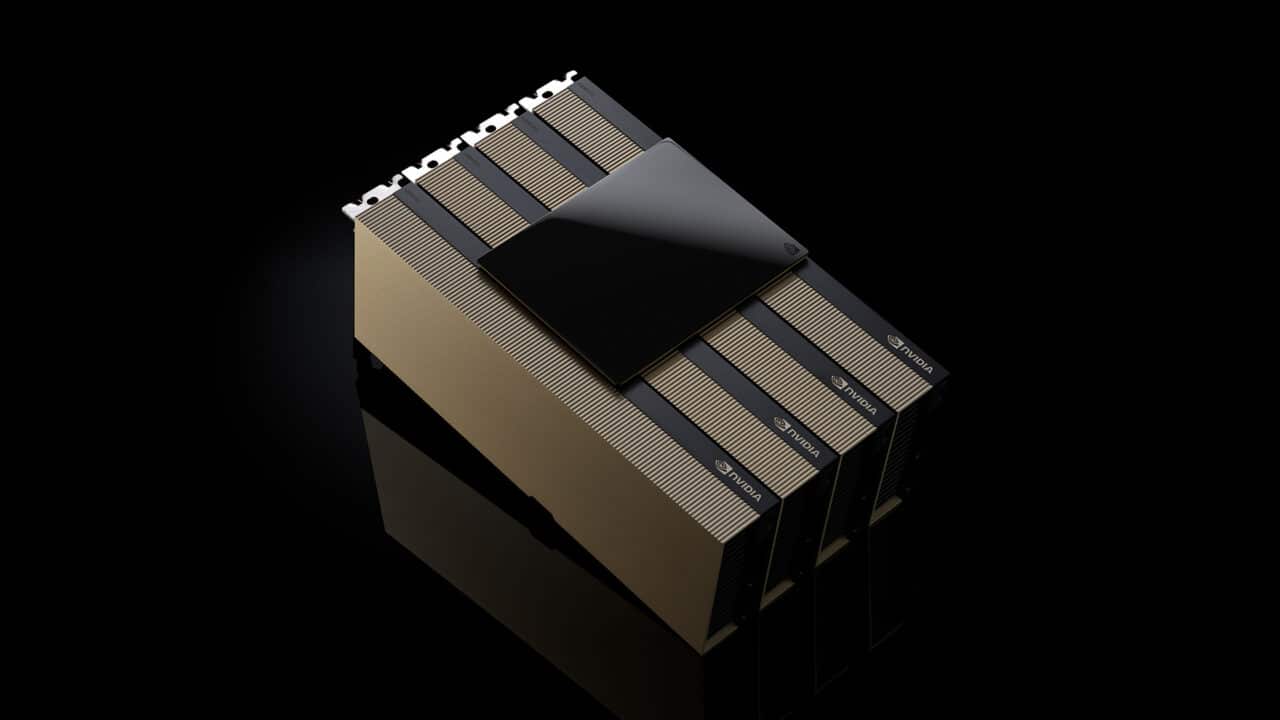
China is sending an increasingly clear signal about the future of its AI infrastructure: it aims to reduce its dependence on Nvidia and increase the production of processors developed domestically. Tencent and ByteDance have received around 10,000 H200 GPUs each in recent weeks, while Beijing maintains restrictions on their use in mainland China and prefers that certain equipment remain in Hong Kong.
The key points of the AI chip battle in 20 seconds
- Tencent and ByteDance have each received about 10,000 Nvidia H200 GPUs.
- Beijing wants to reduce reliance on US accelerators and promote domestic chips.
- Huawei, Cambricon, and other Chinese designers are increasing their presence in AI infrastructure.
- China still faces limitations in advanced manufacturing, HBM memory, and packaging.
- Full self-sufficiency by 2026 remains an estimate, not a confirmed fact.
The situation is particularly noteworthy because, in recent years, the United States has used export controls to restrict Chinese access to the most advanced processors. Now that Washington permits certain H200 sales, it is the Chinese government itself that is trying to prevent its major tech companies from becoming overly dependent on US hardware.
This does not mean China can currently do without Nvidia. The interest of Tencent and ByteDance in acquiring thousands of H200s demonstrates that these processors remain valuable. The difference is that domestic accelerators have advanced enough to become an alternative for an increasing share of workloads.
China allows H200s but shields its domestic market
The US has opened the door for Nvidia to supply H200s to certain Chinese clients that meet the US government’s requirements, including controls related to potential military applications.
Permits consider volumes that could reach 100,000 units for specific clients, a quantity sufficient to deploy large AI clusters.
Initial deliveries are already underway. Tencent and ByteDance are said to have received approximately 10,000 units each, and other major Chinese tech firms may also access new shipments.
However, obtaining US approval is only part of the process.
Beijing is limiting the influx of these accelerators into mainland China and has proposed that companies deploy them in Hong Kong, which maintains a separate customs territory.
This decision allows for a temporary balance between two interests that do not always align.
On one hand, Chinese tech giants need all available computing power to train and run ever larger models. On the other hand, Beijing’s industrial policy seeks to ensure these investments benefit domestic manufacturers and reduce exposure to future restrictions from Washington.
Every H200 purchased from Nvidia also means capacity not bought from Huawei, Cambricon, or other Chinese suppliers.
This issue is becoming especially relevant because China is building enormous amounts of AI infrastructure.
Chinese chips are already an alternative, but 90% requires caution
The prospect that China could meet up to 90% of its demand for advanced AI accelerators through domestic solutions by 2026 has become one of the most notable forecasts around this industry.
It’s important to treat this as what it is: an estimate of market evolution, not a sign that self-sufficiency has already been achieved.
TrendForce analyses clearly show a acceleration in replacing foreign technology. Major Chinese suppliers are increasing the share of their budgets allocated to domestic accelerators, and the range of available options is much broader than just a few years ago.
A forecast from the consultancy estimated that approximately 46% of the AI chip budget Chinese companies expect to allocate to domestic suppliers over the next twelve months, up from 30%.
Other projections suggest a significant reduction of Nvidia’s presence in China during 2026 and a strong growth for Huawei. These are projections; their realization will depend on factors like actual manufacturing capacity.
What is increasingly clear is that China is no longer relying on a single project to build an alternative to Nvidia.
Huawei leads an increasingly broad Chinese industry
Huawei is the manufacturer receiving the most attention due to its Ascend accelerators, but behind it is a growing group of Chinese designers.
Cambricon, Moore Threads, Biren Technology, MetaX, Enflame, Hygon, Iluvatar CoreX, and Kunlunxin are part of this race, along with internal developments from large tech companies.
Alibaba also develops processors through T-Head, while others are working on accelerators and specific ICs for particular AI workloads.
Competition isn’t solely about individual chip performance.
For years, Nvidia has built a platform around CUDA, including libraries, developer tools, interconnection systems, and full data center architectures.
Chinese manufacturers need to replicate much of these capabilities if they truly want to reduce tech dependence.
That’s why larger systems based on domestic accelerators are emerging.
For example, Huawei is using SuperPoD architectures to connect large quantities of Ascend processors and compensate through scale for some of the gaps against more advanced Western GPUs.
Other Chinese manufacturers are pursuing similar approaches. The goal now is not just to produce a powerful GPU but to build complete clusters capable of training and deploying large AI models.
Compatibility with models is also improving. Several Chinese vendors have quickly adapted their platforms to new generations of domestically developed models, reducing one of the traditional hurdles to adopting alternative hardware.
Manufacturing enough chips remains the main challenge
The main difficulty for China is likely no longer demonstrating the ability to design AI accelerators.
The challenge is producing them in sufficient quantities.
Advanced processors require modern fabrication nodes, high-bandwidth HBM memory, sophisticated packaging technologies, and a supply chain capable of high-volume production.
TrendForce highlights the limits of advanced manufacturing, HBM availability, and packaging as key restrictions for expanding Chinese accelerators.
The capacity available in domestic factories must also be shared among many designers.
Huawei HiSilicon, Cambricon, Biren, Moore Threads, MetaX, and other manufacturers need access to production resources that remain more limited than those available to companies free to use TSMC’s most advanced fabs.
That’s why technological independence and manufacturing independence are not exactly the same thing.
China can have designs capable of replacing part of US GPUs but still not the full capacity to produce all the accelerators its data centers need.
There are also differences depending on the workload.
In inference, where pre-trained models are used, there is more flexibility to use different architectures. Training the largest models continues to be an area where Nvidia’s performance, interconnects, and software remain highly attractive.
Chinese tech firms are greatly increasing infrastructure investment
Supply chain pressures will intensify as major Chinese companies are significantly boosting their investments in data centers and computational capacity.
TrendForce estimates that combined capital expenditures from ByteDance, Tencent, Alibaba, and Baidu will grow by over 80% year-over-year in 2026.
Much of this spending will go toward new data centers, AI servers, high-speed networks, storage systems, and accelerators.
The key question is: which chips will power these servers?
If Nvidia maintains a strong presence, the US will continue to influence Chinese AI development via export licenses.
If Huawei and other domestic manufacturers manage to capture a larger share of demand, the effectiveness of future US restrictions will decrease.
This is probably the most important consequence of recent policy actions.
US controls have restricted China’s access to top-tier hardware but have also given Beijing and its companies a huge economic and strategic incentive to develop their own alternatives.
The domestic market also offers a significant advantage. Companies like Alibaba, Tencent, ByteDance, Baidu, and others require enormous amounts of computing capacity, creating a customer base willing to fund new generations of products.
Therefore, the arrival of H200s does not mean China can already do without Nvidia.
It demonstrates something different: Beijing can start deciding where and when to use these chips while increasingly investing in substituting them.
The so-called chip war is far from over. China still depends on foreign technology in key parts of the supply chain and faces ongoing challenges in advanced manufacturing. But the distance between being unable to buy a US GPU and not needing to buy one is precisely what its industry aims to reduce.
The metric that will measure this progress isn’t just the number of H200s that ultimately enter China. It’s the percentage of new AI clusters deployed in 2026 and 2027 that operate with chips designed and produced by Chinese companies.
Frequently Asked Questions
Has China banned Nvidia H200s?
No. Some deliveries are allowed, though Beijing maintains restrictions on their use in mainland China and is favoring the development and purchase of domestic alternatives.
How many H200s have Tencent and ByteDance received?
Available information indicates that Tencent and ByteDance have each received about 10,000 units over recent weeks.
Can China currently manufacture all the AI chips it needs?
Significant limitations still exist, including advanced manufacturing capacity, access to HBM memory, and certain packaging technologies necessary for large-scale production of high-performance accelerators.
Which Chinese companies compete with Nvidia?
Huawei and Cambricon are among the most prominent, alongside Moore Threads, Biren Technology, MetaX, Enflame, Hygon, Iluvatar CoreX, Kunlunxin, and internal projects from major tech groups.
