
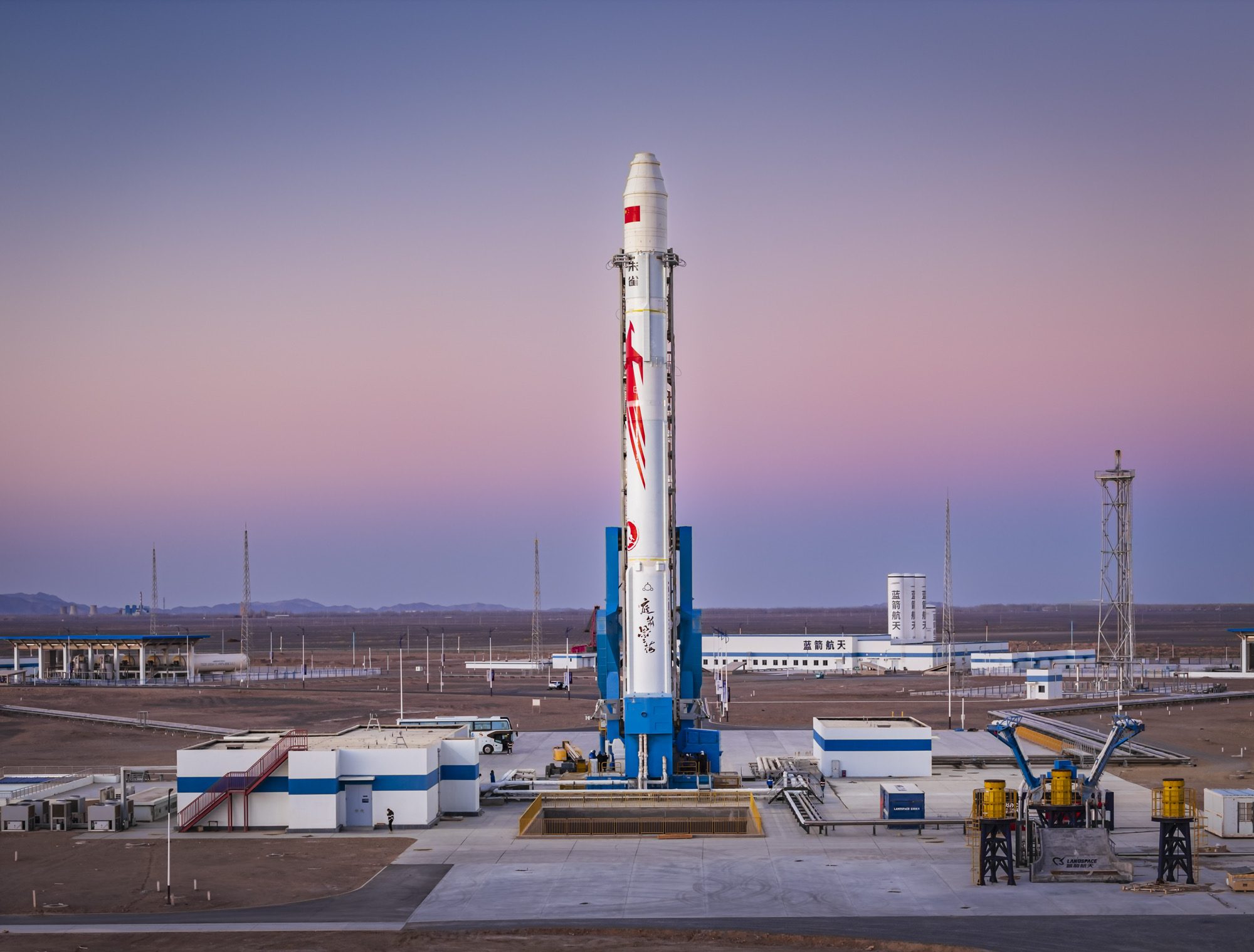
The Chinese private company LandSpace has successfully recovered the first stage of its Zhuque-3 (ZQ-3) rocket after an orbital launch, a milestone that it had previously failed to achieve during its maiden flight in December 2025. The booster descended in a controlled manner and landed vertically on its legs at a recovery zone located in Gansu Province, approximately 390 kilometers downrange. This marks the second orbital booster recovered by China and the first land touchdown by a Chinese private enterprise.
The key moments of Zhuque-3’s 30-second landing
- LandSpace successfully recovered the Zhuque-3 on its second flight, after the failed December 2025 landing attempt.
- It is the first Chinese private company to land a first stage after an orbital launch.
- China had already recovered the government-developed Long March-10B on 07/10/2026 via a system installed on a maritime platform.
- The ZQ-3 uses methane and liquid oxygen, stainless steel structure, and nine engines on its first stage.
- LandSpace aims to reuse each booster up to 20 times and plans to test the recently recovered one within six months.
This achievement goes beyond just the landing itself. China has been developing reusable alternatives to the model that SpaceX has made routine with Falcon 9, but throughout 2025 and early 2026, several attempts failed to achieve recovery after reaching space.
That barrier is beginning to fall.
On July 10, the state-owned China Aerospace Science and Technology Corporation (CASC) successfully recovered the Long March-10B first stage, developed by the China Academy of Launch Vehicle Technology (CALT). Just over a month later, LandSpace has demonstrated a different architecture from the commercial sector.
China thus has two technological paths toward reusability: one driven by its state aerospace industry and another by newer private companies competing in the growing launch market.
Zhuque-3 achieves what it couldn’t in December
The flight is especially notable because of what happened during ZQ-3’s first attempt.
On December 3, 2025, LandSpace managed for the rocket to complete the orbital portion of its first mission, but lost the booster during the recovery attempt due to an anomaly during the final ignition.
The second attempt had a very different outcome.
Zhuque-3 launched from the commercial Dongfeng site, and after stage separation, its first stage executed a controlled descent sequence. It finally landed vertically using its deployable legs. Reuters reports the recovery zone approximately 390 kilometers from the launch site, in Gansu Province.
This result makes LandSpace the first Chinese private company to recover an orbital-class booster on land.
It also provides the company with something more valuable than just a visual demonstration: a real rocket that can now be disassembled, inspected, and potentially relaunched.
LandSpace has indicated plans to reuse the recovered booster within six months. They envision that the Zhuque-3’s first stages could perform up to 20 flights, although reaching that number remains a goal rather than a proven capability.
The difference is significant. Recovering a rocket shows it can return intact. Making it fly again, repeatedly, with reasonable inspection and maintenance costs, is what truly indicates a system is commercially mature and reusable.
Two Chinese rockets and two very different recovery methods
Zhuque-3 is not the first booster China has successfully brought back from orbit.
That distinction belongs to the Long March-10B, which completed its maiden flight on July 10 from Hainan.
The comparison between the two programs is particularly interesting:
| Feature | LandSpace Zhuque-3 | Long March-10B |
|---|---|---|
| Developer | LandSpace | CALT / CASC |
| Model | Private commercial company | State aerospace program |
| First flight | 12/03/2025 | 07/10/2026 |
| First stage propellant | Methane + liquid oxygen | RP-1 kerosene + liquid oxygen |
| Recovery method | Propulsive landing on legs | Capture via net |
| Recovery location | Land | Maritime platform |
| First successful recovery | 18–19/08/2026* | 10/07/2026 |
| Outcome | Vertical landing | Vertical capture via cables/net |
| Announced reusable LEO capacity | ~12.5 tons returning to launch site | ≥16 tons |
*The launch occurred in the late afternoon of August 18 US time, and on August 19 in China.
The most striking difference lies in how they return.
LandSpace has adopted an architecture conceptually similar to Falcon 9: the rocket performs a powered descent and deploys legs to land vertically.
CALT opted for a much less conventional solution.
During the inaugural flight of Long March-10B, the first stage returned vertically towards a specially designed maritime platform. Instead of landing directly on it, components attached to the booster hooked onto a cable and net structure, leaving the stage suspended.
This operation took place roughly six minutes after liftoff and, according to Chinese authorities, marked China’s first orbital rocket recovery using this system.
The idea aims to reduce some of the weight associated with landing legs. Less mass dedicated to recovery could translate into more payload capacity, although it remains to be seen how the system performs as launch and recovery frequency increase.
The Zhuque-3 is designed from the ground up for reuse
LandSpace built the ZQ-3 around a technological approach that inevitably recalls some decisions made by SpaceX with Starship.
It’s a two-stage rocket using methane and liquid oxygen (methalox) and employing stainless steel for much of its structure.
The first stage utilizes nine Tianque TQ-12A/B engines, while the second stage is powered by a vacuum-optimized TQ-15A/B engine.
The choice of methane makes sense for a reusable vehicle. Compared to other propellants, it can simplify some aspects related to engine residue and maintenance, which is advantageous when the goal extends beyond single-use propulsion.
Performance figures also depend on operational strategies.
LandSpace estimates around 12,500 kilograms of payload capacity to low Earth orbit (LEO) when the first stage returns to the launch site, while a completely expendable mission could reach approximately 21,300 kilograms.
This aligns with a key rule of reusability: recovering a rocket carries an energy cost.
Part of the propellant that could boost payload might instead be reserved for trajectory adjustments, deceleration, and landing maneuvers.
The company now needs to demonstrate which recovery, payload, and reuse combination is economically competitive.
China now has both state and private sectors pursuing the same goal
The real shift may be that Chinese reusability is no longer reliant on a single program.
CALT embodies the huge, state-backed aerospace industry, while LandSpace belongs to a much newer generation of private companies trying to develop launchers with faster evolution cycles.
Both models achieved recovery of an orbital booster within just a few weeks of each other.
However, China is still far from the operational experience amassed by SpaceX.
Falcon 9 has been landing since 2015, with its first stages achieving dozens of reuse cycles. LandSpace has just completed its first successful landing, and CALT has only recovered once using its new maritime system.
So, the next key metric shifts from just landing to reflighting the same booster.
Reuters reports that LandSpace plans to do this within six months. If successful, they will start measuring inspection times, component replacements, engine degradation, and actual costs per flight.
That will largely determine the economic viability of the system.
Increased launch capacity for China’s constellations
The push also stems from China’s massive internal demand expected in the coming years.
China is deploying large constellations of communications satellites in low Earth orbit and needs to significantly increase its launch cadence. Manufacturing a new first stage for each mission limits both pace and costs.
Reusable boosters could change that equation.
Additionally, LandSpace has economic incentives. Reuters reports that the company seeks to raise around 7.5 billion yuan (about $1.11 billion) through an IPO on the Shanghai STAR Market.
Proving that their primary reusable rocket can land intact provides a strong technological argument, though they still need to demonstrate how to turn that capability into ongoing commercial operations.
Thus, the Zhuque-3 landing should be seen as the start of a new phase, not the conclusion of the program.
China has now demonstrated two different ways to bring back an orbital first stage. The next challenge is clear: reusing them frequently enough to genuinely alter the economics of launches.
Frequently Asked Questions
What has LandSpace achieved with the Zhuque-3?
It has successfully recovered the first stage of the ZQ-3 after an orbital launch. This is the first land-based orbital booster recovery by a Chinese private company.
Is this the first orbital rocket recovered by China?
No. The state-owned Long March-10B achieved China’s first controlled recovery on 07/10/2026, with its first stage captured via a net on a maritime platform.
Can the Zhuque-3 now be reused?
Recovery is the first step, but LandSpace still needs to demonstrate reflights of a recovered stage. The company plans to reuse the recently landed booster within six months and aims for up to 20 reuse cycles per stage.
What fuel does the Zhuque-3 use?
It uses liquid methane and liquid oxygen in both stages. The first stage is equipped with nine Tianque TQ-12A/B engines.
