
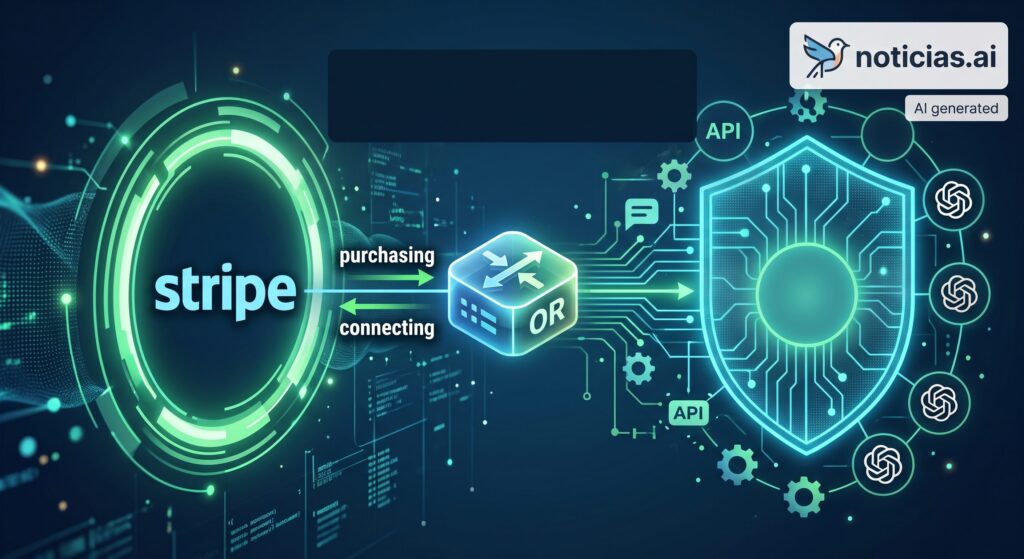
Stripe has agreed to acquire OpenRouter for more than $7 billion, according to reports from various tech media. This operation could give the payments company control over one of the fastest-growing layers surrounding generative artificial intelligence. OpenRouter does not develop comparable models like Claude, Gemini, or GPT; instead, it provides a common API to access hundreds of models and decide which model and provider to use at any given moment. Neither Stripe nor OpenRouter have officially announced the deal, so the final price and terms are not publicly known.
The Key Points of Stripe and OpenRouter in 20 Seconds
- Some tech outlets estimate the acquisition of OpenRouter exceeds $7 billion, though no official announcement has been made yet.
- OpenRouter offers access via an API to more than 400 models from over 70 providers.
- The platform’s infrastructure allows switching models based on price, performance, availability, or latency.
- In May, it raised $113 million with an approximate valuation of $1.3 billion.
- Stripe was already providing OpenRouter with payment, billing, tax, and fraud management services.
This figure is particularly striking for another reason. In May, OpenRouter closed a Series B funding round of $113 million, valuing the company around $1.3 billion. Taking into account the current publicly reported valuation of over $7 billion, Stripe would be valuing the company at more than five times that just a few months later.
But the technological interest of the deal lies elsewhere. The possible acquisition highlights the growing importance of infrastructure positioned between AI applications and AI models.
In recent years, the focus has been on who builds the most capable model. OpenRouter poses a different question: what happens when an application can choose among hundreds of models, and it no longer makes sense to send all requests to a single one?
OpenRouter Aims to Become the Layer of Abstraction for AI Models
The simplest way to understand OpenRouter is to think of it as a common gateway to different AI providers.
A developer can integrate their application with OpenRouter’s API, gaining access to models from Anthropic, Google, OpenAI, Meta, DeepSeek, and other providers available on the platform, without having to build separate integrations from scratch for each one.
The proposition goes beyond just offering a catalog.
The platform can select between different providers for the same model, apply fallback mechanisms when availability issues occur, and set policies related to price, latency, or data handling.
| Function | What it Adds to an AI Application |
|---|---|
| Unified API | Reduces the need for specific integrations with each provider |
| 400+ models | Allows switching models based on load |
| 70+ providers | Expands inference infrastructure options |
| Routing | Selects provider based on different criteria |
| Fallback | Offers alternatives when a provider fails |
| Cost control | Facilitates comparison and management of expenses across models |
| Centralized billing | Pools consumption from various services |
This architecture is becoming more relevant because the AI model market is fragmenting.
The most powerful model isn’t necessarily the best fit for every request. Using an advanced reasoning model for simple text classification may unnecessarily increase costs. Conversely, employing a smaller model for complex tasks could lead to inadequate results.
An application might need different models for programming, reasoning, translation, vision, image generation, or routine tasks.
This is where model routing comes in: the programmatic decision of where to run each request.
Model Routing Can Be as Important as the Model Itself
This layer gains even more importance with AI agents.
Interacting with a traditional chatbot might generate one or a few calls to a model. An AI agent tasked with completing a specific job could make dozens of requests, use external tools, review outputs, and consult different models before finishing.
Multiplied by thousands or millions of users, choosing the right place to run each operation begins to have significant economic consequences.
The issue then shifts from simply asking:
Which is the best model?
To a more technical question of which offers the best balance of quality, price, latency, and availability for each request.
OpenRouter aims to address this decision seamlessly, without requiring developers to constantly modify their applications.
In May, the company claimed its volume had increased from roughly 5 trillion to 25 trillion tokens weekly in six months, along with surpassing eight million developers. Today, its website mentions more than 10 million global users and over 200 trillion tokens processed monthly.
These figures come from OpenRouter itself but help explain why an infrastructure initially seen as just an API aggregator is now attracting multimillion-dollar valuations.
Stripe Was Already Embedded in OpenRouter’s Economic Infrastructure
The connection between the two companies predates this potential acquisition.
In early 2026, Stripe announced that OpenRouter utilized various components of its platform to manage its economic infrastructure.
These included Stripe Invoicing, Stripe Tax, and Radar.
This relationship is particularly interesting because monetizing AI services presents a different challenge than many traditional SaaS products.
An application can consume multiple models with different pricing schemes, charged by input tokens, output tokens, images, cache, or other units. Moreover, the rates vary.
Developers need to convert this variable consumption into prices and invoices for their own customers.
Stripe and OpenRouter were already collaborating on this issue.
Now, the acquisition would unify the layers responsible for deciding where requests are processed and enabling billing for those requests—and turning that consumption into transactions, pricing, and invoices.
From Payment Routing to Model Routing
There is also a technological parallel between the two businesses.
Stripe built much of its position by converting the complexities of payments into interfaces that developers could integrate via software.
OpenRouter is attempting to do something similar for models.
In one case, there are banks, credit cards, currencies, countries, payment methods, fraud, and different networks. In the other, models, inference providers, tokens, prices, contexts, availability, and latency.
Both companies act as abstraction layers, even though the underlying technical problems differ.
Stripe can now try to connect both layers.
An application could measure how much it costs to run specific AI functions, route requests to specific infrastructure, record usage, and invoice accordingly.
This is especially relevant as AI moves from traditional subscription models toward pay-per-use schemes.
The Acquisition Raises Concerns About Vendor Lock-in
OpenRouter has emphasized its independence from any single provider as a key advantage.
The idea is straightforward: if a better or cheaper model emerges tomorrow, an application should be able to incorporate it without rebuilding much of its infrastructure.
This acquisition does not necessarily eliminate that technical capability.
However, it raises a critical question for companies: to what extent can a layer designed to reduce dependency on model providers become a new dependency itself?
The abstraction layer removes one type of lock-in but can create another.
A company that manages policy, keys, billing, observability, and routing around a single gateway will still depend on a third-party piece, even if the backend can switch between Claude, Gemini, or any other model easily.
Currently, there is no information suggesting Stripe plans to change OpenRouter policies or favor specific providers. There are no announced updates to pricing, API, or conditions for users.
Therefore, any conclusions at this stage would be premature.
$7 Billion for Being in the Middle
The deal also reflects a broader shift in the AI industry.
Massive investments in foundational models have sparked a secondary industry focusing on gateways, observability, inference, vector databases, evaluation, security, agents, and cost management tools.
OpenRouter occupies a strategic position because it sits on the path of every request.
The more models exist, the greater the need for a layer that can compare and switch between them.
And as more agents perform tasks automatically, the volume of decisions about which model to use for each operation and how much to spend increases.
This is likely the asset Stripe is paying for.
OpenRouter doesn’t need to build the next big model. It benefits from the fact that many competitors exist, and none have yet become the sole standard.
The shared analysis around this deal suggests that the ongoing debate among developers and tech leaders is shifting toward whether model routing will become a standard component of AI backend infrastructure.
Stripe or OpenRouter have yet to formally confirm the acquisition or explain how the company will integrate into their group.
But a valuation exceeding $7 billion sends a clear signal: the next phase of AI may involve both building models and managing the infrastructure that decides when, where, and at what cost to use them.
Frequently Asked Questions
Has Stripe officially acquired OpenRouter?
Bloomberg reports that Stripe has reached an agreement to acquire OpenRouter for over $7 billion. The companies have not yet made an official announcement regarding the final terms of the deal.
What is OpenRouter used for?
OpenRouter provides a common API to access hundreds of AI models from various inference providers. It centralizes their use and allows selecting among alternatives based on factors like cost, availability, or features.
What is model routing?
It is the dynamic selection of the model or provider that will process a request. For example, using a less expensive model for simple tasks and reserving more capable, costly models for complex operations.
Why might OpenRouter be interesting for Stripe?
Stripe already supplies payment and billing infrastructure to OpenRouter. The acquisition would combine the layer that manages the consumption and routing of models with a platform that turns that consumption into transactions, pricing, and billing.
