
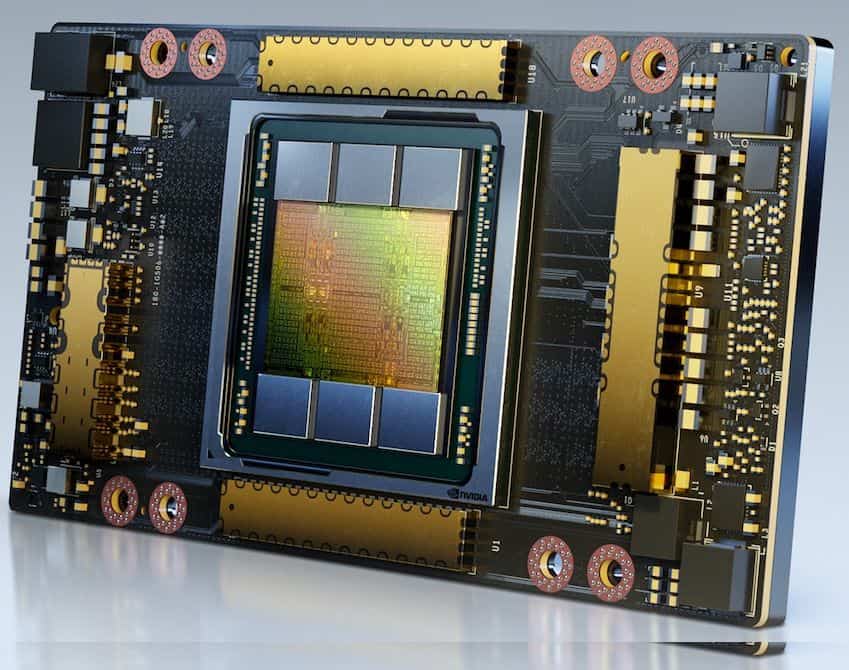
The speed at which Nvidia introduces new generations of accelerators might lead one to believe that an AI GPU becomes obsolete within a few years. However, CoreWeave’s experience points in a different direction. The infrastructure provider has signed a contract to continue leasing Nvidia A100 GPUs through 2029, as recently explained by their CFO, Nitin Agrawal. By then, a architecture introduced in 2020 will be nearly a decade old and could still generate revenue even after being fully amortized.
The key points of the second life of AI GPUs in 30 seconds
- CoreWeave has contracted capacity based on Nvidia A100 through 2029, according to statements reported by The Wall Street Journal.
- The A100s arrived on the market in 2020 and are still capable of handling numerous training, inference, and computing loads.
- Fully amortized hardware can be highly profitable if it maintains sufficient utilization.
- The latest generations offer much more computation per megawatt, which is crucial where electricity is scarce.
- The economic lifespan of a GPU could depend as much on its efficiency and workload as on its age.
This issue has implications that go far beyond CoreWeave. In recent years, tens of billions of dollars have been invested in accelerators to build AI infrastructure. If these GPUs remain economically useful for eight, nine, or more years, it changes the calculations around amortization, financing, and residual value of assets that have so far been treated as hardware subject to rapid obsolescence.
The A100s are a good example. Nvidia introduced this architecture in 2020 and subsequently replaced it with generations like Hopper and Blackwell. But the existence of much faster hardware doesn’t automatically mean that the A100s have stopped being useful.
Nvidia still documents capabilities such as Multi-Instance GPU (MIG), which allows dividing an A100 into up to seven independent instances— a useful feature for sharing the accelerator among workloads that don’t require a full GPU. The 80 GB version also has enough memory for numerous enterprise, scientific, and inference applications.
A fully amortized GPU can become a margin machine
The most interesting aspect of the CoreWeave case is economic.
Companies typically depreciate their servers and accelerators over several years. That depreciation expense reduces earnings during the asset’s accounting life.
When that period ends, the server doesn’t disappear.
If it continues to function and there’s a customer willing to pay for its use, the infrastructure can keep generating income without bearing the same depreciation costs. Electricity, cooling, networking, maintenance, facilities, and other operating costs remain, but the asset’s economics change.
Agrawal explained that CoreWeave is observing longer utilization periods and better-than-expected prices. The missing detail is important: the company has not disclosed how much the customer is paying for those A100s or what workload they will run.
Without knowing the price and utilization, it’s impossible to determine exactly how profitable it is to extend its life.
But this contract challenges one of the assumptions used during the AI infrastructure boom: that old GPUs will quickly lose most of their value because each new generation will be much more efficient.
An A100 doesn’t necessarily need to compete directly with a Blackwell on the same task to remain profitable.
It can be assigned to smaller models, inference, research, batch processing, development, model tuning, or high-performance computing workloads where its features remain sufficient.
This situation resembles what has happened for decades with traditional servers. The release of faster processors didn’t automatically turn previous generations into electronic waste. Hardware was repurposed for less demanding workloads or markets where cost mattered more than squeezing out maximum performance.
AI infrastructure may now be developing its own version of this cycle.
The limit of old GPUs may be the megawatt
However, there’s an important difference from traditional servers: electricity is becoming one of the scarcest resources in AI infrastructure.
And that’s where old GPUs face a problem.
New architectures not only process faster. They also deliver much more useful computation per unit of energy, although the exact comparison depends heavily on the model, precision, software, and system configuration.
Nvidia claims that their current Blackwell systems offer significant improvements over Hopper in certain inference workloads. For example, the company reports that for GB300 NVL72, Blackwell achieves 50 times more tokens per megawatt and a cost per million tokens up to 35 times lower compared to a Hopper platform in specific scenarios used for that comparison. These figures come from the manufacturer and shouldn’t be extrapolated to all applications, but they indicate the direction in which infrastructure design is heading.
And Hopper is already subsequent to Ampere—the architecture behind the A100.
This creates a seemingly contradictory situation.
A fully amortized A100 may be low-cost financially but expensive energy-wise.
If a data center has unused electrical capacity, maintaining that hardware could make sense. But if there’s a limit of 100 MW and a queue of clients waiting for capacity, every megawatt dedicated to old accelerators carries an opportunity cost.
So, the question shifts from “How much does the GPU cost?” to “How much work or revenue can each available megawatt generate?”
This shift may ultimately determine the actual lifespan of AI hardware far more than the age of servers.
A second life for GPUs also changes how they are financed
There’s another less visible consequence.
An AI GPU capable of generating income for many years becomes a different kind of financial asset than one whose value approaches zero rapidly.
Specialized AI infrastructure providers have needed enormous amounts of capital to acquire accelerators. Part of that financing uses the GPUs themselves and associated contracts as collateral.
If a market exists for hardware that can be used for five, seven, or nine years, financiers have an asset with a potentially higher residual value.
But it’s also important not to overstate this conclusion.
The physical lifespan of an accelerator doesn’t guarantee its economic lifespan. Components can fail, maintenance costs increase with age, and future models may require more memory or features that make older generations less viable.
There’s also a risk that rental prices could drop quickly.
An A100 might still function perfectly in 2029, but it could cease to make economic sense if the price needed to attract customers doesn’t cover electricity, space, cooling, and operational costs.
The obsolescence of an AI GPU probably doesn’t have a universal date.
It will depend on a combination of electricity price, power availability, space cost, reliability, memory, software, performance requirements, and what the market is willing to pay per GPU hour.
This may lead to a quite different hierarchy of infrastructure dependencies than today’s.
Data centers with limited power and clients demanding maximum performance will tend to focus on the latest generations. Others with available electricity and fully amortized hardware may continue using older accelerators for workloads where cost is more critical than density of computation.
A more specialized secondary market for AI servers could also emerge.
What’s happening with CoreWeave’s A100s raises an important question for an industry that has built its forecasts assuming extremely rapid technology cycles.
The newest GPU will almost always be faster. That doesn’t mean the previous one loses all value.
In a capital-constrained industry, operating paid-off infrastructure for more years can be extremely attractive. In an electricity-limited industry, replacing it with hardware that delivers much more computation per megawatt may become inevitable.
The true expiration date of a GPU may not be written on the chip. It could depend on electricity prices and the value of each megawatt in the data center.
Frequently Asked Questions
What is the Nvidia A100?
The A100 is a data center GPU based on Nvidia’s Ampere architecture, introduced in 2020. Designed for artificial intelligence and high-performance computing, it is available in 40 GB and 80 GB memory configurations.
Will CoreWeave continue using Nvidia A100s in 2029?
According to statements from their CFO reported by The Wall Street Journal, CoreWeave has signed a lease agreement for A100-based capacity extending through 2029. The company has not disclosed the specific contract price.
Why can it be profitable to use an old GPU?
Once fully depreciated, hardware can continue generating income as long as operational and maintenance costs allow it to be offered at a competitive price. Some workloads do not require the capabilities of the latest generation.
Why might GPUs that still work be retired?
Electricity availability and data center capacity can make it economically sensible. When power is limited, a modern accelerator capable of doing much more work per megawatt can justify replacing old hardware even if it is still functional.
