
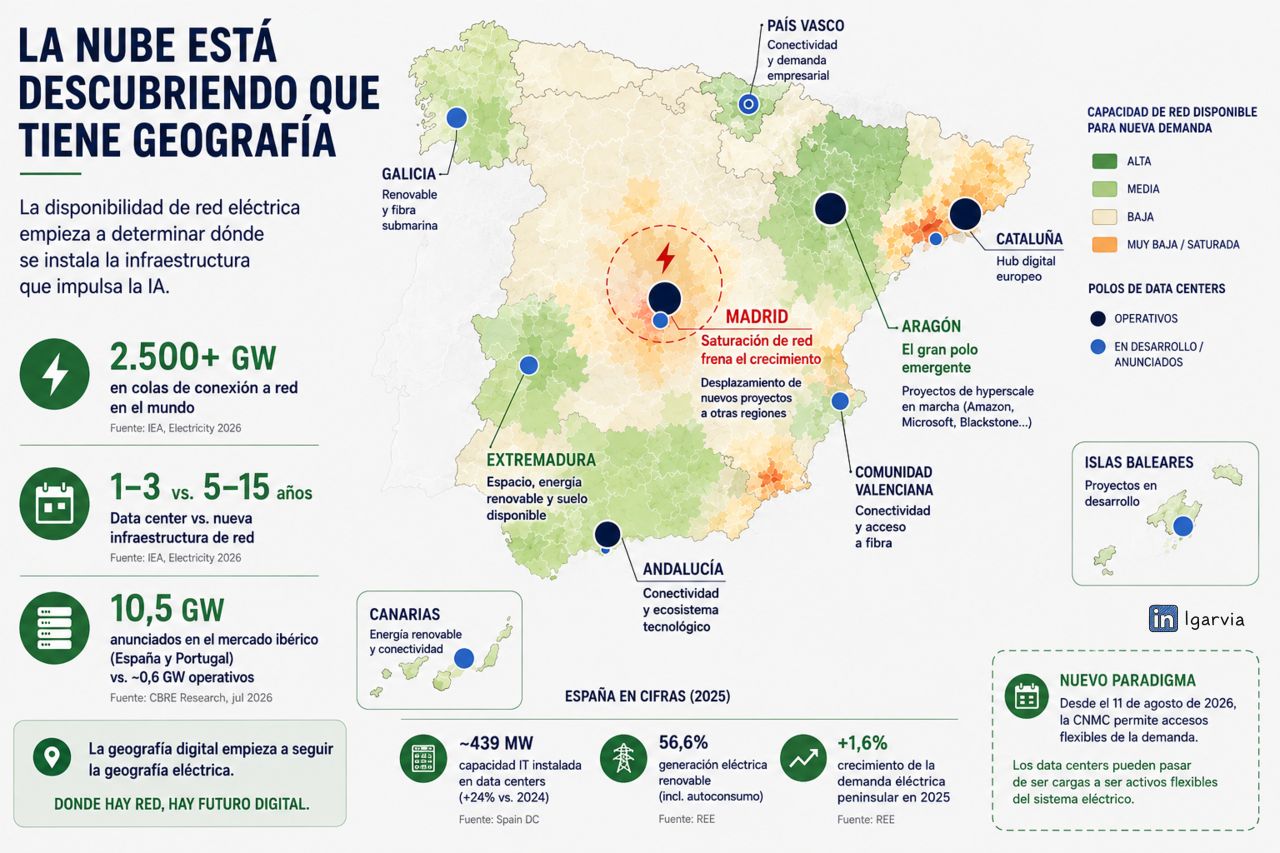
The expansion of artificial intelligence is bringing geography back to the center of the digital economy. For years, cloud computing gave the impression that the physical location of computing infrastructure was nearly irrelevant to consumers of its services. The new generation of data centers is reminding us that behind that abstraction are buildings, power lines, substations, fiber optics, and massive amounts of energy. An increasingly visible limit emerges: a data center can be built much faster than the electrical infrastructure needed to connect it.
The keys to AI’s electrical geography in 20 seconds
- Over 2,500 GW of projects await connection to electrical grids worldwide, according to the International Energy Agency (IEA).
- A data center can be built in 1-3 years, compared to 5-15 years for new network infrastructure.
- Spain produced, in 2025, 56.6% of its electricity from renewables, including self-consumption.
- Grid capacity is starting to weigh as much as land, fiber, or energy prices.
- Flexible connections can facilitate new hookups by adapting part of the consumption to electricity availability.
The difference between these timelines is significant. The IEA’s Electricity 2026 report estimates that planning, permitting, and building new electrical infrastructure can take between 5 and 15 years, whereas a new data center can be developed in roughly one to three years.
The result is a global queue that already exceeds 2,500 GW of generation, storage, and large consumer projects waiting for connection. Not all are data centers—an important distinction—but large digital loads are part of the problem.
This shifts the traditional industry question. It’s no longer enough to know where cheap electricity exists; it’s essential to know where the grid capacity exists to deliver it.
Having energy nearby doesn’t guarantee connection
A project may be located near a region with abundant solar or wind production and still face difficulties in securing hundreds of megawatts of firm capacity at the exact point where it wants to be installed.
The grid has physical limits. Substations, transformers, and lines have defined capacities, and expanding them requires planning, permits, equipment, and construction that follow very different timelines from the tech industry.
The IEA warns that grids are becoming a bottleneck for connecting new generation, storage, and demand. It also estimates that annual global investment in grids must increase by around 50% by 2030, starting from approximately $400 billion.
For AI data centers, the issue takes on an even larger dimension.
A conventional campus could grow gradually over years. However, AI-related projects concentrate large amounts of accelerators and quickly elevate electrical needs. Developers increasingly speak of campuses measured in hundreds of megawatts—and some planning surpassing a gigawatt.
Therefore, electricity and grid capacity have shifted from being mere technical considerations to directly influencing location decisions.
Spain shows how the data center map is changing
Spain has several favorable conditions to observe this phenomenon: renewable generation, international telecom connections, available land, and a rapidly growing data center market.
Red Eléctrica confirmed that renewables generated 55.5% of Spain’s electricity in 2025. Including self-consumption estimates, the proportion reached 56.6%. Electricity demand increased by 2.8% gross, and by 1.6% when adjusting for labor and temperature effects.
But having high renewable generation nationwide doesn’t automatically guarantee connection capacity anywhere.
This is where the map begins to change.
Madrid has historically housed a significant portion of the Spanish data center market thanks to its connectivity, business concentration, availability of operators, and proximity to large digital consumers. However, the growth in electricity demand is prompting a look elsewhere.
Aragon is probably the most visible example. The region has attracted major digital infrastructure projects and is shaping up as a new hub for data centers. Other regions also offer various combinations of land, renewables, fiber, or electrical capacity that could gain importance as the market expands.
CBRE noted in July that the Iberian market has multiplied its capacity more than four times since 2019 and projects a medium-term potential of 4.5 GW of IT capacity.
The gap between current installed capacity, announced projects, and those finally able to be built is crucial. Investment announcements do not equal operational megawatts: each project requires permits, financing, equipment, and especially a viable electrical connection.
The digital geography thus begins to resemble energy geography more and more.
From adapting the grid to the data center, to adapting the data center to the grid
Another possibility that could change this relationship is better utilization of existing electrical infrastructure.
Grids are designed to handle peak demand, even though part of that capacity remains unused during other hours. The IEA suggests that grid enhancement technologies, regulatory reforms, and more active demand participation could free additional capacity without necessarily waiting to build new infrastructure.
Estimates indicate these measures could enable the connection of between 1,200 and 1,600 GW of advanced-stage projects currently stuck in connection queues.
A particularly interesting idea for data centers emerges here: turning them, whenever technically feasible, into more flexible consumers.
Not all computational loads need to run exactly at the same time.
A banking transaction, an application query, or a real-time inference request have very different availability requirements than training certain models, batch tasks, content generation, or some scientific processes.
Part of this computing could be shifted temporally. In distributed infrastructures, some loads could also be geographically relocated between data centers.
This doesn’t automatically turn a 200 MW data center into a virtual battery nor mean that any AI load can pause when the grid needs it. Servers, storage, cooling, and service commitments impose technical and economic limits.
However, it introduces a concept that has rarely been part of cloud design until now: programming certain calculations based on the state of the electrical system.
The potential outcome is a different relationship between data centers and networks. Until now, the usual model involved requesting a certain power and waiting for the electrical infrastructure to supply it consistently. Flexible models allow for connections where part of the demand accepts specific conditions in exchange for earlier access or better utilization of available capacity.
This could be especially relevant for AI. The greater the volume of computation that can be shifted in time or between regions, the more the digital infrastructure can be used as a manageable demand.
For two decades, the Internet made the physical location of servers seem to disappear for users. Cloud computing reinforced that abstraction: an application was simply “in the cloud.”
Now, AI expansion is making all that is underneath visible again.
Models need GPUs. GPUs need servers. Servers need buildings, cooling, and network connections. And all of this requires electric power that must physically reach a specific point on the territory.
That’s why energy, the electrical grid, land, and fiber are beginning to jointly determine where the next generation of digital infrastructure can be installed.
Silicon Valley will remain crucial for designing chips, models, and software. But an increasing portion of the investment enabling that technology may ultimately be decided by something much less abstract: the electrical grid map.
FAQs
How long does it take to build a data center versus a new electrical grid?
The IEA estimates roughly 1-3 years for a data center, while planning, permitting, and constructing new electrical infrastructure can take between 5 and 15 years.
Are there really 2,500 GW of projects waiting for connection?
No. The over 2,500 GW calculated by the IEA include renewable projects, storage, and large consumers, among them data centers. Presenting this entire figure as data centers would be incorrect.
What percentage of Spanish electricity is renewable?
In 2025, renewables accounted for 55.5% of Spanish electricity generation. Including self-consumption estimates, the proportion rose to 56.6%.
Can a data center adapt its consumption to the grid?
Certain computational loads can be shifted in time, and in distributed architectures, some can also be moved geographically between data centers. However, flexibility depends on the application, service commitments, and technical design of the data center.
Sources:
- International Energy Agency (IEA), Electricity 2026, chapter on grids.
- International Energy Agency, Electricity 2026, executive summary.
- Red Eléctrica, The Spanish electrical system in 2025, 03/11/2026.
- CBRE Spain, Iberia accelerates in Europe as the leading data center hub, 07/16/2026.
- Featured image from Luis García Vega’s LinkedIn.
