
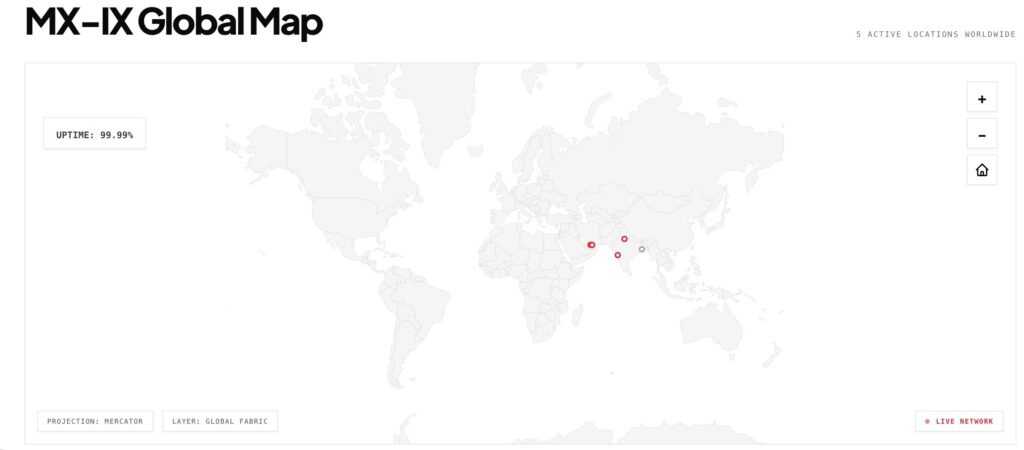
MX-IX has officially launched its project as a new operator- and data center-neutral Internet Exchange (IX), with Rohit Yadav serving as founder and CEO. Although the public announcement emphasizes the beginning of a new phase, the infrastructure is already registered and operational in industry databases: it has exchange points in Mumbai, Delhi, Dubai, and Fujairah, operating under the autonomous system AS141539 for its route servers.
The key points of MX-IX in 20 seconds
- MX-IX presents itself as a neutral Internet Exchange aimed at operators, cloud providers, content networks, and ISPs.
- The platform is present in Mumbai, Delhi, Dubai, and Fujairah.
- Offers connections at 1, 10, 100, and 400 Gbps, using AS141539 for its route servers.
- Plans include expanding services to remote peering, cloud connectivity, DDoS protection, and network infrastructure for AI.
The project is led by Rohit Yadav, a professional with direct experience in the Asian interconnection market. Before embarking on this new phase, he was associated with AMS-IX and participated in specialized peering and Internet Exchange Points (IXP) meetings in India and other Asian markets. Records from INNOG and AMS-IX previously listed him as a regional representative and manager of the organization.
MX-IX’s proposal is based on a simple idea: to facilitate direct traffic exchange between networks, minimizing the need for this traffic to traverse external IP transit providers whenever possible.
This is the fundamental principle of Internet Exchanges. A telecommunications operator, CDN, cloud provider, or digital platform can connect to the same exchange point and establish peering sessions with other networks.
The result can be shorter traffic routes, reduced dependence on IP transit, and, depending on topology and participant agreements, improvements in latency, costs, and resilience.
From Mumbai and Delhi to Dubai and Fujairah
Public information confirms that MX-IX goes beyond a mere commercial presentation.
PeeringDB currently lists exchange points associated with MX-IX in Mumbai, Delhi, Dubai, and Fujairah. The route servers use ASN AS141539 and are active in all four locations.
Physical presence is gradually expanding as well.
MX-IX Mumbai is available at data centers operated by various providers, including Equinix MB1 and MB2, CtrlS Mumbai DC1, Sify Airoli, STT Mumbai 2, Tata Communications Mumbai, and Web Werks Mumbai 1. PeeringDB reports a combined capacity of 120 Gbps at this exchange.
In Delhi, facilities include Sify Greenfort and several STT centers. The exchange’s last reported capacity is 220 Gbps with three members, according to data from Internet Society Pulse sourced from PeeringDB.
While these figures belong to a relatively small IXP compared to major international exchange points, it is more accurate to describe MX-IX as a platform in its early growth stage rather than a direct competitor to well-established IXPs.
However, the announced strategy aims at building a broader regional presence.
Ports up to 400 Gbps and route servers
MX-IX offers connections via ports of 1, 10, 100, and 400 Gbps, operating on a port basis without charging based on traffic volume exchanged.
The platform utilizes route servers to streamline multilateral peering. Instead of establishing individual BGP sessions with each participant, a network can connect to the route server to exchange routes with multiple members according to predefined policies.
Additionally, the company claims to implement filtering using RPKI (Resource Public Key Infrastructure) and IRR (Internet Routing Registry). RPKI cryptographically validates which autonomous systems are authorized to announce certain IP prefixes, helping to reduce routing errors and BGP hijacks.
It’s important to differentiate between the operator’s infrastructure and the practices of its participants. As of May, Internet Society Pulse indicated that two out of three members in MX-IX Delhi used RPKI, and the IXP was not listed as a participant in the MANRS program for IXPs at that time.
MX-IX also supports both public and private peering, data center interconnections, cloud service access, and mechanisms like blackholing to help mitigate certain DDoS attacks.
Beyond a traditional Internet Exchange
One of the most interesting aspects of the announcement is that MX-IX does not aim to limit itself to public traffic exchange.
Its roadmap mentions remote peering, DDoS protection, cloud connectivity, and network infrastructure tailored for AI workloads.
Remote peering allows a network to connect to an exchange point without deploying its own equipment at every data center where the IX is present. A connectivity provider can transport traffic to the platform, effectively expanding its geographic reach.
Cloud connectivity reflects a market evolution. Enterprises no longer only exchange traffic with operators and content providers but increasingly require private connections to cloud platforms, SaaS providers, data centers, and across different regions.
AI adds another dimension. Moving large volumes of data between storage systems, GPU clusters, cloud services, and end users highlights the need for high-capacity networks with efficient routing.
While this doesn’t automatically turn an Internet Exchange into an AI infrastructure, it broadens the market potential for platforms capable of providing high-capacity interconnection between data centers and providers.
For MX-IX, the challenge now is increasing the number of connected networks. The value of an exchange point largely depends on its network effect: the more operators, content providers, CDNs, and cloud platforms participate, the more interconnection opportunities it offers to new members.
The project starts with an advantage: its founder has direct experience in this market. Rohit Yadav previously worked on developing AMS-IX in Asia and participated in various peering community events in the region.
Now, MX-IX must leverage that experience and its initial deployment to build a sufficiently broad community of connected networks.
Frequently Asked Questions
What is MX-IX?
MX-IX is a operator- and data center-neutral Internet Exchange that enables different networks to exchange traffic via peering. Its public infrastructure is currently associated with locations in India and the United Arab Emirates.
Where is MX-IX available?
PeeringDB lists MX-IX exchange points in Mumbai, Delhi, Dubai, and Fujairah. The specific availability depends on data centers and connectivity providers in each market.
What speeds does MX-IX offer?
The company offers ports at 1, 10, 100, and 400 Gbps, along with public and private peering services, cloud connectivity, and data center interconnection.
Who is the founder of MX-IX?
MX-IX is led by Rohit Yadav as founder and CEO. Yadav has prior experience in the Internet Exchange sector and previously worked with AMS-IX in the Asian region.
