
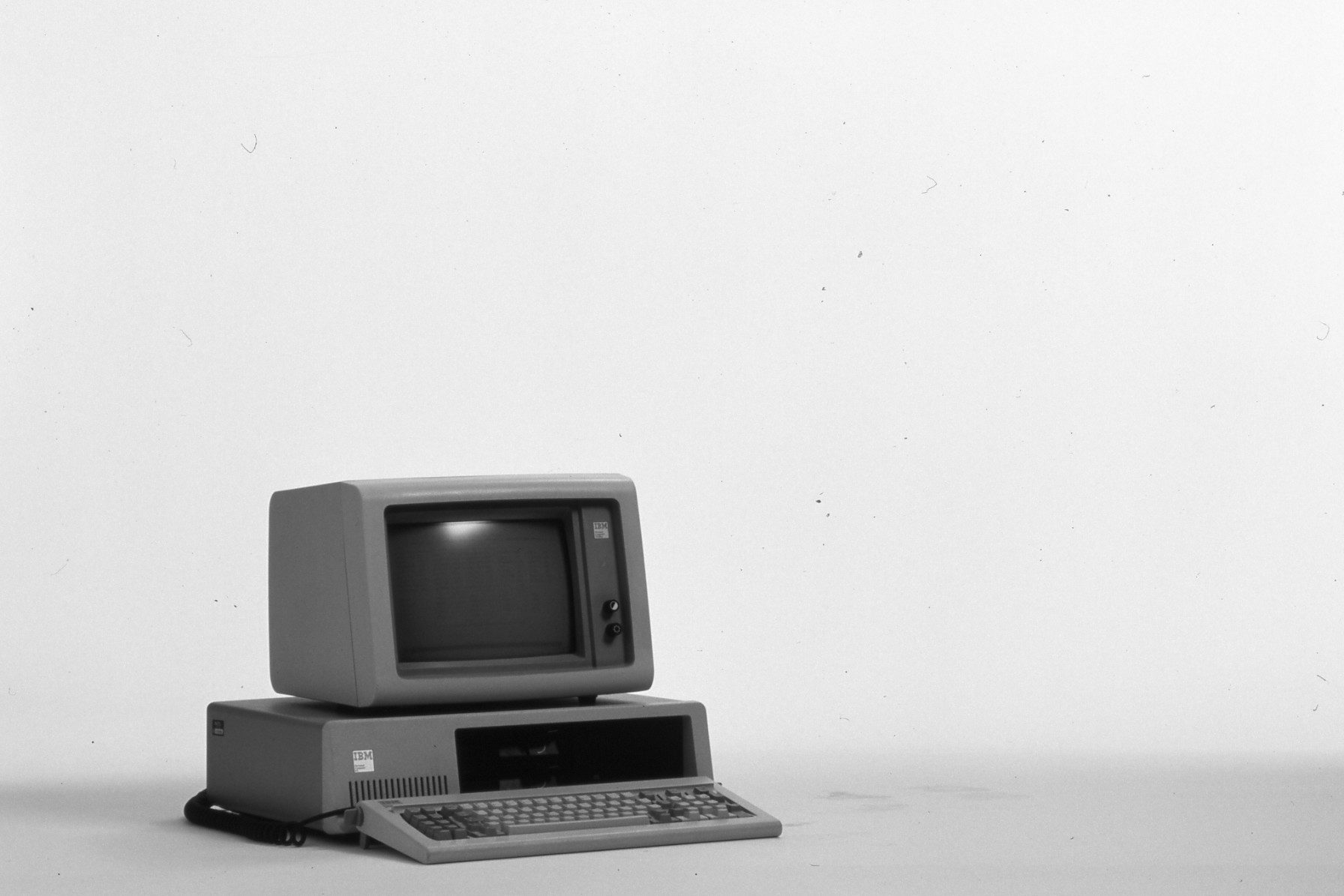
On August 12, 1981, IBM introduced the IBM Personal Computer 5150, a machine that wasn’t the first personal computer in history but helped define what PCs would look like for the following decades. Inside, it worked with an Intel 8088 running at 4.77 MHz, a choice driven by cost and compatibility considerations that ended up being one of the industry’s biggest strokes of luck: this family of processors eventually spread the x86 architecture across millions of computers.
The key points of IBM PC’s 45-year history in 20 seconds
- IBM launched the PC 5150 on August 12, 1981, with an Intel 8088 at 4.77 MHz.
- The 8088 maintained a 16-bit internal architecture but used an 8-bit external data bus.
- This decision reduced the cost of the computer and allowed the use of existing components.
- IBM’s open architecture later favored compatible PCs and made x86 a de facto standard.
The story is particularly interesting because IBM didn’t choose the most powerful processor Intel could offer. The 8086, introduced in June 1978, was technically superior in some aspects and marked the beginning of the family we would later call x86. The 8088 appeared a year later as a variant designed for more economical systems.
That seemingly minor difference had enormous consequences.
Why did IBM choose the Intel 8088 instead of the 8086?
The two processors were closely related. The 8086 had a 16-bit architecture and a 16-bit external data bus. The 8088 retained much of that architecture but reduced the external bus to 8 bits.
On paper, this might have seemed like a step back.
A narrower bus meant transferring less data simultaneously, which could reduce performance. But IBM was aiming to develop a personal computer quickly and at a price low enough to reach a much larger market.
That’s where the 8088 had a practical advantage.
Its 8-bit bus allowed the use of cheaper, already available components and peripherals. IBM itself acknowledges in its PC history that the project team decided to use commercial off-the-shelf components to meet the schedule and approximate the initial price goal.
The result was a computer that used an Intel 8088 at 4.77 MHz, could address up to 1 MB of memory, and in its entry-level configuration, came with just 16 KB of RAM.
The IBM PC launched at $1,565, though that basic setup didn’t include a disk drive. Adding a monitor, two floppy drives, and a printer significantly increased the cost.
Looking back from 2026, it’s hard to imagine the scale of that hardware. Intel’s documentation describes the 8088 as a processor manufactured with a 3-micron process and roughly 29,000 transistors. Today’s processors can contain tens of billions.
But the legacy of the 8088 can’t be measured by its specifications alone.
The real success was around the processor
Perhaps IBM’s most important decision wasn’t choosing the 8088.
It was building a computer with a relatively open architecture and using many commercially available components.
Until then, IBM typically designed much of their system elements. To develop the PC quickly, they did something different—used third-party components, relied on Microsoft for the operating system that would become MS-DOS, and published detailed technical documentation of the computer.
IBM even released technical references with circuit designs and source code to facilitate third-party software and hardware development.
This allowed an industry to emerge rapidly around the PC.
Manufacturers of cards, peripherals, and software could create compatible products. Soon after, computers capable of running the same software appeared.
The so-called PC compatibles or clones ended up being even more important than IBM’s own machine.
The Computer History Museum dates the arrival of the first compatible PC from Compaq to 1983 and notes that IBM’s published architecture facilitated the proliferation of compatible machines.
The result was a network effect that was hard to stop.
The more compatible computers sold, the more attractive software development became. The more software available, the more compelling it was to buy a compatible PC.
And almost all shared one characteristic: they used processors compatible with x86.
From 29,000 transistors to today’s processors
The origin of that architecture was actually a bit earlier.
Intel introduced the 8086 on June 8, 1978. The company explains that its development was completed in about 18 months and that the architecture created then served as the foundation for subsequent generations of processors.
The x86 name came later.
The 8086, 80186, 80286, 80386, and 80486 all shared that suffix, leading the term to be used to identify the family and its instruction set.
Over the following decades, we saw the emergence of 286, 386, 486, Pentium, and subsequent Intel processor generations. AMD eventually became the other major x86 CPU manufacturer, while many companies attempted their own designs at different times.
Companies like Cyrix, VIA/Centaur, NEC, IBM, NexGen, Transmeta, and others participated in this history in various ways.
But perhaps the most significant element was the accumulated compatibility.
Processors changed radically while maintaining the ability to work with a vast ecosystem of software built around x86. Intel specifically credits this continuity as one of the reasons users and businesses could upgrade their systems without abandoning their entire software library.
This advantage grew with each generation.
45 years later, x86 is no longer alone
The anniversary also comes at a significantly different moment for the industry.
For decades, x86 dominated the PC market and a large part of the server market without much contest. Now, Arm has a huge presence in mobile phones and has gained ground in personal computers and data centers.
Apple demonstrated with its Apple Silicon processors that a desktop or laptop computer doesn’t need to be x86. In servers, AWS, Microsoft, and Google have also developed their own Arm processors for specific workloads.
And artificial intelligence has further altered the computing landscape.
An increasing share of data center investments no longer goes solely into general-purpose CPUs. GPUs and specialized accelerators from NVIDIA, AMD, and other manufacturers are investing heavily in training and inference models.
The PC is also starting to incorporate NPUs—specialized units for executing certain AI workloads locally.
None of this could have been reasonably imagined in 1981.
That IBM 5150 had a 4.77 MHz processor and could initially be purchased with just 16 KB of memory. It didn’t need to be the most powerful or use the most advanced processor to shift the market.
The winning combination was actually another: a sufficiently capable processor, an affordable price for the time, available components, third-party software, and an architecture that other companies could expand and later reproduce.
That’s why the 8088 holds such a special place in computer history. The 8086 created the architecture in 1978, but it was the decision to put its sibling, the 8088, into the IBM PC three years later that helped bring it to mass market.
Forty-five years later, that lineage continues to run in personal computers and servers worldwide.
Frequently Asked Questions
When was the first IBM PC introduced?
IBM officially announced the IBM Personal Computer Model 5150 on August 12, 1981, in New York.
What processor did the IBM PC 5150 use?
It used an Intel 8088 at 4.77 MHz. The processor had a architecture related to the 8086 but used an 8-bit external data bus.
Why did IBM choose the 8088 instead of the 8086?
Among other factors, the 8-bit bus of the 8088 allowed for a more economical system built with components available at the time. IBM also needed to develop the PC quickly and keep its price manageable.
Was the IBM PC the first personal computer?
No. Personal computers existed before 1981. What’s important is that IBM’s popularity, architecture, and the subsequent emergence of compatibles helped establish a platform that would dominate much of personal computing.
Image from Intel.
