
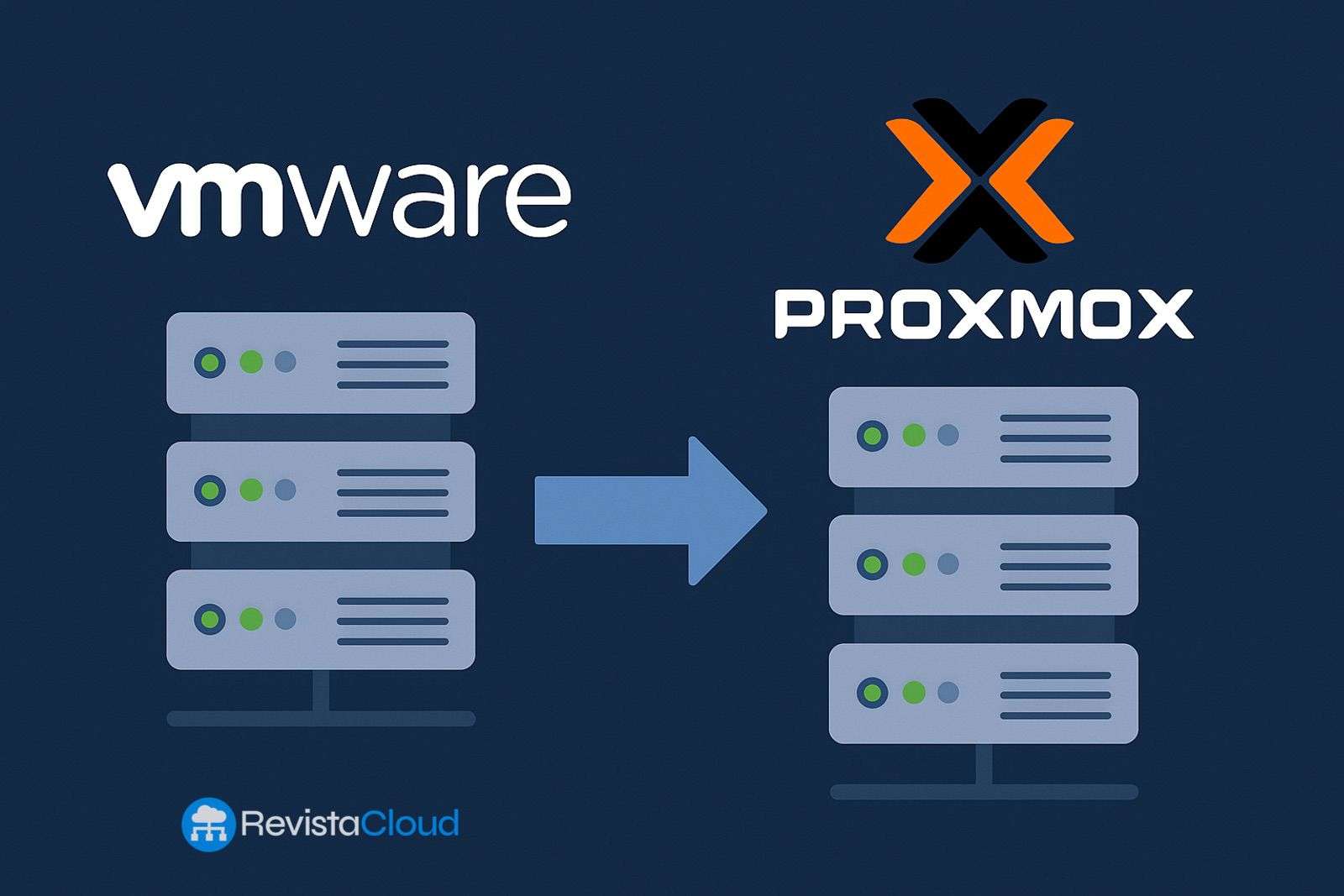
Proxmox has stopped appearing solely in laboratories, small businesses, or infrastructures managed by administrators closely aligned with open source software. Proxmox Virtual Environment (Proxmox VE) is increasingly entering projects where just a few years ago VMware would have been the almost automatic choice, especially when it comes time to upgrade servers, storage, or virtualization contracts.
The key differences between Proxmox and VMware in 20 seconds
- Proxmox VE combines KVM virtual machines and LXC Linux containers on an open-source platform.
- VMware has significantly changed its catalog and licensing model under Broadcom.
- Proxmox offers dedicated tools to facilitate migration from VMware ESXi.
- Cost, technological independence, and flexibility are increasingly influencing decisions.
- The migration process requires reviewing storage, networking, backups, high availability, and operations.
This shift doesn’t mean VMware is disappearing from data centers. Its installed base remains vast, and VMware Cloud Foundation (VCF) continues to be a comprehensive platform for building private clouds. What is fading away is another perception: the idea that VMware is a decision without viable alternatives on the table.
For cloud providers, integrators, sysadmins, and companies with their own infrastructure, this openness is making Proxmox one of the most frequently mentioned names when designing the next phase of infrastructure.
Broadcom Changes VMware and Forces Many Companies to Do the Math
The acquisition of VMware by Broadcom has substantially altered the landscape. The manufacturer simplified its catalog, reduced the number of products, and shifted its strategy mainly toward VMware Cloud Foundation and VMware vSphere Foundation, along with other vSphere options.
It also marked the commercial abandonment of much of the traditional perpetual licensing model in favor of subscriptions.
This evolution is evident in the current generation. From VMware Cloud Foundation 9.0 and VMware vSphere Foundation 9.0, the old 25-character license keys have been replaced by subscription-related files managed centrally via VCF Operations. Broadcom also maintains capacity-based subscription calculations for VCF and VVF.
That doesn’t mean a company with old perpetual licenses suddenly loses its infrastructure. Broadcom clarifies that the expiration of support and subscription contracts does not revoke the right to use the software version covered by a perpetual license. The challenge appears when considering new versions, support, and the next renewal cycle.
That’s where many IT departments are crunching the numbers.
If an organization plans to upgrade hardware, refresh its platform, and sign a new virtualization contract for several years, it makes sense to compare the costs of continuing with VMware versus rebuilding that infrastructure with other technologies.
And Proxmox arrives at this comparison at a particularly advantageous moment.
Proxmox Is No Longer Just About Installing KVM
Reducing Proxmox VE to merely a graphical interface for KVM doesn’t accurately reflect what the platform currently offers.
Proxmox combines KVM (Kernel-based Virtual Machine) for full virtualization and LXC for Linux containers, with centralized browser-based management, clustering, high availability, live migration, network management, firewalls, and various storage options.
It can work with local or shared storage and fit into architectures based on technologies like ZFS and Ceph, in addition to integrating with external systems through various protocols.
Complementing this is Proxmox Backup Server, which enables building a comprehensive backup strategy connected to the platform without requiring all components from the same vendor.
This modularity is one of its biggest strengths.
A company can select servers, storage, networking, and backup strategies based on its needs without necessarily replicating a proprietary stack from a single provider.
But that freedom also has another side: someone must design the architecture correctly.
Proxmox doesn’t automatically turn three servers into a well-designed enterprise infrastructure. Decisions need to be made about how storage is distributed, where quorum resides, how high availability is built, what happens in node failures, how backups are performed, and what disaster recovery strategies are actually necessary for the business.
Migrating from VMware Is Now Much Easier
One of Proxmox’s major steps to compete with VMware installations arrived with Proxmox VE 8.2.
The company introduced an Import Wizard for VMware ESXi directly into the platform. Administrators can add an ESXi server as a source and use Proxmox’s web interface to import an entire virtual machine.
It might seem like a minor feature, but it removes one of the biggest hurdles for any VMware alternative.
Replacing a hypervisor has never been just about having another capable of running Windows or Linux. The real challenge is what to do with the dozens, hundreds, or thousands of virtual machines already in production.
Having an import path reduces part of that work, though it doesn’t eliminate the need to plan a full migration.
A virtual machine can be transferred relatively quickly. Migrating a complete enterprise virtualization platform is a different story.
It involves reviewing VLAN configurations, IP addressing, virtual interfaces, storage, snapshots, backups, retention policies, monitoring, automation, high availability, permissions, directory integrations, and operational procedures.
There are also VMware components that may not have a direct counterpart outside its platform. Broadcom, for instance, specifies that certain components of VCF Operations and VMware Aria Operations are designed and supported on VMware vSphere, not on third-party hypervisors like Proxmox VE.
Therefore, a well-structured migration begins with an inventory, not with installing Proxmox.
Cost Should Not Be the Only Consideration in Comparing Proxmox and VMware
Cost explains an important part of the current interest, but relying solely on that comparison would be a mistake.
Proxmox VE is open-source software, and its commercial model revolves around subscriptions that give access to the Enterprise repository and different levels of support. This offers a different approach to virtualization compared to proprietary licensing schemes.
However, in critical infrastructure, the true cost involves many more variables.
This includes servers, storage, switches, operating system licenses, backups, monitoring, personnel, support, migration, and the hours necessary to maintain the platform over several years.
An organization with an experienced VMware team might find switching costs particularly high initially. Conversely, a company already familiar with Linux, Debian, KVM, Ceph, or ZFS can often transition more easily.
Decisions also depend on scale.
A small cluster of three to five nodes for running enterprise virtual machines is very different from managing multiple data centers, thousands of workloads, NSX, vSAN, and automation built over years.
The Growing Importance of Vendor Independence
Another major reason fueling interest in Proxmox — likely more impactful in the long term than occasional price changes — relates to how companies want to control their infrastructure.
Virtualization sits on a particularly delicate layer: above are applications and data; below are servers, network, and storage. Changing this layer after ten years can be much more complex than replacing nearly any business application.
Using open technologies like KVM reduces some forms of dependence but doesn’t eliminate the risk entirely. A company can still be constrained by the design of its storage, its service provider, or the capabilities of its team.
The key is having more options.
This aspect is increasingly influencing decisions around private clouds, dedicated infrastructures, and hybrid strategies.
VMware and Proxmox Represent Two Different Approaches to Infrastructure
VMware still has strong arguments. Broadcom is focusing its efforts on VMware Cloud Foundation as an integrated private cloud platform, with virtualization, storage, networking, automation, and operations built on a common architecture.
For large organizations needing that level of integration, with specialized teams and established processes around VMware, maintaining the platform may still be the most reasonable choice.
Proxmox, on the other hand, offers a different approach.
Its appeal lies in providing a relatively comprehensive virtualization platform without enforcing a fully proprietary tech stack. This is especially attractive for infrastructure providers, companies managing their own private cloud, or organizations that prefer to separate compute, storage, backup, and networking.
Therefore, The real battle between VMware and Proxmox isn’t just about which hypervisor runs a VM better.
It’s about the infrastructure model each company wants to maintain over the coming years.
VMware favors a more integrated enterprise platform. Proxmox provides a more open and modular architecture but requires operators and integrators to take more design decisions.
For CIOs and system managers, having a credible alternative changes even negotiation with the current provider. It’s no longer just about renewing VMware—it’s about calculating the costs of staying, migrating, and choosing an architecture that offers more flexibility for the next technological cycle.
Perhaps the most important change is that Proxmox doesn’t need to replace VMware everywhere to disrupt enterprise virtualization. It just needs to be seen as a viable alternative companies must consider.
Frequently Asked Questions
Can Proxmox replace VMware in production?
Yes, Proxmox VE can be used in production environments with clusters and high availability. The feasibility depends on the features used, storage, networking, backups, integrations, and support requirements of each organization.
Can virtual machines be migrated from VMware ESXi to Proxmox?
Yes. Proxmox includes an integrated assistant that allows importing virtual machines from VMware ESXi. However, a full enterprise migration involves reviewing many other components beyond just the VMs.
Is Proxmox free?
Proxmox VE is open-source software and can be installed without purchasing a traditional license. Proxmox Server Solutions offers commercial subscriptions that provide access to the Enterprise repository and various support levels.
Why are migrations from VMware increasing?
Catalog and licensing changes introduced under Broadcom have prompted many organizations to reassess costs and alternatives. There is also a growing interest in open architectures and reducing dependency on a single vendor.
